
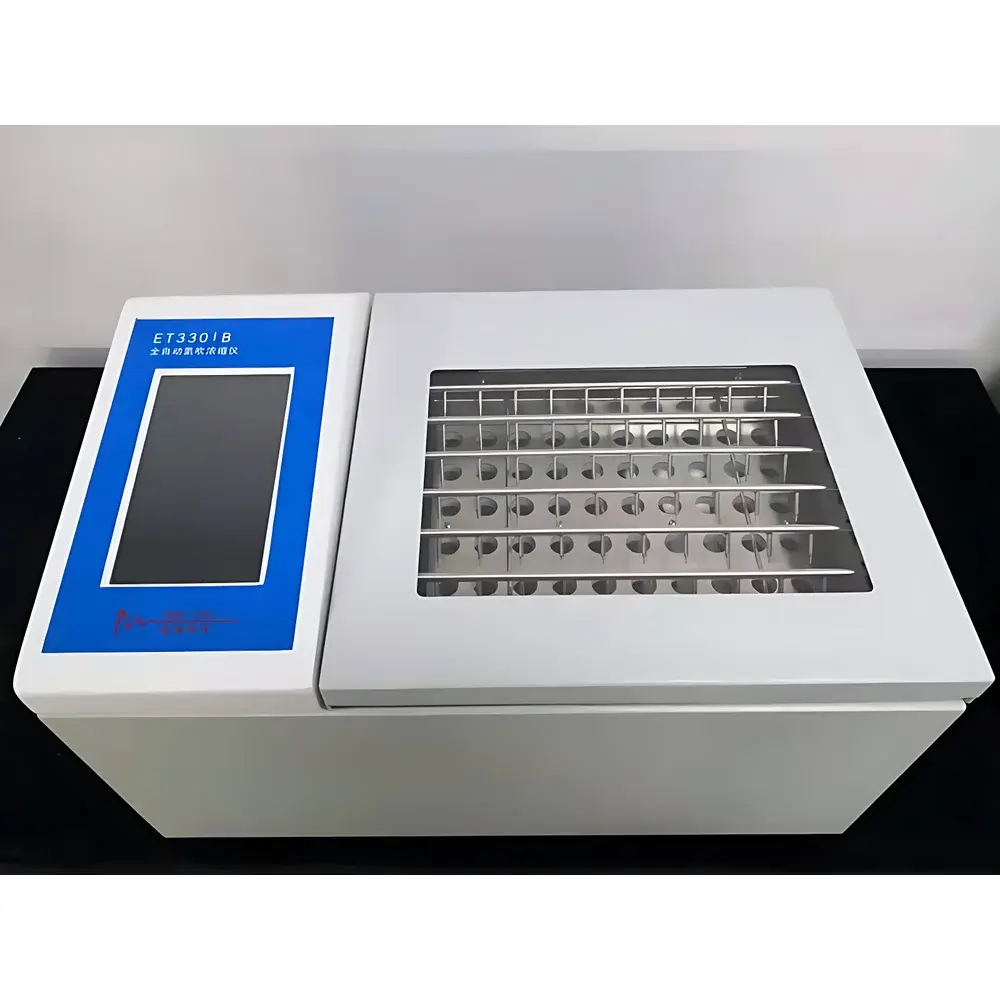
EuroTech ET3301B Automated Nitrogen Evaporator
| Brand | EuroTech |
|---|---|
| Origin | Shanghai, China |
| Manufacturer Type | Authorized Distributor |
| Country of Origin | China |
| Model | ET3301B |
| Price Range | USD 7,000 – 14,000 |
| Sample Capacity | Up to 60 positions |
| Water Bath Temperature Range | Ambient to 95 °C |
| Timer Range | 1–999 minutes |
| Gas Inlet Pressure | 60–100 psi |
| Nitrogen Flow per Nozzle | Up to 2 L/min |
| Flow Control | Digital Pressure-Regulated |
| Independent Channels | 6 |
| Display | 7-inch LCD touchscreen |
| Dimensions (W×H×D) | 54 × 31 × 35 cm |
| Net Weight | 25 kg |
| Power Supply | 230 V, 50 Hz (optional 110 V, 60 Hz) |
Overview
The EuroTech ET3301B Automated Nitrogen Evaporator is an engineered solution for high-throughput, inert-gas-assisted solvent removal in analytical sample preparation workflows. It operates on the principle of controlled nitrogen sweep across the surface of liquid samples immersed in a thermostatically regulated water bath—disrupting the liquid–vapor equilibrium to accelerate evaporation while minimizing thermal degradation and oxidation. Unlike rotary evaporation or vacuum centrifugation, this system eliminates reliance on vacuum pumps, condensers, or complex cooling infrastructure. Its design prioritizes reproducibility, operator safety, and integration into GLP-compliant laboratories where trace-level analyte integrity is critical—particularly in pesticide residue, environmental contaminant, and bioanalytical quantification protocols.
Key Features
- Six independently programmable nitrogen channels, each with real-time pressure monitoring and user-defined time control (1–999 min), enabling concurrent processing of heterogeneous sample sets (e.g., varying solvent volatilities or volumes).
- Patented angled stainless-steel nozzles generate helical gas flow patterns that maximize surface area exposure and enhance mass transfer efficiency without splashing or cross-contamination.
- Integrated 7-inch capacitive touchscreen interface displays live parameters: bath temperature, channel-specific remaining time, nitrogen pressure per port, exhaust status, and heating activation state.
- Auto-suspend functionality halts gas flow and pauses timing upon lid opening—resuming seamlessly when closed—ensuring protocol fidelity and operator safety during manual intervention.
- Self-contained exhaust system with dedicated ducting (3 m × 5 cm ID) removes solvent vapors directly from the water bath zone, preventing condensation-induced water droplet formation on sample tubes and preserving analyte concentration accuracy.
- Modular rack architecture supports customizable tube configurations (4–35 mL); standard configuration accommodates 60 samples; racks are fully removable for batch handling and cleaning.
Sample Compatibility & Compliance
The ET3301B is validated for use with common organic solvents (e.g., acetonitrile, ethyl acetate, hexane, methanol, dichloromethane) and aqueous matrices encountered in regulated testing environments. It complies with core operational requirements of ISO/IEC 17025:2017 for method validation and supports audit-ready workflows under FDA 21 CFR Part 11 when paired with EuroTech’s optional electronic logbook module (not included). The absence of vacuum components reduces mechanical failure points, enhancing long-term reliability in routine QC/QA labs performing EPA Method 525.3, AOAC 2007.01, or EN 15662–2018–based analyses.
Software & Data Management
While the ET3301B operates as a standalone instrument with embedded firmware, its touchscreen controller logs all session metadata—including start/end timestamps, final bath temperature, total gas consumption per channel (calculated via pressure/time integration), and alarm events (e.g., lid-open interruptions, timeout completion). Data export is supported via USB flash drive in CSV format for LIMS integration or audit documentation. Optional firmware upgrades introduce password-protected user roles, electronic signature capture, and configurable audit trail retention periods—aligning with GMP Annex 11 and EU GMP Chapter 4 expectations.
Applications
- Agricultural residue analysis: Concentration of extracts from fruits, vegetables, cereals, and plant tissues prior to GC-MS or LC-MS/MS detection of organophosphates, neonicotinoids, and triazoles.
- Environmental monitoring: Processing of drinking water, wastewater, and soil leachates per EPA Methods 8081B, 8270D, and 8260C.
- Clinical and forensic toxicology: Pre-concentration of serum, plasma, urine, and oral fluid specimens for steroid profiling, drug-of-abuse screening, and metabolite quantification.
- Food and beverage safety: Residue analysis in dairy products, fruit juices, alcoholic beverages, and meat homogenates—including β-agonists (e.g., clenbuterol), veterinary antibiotics, and mycotoxins.
- Pharmaceutical quality control: Final cleanup step in dissolution testing, stability-indicating assays, and impurity profiling per ICH Q2(R2) guidance.
FAQ
Does the ET3301B require connection to an external fume hood?
No. Its integrated exhaust ducting and sealed bath enclosure allow safe operation outside a fume hood, provided the exhaust outlet is routed to a properly vented external location.
Can the water bath temperature be calibrated traceably?
Yes. The PID-controlled heating system includes a factory-calibrated Pt100 sensor; users may perform field verification using NIST-traceable thermometers per ASTM E74-22.
Is remote monitoring or control supported?
Not natively—but Ethernet or Wi-Fi modules can be added via EuroTech’s OEM integration kit (ET-IO-Link), enabling SNMP-based status polling and alarm notifications via lab network infrastructure.
What maintenance is required for long-term performance?
Annual inspection of O-rings, nozzle alignment, and pressure regulator calibration is recommended. Stainless-steel components resist corrosion; no consumables beyond standard nitrogen supply are needed.
How does the system ensure consistent evaporation across all 60 positions?
Uniform bath temperature distribution (±0.3 °C at 60 °C) combined with individually regulated gas flow per channel minimizes inter-position variability—validated using gravimetric recovery tests per USP .



