
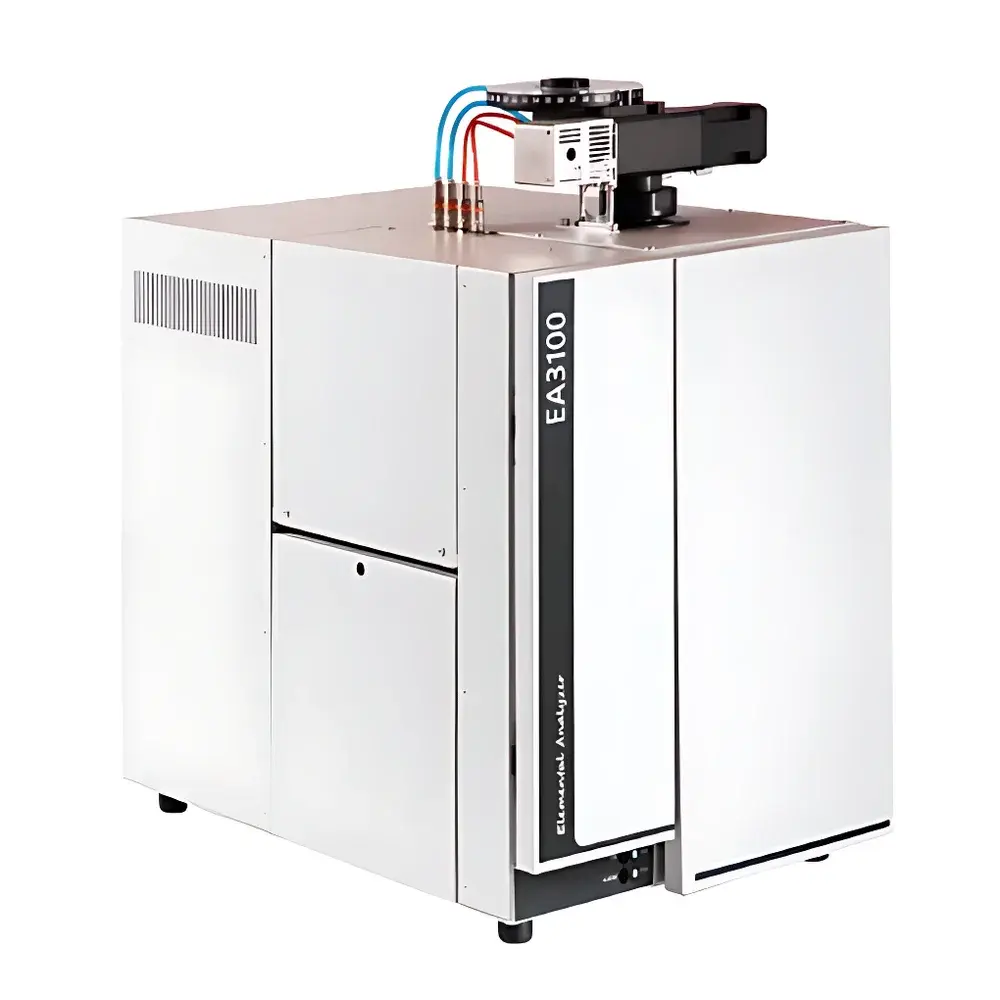
EuroVector EA3017 Dumas Combustion Protein & Elemental Analyzer
| Brand | EuroVector |
|---|---|
| Origin | Italy |
| Model | EA3017 |
| Analysis Principle | Dumas Combustion Method |
| Automation Level | Fully Automated Nitrogen Determinator |
| Nitrogen Range | 0–100% |
| Repeatability | ±0.5% RSD |
| Sample Mass Capacity | ≤5 g (solid) |
| Dimensions (L×W×H) | 480 mm × 480 mm × 600 mm |
Overview
The EuroVector EA3017 is a high-performance, fully automated Dumas combustion-based elemental analyzer engineered for precise and reliable quantification of nitrogen—and by extension, protein content—in organic matrices. Operating on the fundamental principle of high-temperature dynamic flash combustion (Turbo Flash technology), the EA3017 introduces programmable oxygen dosing and optimized injection kinetics to ensure stoichiometric, reproducible oxidation of sample material under strictly controlled thermal conditions. Following complete combustion, evolved gases—including N₂, CO₂, H₂O, and SO₂—are carried through a proprietary gas stream conditioning system. Selective removal of CO₂ and H₂O occurs in integrated adsorption traps, while nitrogen is separated via high-resolution gas chromatography and quantified using a thermally stable, low-drift thermal conductivity detector (TCD). This architecture delivers trace-level sensitivity, high linearity across the full 0–100% nitrogen range, and robust performance in routine laboratory environments—particularly where regulatory compliance, method traceability, and inter-laboratory reproducibility are critical.
Key Features
- Turbo Flash dynamic combustion system with real-time oxygen volume control and adaptive injection profiling for consistent, complete oxidation of heterogeneous samples
- Fully automated sample handling—including auto-sampler integration, sealed crucible loading, and inert-gas purged combustion chamber—minimizing operator intervention and contamination risk
- Integrated dual-stage purification train: chemical scrubbers for CO₂/H₂O removal and catalytic reduction for NOx conversion, ensuring baseline stability and TCD longevity
- Modular hardware architecture enabling field-upgradeable configurations: standard N-mode can be extended to CHN, CHNO, or CNS analysis without major mechanical retrofitting
- Compliance-ready design supporting audit trails, electronic signatures, and instrument qualification documentation per ISO/IEC 17025 and FDA 21 CFR Part 11 requirements
Sample Compatibility & Compliance
The EA3017 accommodates solid samples up to 5 g—including foodstuffs (cereals, dairy powders, meat products), feed ingredients (soybean meal, fishmeal), botanical tissues (leaves, roots, stems), agricultural soils, fertilizers, and waste-derived biomass. Its combustion efficiency exceeds 99.8% for nitrogenous organics, validated against certified reference materials (CRMs) such as IAEA-328 (wheat gluten) and NIST SRM 1547 (peach leaves). The system adheres to internationally recognized standards including ASTM D515-18 (total nitrogen in water), ISO 14891:2013 (Dumas method for food protein), and EN 16948:2016 (determination of nitrogen in animal feeding stuffs). It also satisfies national regulatory protocols cited in GB 5009.5-2010, GB/T 24318-2009, and GB/T 31578-2015—making it suitable for GLP-compliant quality control laboratories in food safety, agronomy, and biofuel research sectors.
Software & Data Management
Controlled via EuroVector’s EVO software suite, the EA3017 provides intuitive method setup, real-time combustion diagnostics, and automated calibration curve generation using internal standards (e.g., acetanilide, sulfanilamide). All analytical sequences are timestamped and logged with full metadata—including operator ID, sample ID, instrument parameters, raw TCD signals, and post-run diagnostic flags. Data export conforms to ASTM E1382-compliant .csv and .xml formats, and optional LIMS connectivity supports bidirectional data exchange. Audit trail functionality records all user actions—including method edits, calibration events, and result approvals—with immutable timestamps and role-based access control, satisfying GMP/GLP documentation requirements for regulated environments.
Applications
- Protein quantification in food and feed: direct conversion of total nitrogen to crude protein using species-specific nitrogen-to-protein conversion factors (e.g., 6.25 for cereals, 5.70 for wheat gluten)
- Biomass characterization: CHNO mode enables simultaneous determination of carbon, hydrogen, nitrogen, and oxygen for energy content modeling and combustion efficiency assessment
- Environmental monitoring: CNS configuration supports sulfur-nitrogen co-quantification in soils, sludges, and composts—critical for nutrient balance studies and regulatory reporting
- Pharmaceutical excipient testing: nitrogen profiling of gelatin, casein, and plant-derived polymers per USP and EP 2.5.22 guidelines
- Research applications: rapid screening of nitrogen fixation in leguminous plants, nitrogen-use efficiency in crop varieties, and protein stability under thermal processing
FAQ
What sample types are compatible with the EA3017?
Solid organic samples up to 5 g—including foods, feeds, plant tissues, soils, fertilizers, and biochar—can be analyzed directly without acid digestion or wet chemistry.
Can the EA3017 measure elements other than nitrogen?
Yes. With factory-installed modules and firmware upgrades, it supports CHN, CHNO, and CNS elemental configurations—enabling comprehensive stoichiometric analysis of biomass and environmental samples.
Is the system compliant with FDA 21 CFR Part 11?
EVO software includes electronic signature support, audit trail logging, and user permission management—fully configurable for Part 11 compliance when deployed with validated IT infrastructure.
How is calibration performed and verified?
Calibration uses certified reference materials (CRMs) traceable to NIST or BCR; multi-point response curves are generated automatically, and daily system suitability checks monitor combustion efficiency and detector stability.
What maintenance is required for long-term operational reliability?
Routine tasks include replacement of CO₂/H₂O traps every 200–300 runs, annual catalyst regeneration, and quarterly TCD filament inspection—documented in the built-in maintenance scheduler within EVO software.
Related Products




