
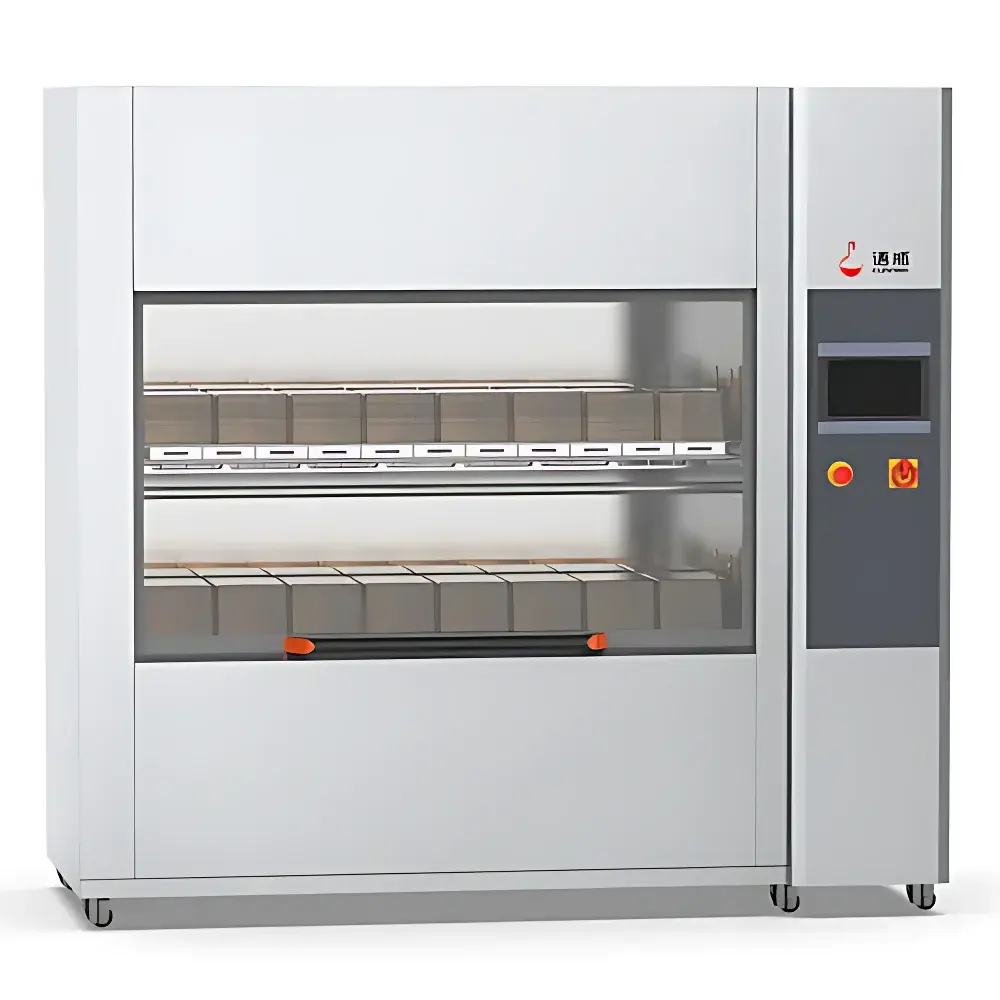
EURPING IVC100 Animal Cage Washer
| Brand | EURPING |
|---|---|
| Origin | Tianjin, China |
| Manufacturer Type | OEM Manufacturer |
| Country of Origin | China |
| Model | IVC 100 |
| Chamber Volume | 1200 L |
| Heating Power | 9 kW |
| Wash Temperature | 82 °C |
| Rinse Temperature | ≥82 °C |
| Cleaning Agents | Acidic & Alkaline Detergents (6 kg each onboard) |
| External Dimensions (L×W×D) | 2256 × 1353 × 1920 mm |
| Power Supply | 380 V, 50 Hz |
| Control System | Siemens PLC with 9-inch Touchscreen HMI |
| Spray Arm Configuration | 12 arms, 72 wash nozzles, 72 rinse nozzles |
| Wash Pressure | ≥1.5 bar (wash), ≥1.4 bar (rinse) |
| Cycle Time (Standard) | ≤4.5 min |
| Throughput | ≥32 cages per cycle |
| Door Type | Dual motorized vertical-lift full-glass doors with infrared anti-pinch safety sensors |
| Sealing | Pneumatically inflated silicone gasket |
| Insulation | High-efficiency thermal insulation on chamber and tanks |
| Programmability | ≥20 user-editable cycles, including alkaline-only or acid-alkaline-rinse sequences |
| Data Output | USB interface + integrated thermal printer for audit-ready cycle logs |
| Compliance | Designed to support GLP/GMP-aligned validation protocols |
Overview
The EURPING IVC100 Animal Cage Washer is an industrial-grade, fully automated cleaning system engineered specifically for high-throughput decontamination of laboratory animal housing equipment—including rodent cages, rabbit and guinea pig enclosures, and drinking bottles. It operates on a closed-loop thermally optimized washing principle: soft water is recirculated at high flow rates through a dedicated wash circuit, delivered via 12 precision-engineered spray arms with 72 calibrated nozzles per function (wash/rinse). Unlike conventional batch washers, the IVC100 integrates a physically isolated rinse subsystem—featuring a dedicated temperature-controlled rinse tank, independent pump, and sealed piping—to guarantee microbiological purity of final rinse water. This architecture ensures consistent thermal delivery (≥82 °C for final rinse), minimizes cross-contamination risk, and enables compliance with stringent hygiene benchmarks required in AAALAC-accredited facilities and regulated preclinical research environments.
Key Features
- Siemens S7-1200 PLC-based control architecture with deterministic real-time cycle execution and embedded fault diagnostics
- 9-inch capacitive touchscreen HMI supporting multilingual UI, password-protected parameter editing, and intuitive drag-and-drop program sequencing
- Dual motorized vertical-lift full-glass doors with IR-based anti-pinch detection and fail-safe interlocked door closure verification
- Pneumatically actuated silicone gasket sealing system ensuring >99.9% containment integrity during thermal cycles
- Variable-frequency drive (VFD)-controlled circulation pumps with soft-start functionality to mitigate mechanical stress on delicate cage components
- Onboard dual-detergent reservoirs (6 kg alkaline + 6 kg acidic) enabling fully automated two-step neutralization protocols without manual intervention
- Adaptive rack system accommodating heterogeneous cage geometries—horizontal, tilted, or stacked configurations—for simultaneous processing of mouse, rat, rabbit, and guinea pig housing units
- Thermal recovery design: high-purity hot rinse water is captured and redirected as preheated wash water, reducing energy consumption by up to 22% versus non-recirculating systems
Sample Compatibility & Compliance
The IVC100 is validated for use with polypropylene, polycarbonate, stainless steel, and borosilicate glass animal housing systems. Its mechanical action, thermal profile, and detergent compatibility meet functional requirements outlined in ISO 15883-1 (washer-disinfectors for medical devices) and ASTM E2551 (standard guide for validation of cleaning processes for laboratory animal caging). The system supports IQ/OQ/PQ documentation packages and generates timestamped, tamper-evident printouts compliant with FDA 21 CFR Part 11 data integrity expectations when paired with optional audit-trail software modules. All electrical components conform to IEC 61000-6-2/6-4 EMC standards; structural design adheres to EN 61000-1-2 mechanical safety directives.
Software & Data Management
The embedded control firmware records complete cycle metadata—including inlet water conductivity, actual temperatures at multiple sensor points (wash tank, rinse tank, chamber exhaust), pump pressure traces, door status timelines, and detergent dosing events. Data export occurs via USB 2.0 port in CSV format, compatible with LIMS integration or third-party validation software (e.g., ValGenesis, TrackWise). Optional Ethernet connectivity enables remote monitoring via Modbus TCP or OPC UA. Thermal printer output includes operator ID, cycle name, start/end timestamps, pass/fail indicators per critical parameter threshold, and digital signature fields for GLP sign-off.
Applications
Primary deployment contexts include centralized vivarium core facilities, contract research organizations (CROs) conducting GLP toxicology studies, academic institutions maintaining SPF rodent colonies, and biopharmaceutical manufacturers operating GMP-compliant animal testing suites. The IVC100 supports routine decontamination of soiled bedding-contact surfaces, removal of organic residues (urine, feces, feed particulates), biofilm disruption via thermal shock and alkaline saponification, and endotoxin reduction through validated high-temperature pure-water rinsing. Its programmable logic also accommodates specialized protocols for sterilization-prep cycles prior to autoclaving or vaporized hydrogen peroxide treatment.
FAQ
What types of animal cages can be processed in a single cycle?
The IVC100 accommodates mixed loads—including standard IVC mouse/rat cages (up to 32 units), rabbit cages (up to 8 units), and guinea pig enclosures (up to 12 units)—within one standardized 4.5-minute cycle, thanks to its adaptive rack geometry and multi-angle nozzle targeting.
Is validation support documentation provided with the system?
Yes. EURPING supplies a comprehensive validation toolkit including URS templates, FAT/SAT checklists, IQ/OQ test scripts, and blank PQ protocol worksheets aligned with ISO 15883-1 Annex C and AAALAC International Guideline 3.2.2.
How is water quality managed to prevent spotting or residue formation?
Integrated softening resin cartridges (replaceable every 6–12 months depending on inlet hardness) reduce calcium/magnesium ions to <1 ppm; final rinse uses thermally polished water heated to ≥82 °C and filtered through 0.22 µm membrane elements.
Can the IVC100 be integrated into a building’s BMS?
Yes. Standard Modbus RTU over RS-485 is included; optional Ethernet/IP or BACnet MS/TP gateways are available for direct BMS interoperability.
What maintenance intervals are recommended for optimal performance?
Daily: visual inspection of nozzles and door seals; weekly: descaling of heat exchangers and calibration of temperature sensors; semi-annual: replacement of softener resin and VFD capacitor health check. Full service logs are auto-generated and exportable.



