
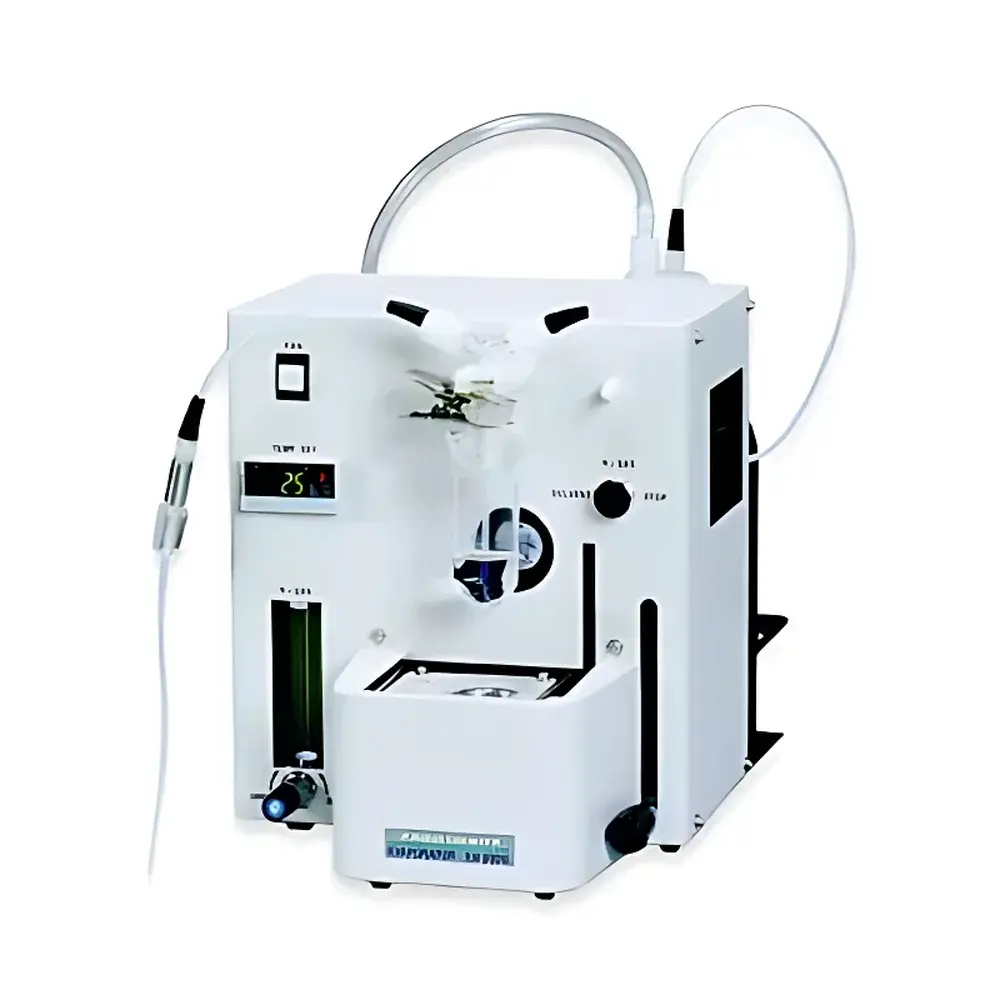
EV-2000L Evaporation Oven by Hirano (Hirano EV-2000L Karl Fischer Water Evaporator)
| Origin | Shanghai, China |
|---|---|
| Manufacturer Type | Authorized Distributor |
| Model | EV-2000L |
| Pricing | Available Upon Request |
| Moisture Evaporation Method | Azeotropic Distillation with Inert Carrier Gas |
| Heating Range | Ambient to 200 °C |
| Heater Type | Band Heater |
| Max Sample Volume | ≤10 mL |
| Azeotropic Solvent | Toluene or Xylene (5–10 mL per analysis) |
| Carrier Gas | Nitrogen or Dry Compressed Air (optional integrated air dryer/pump available) |
| Gas Flow Rate | 30–300 L/min |
| Inlet Pressure | ≤0.8 MPa |
| Desiccant | Molecular Sieve (4 Å) |
| Power Supply | AC 100–240 V, 50/60 Hz, 150 VA |
| Dimensions (W×D×H) | 220 × 370 × 265 mm |
| Net Weight | ~7 kg |
Overview
The Hirano EV-2000L Evaporation Oven is a dedicated sample preparation module engineered for precise and reproducible moisture determination in hydrophobic liquid matrices—particularly lubricating oils, transformer oils, insulating fluids, and other petroleum-based or synthetic industrial oils. It operates on the principle of azeotropic distillation, where a low-boiling-point, water-immiscible solvent (e.g., toluene or xylene) forms a binary azeotrope with entrained water. Upon heating, the solvent–water vapor mixture condenses in a cooled receiver, and the liberated water phase separates gravimetrically or is transferred directly to a coupled Karl Fischer (KF) titrator for coulometric or volumetric quantification. Unlike direct KF titration—which suffers from poor solubility, electrode passivation, or side reactions in viscous or reactive oil samples—the EV-2000L ensures complete water extraction prior to detection, thereby eliminating matrix interference and significantly improving accuracy, repeatability, and method robustness in compliance with ASTM D6304, ISO 12937, and IP 74.
Key Features
- Programmable temperature control (ambient to 200 °C) with ±1 °C stability, enabling optimization for diverse oil viscosities and boiling points of selected azeotropic solvents.
- Integrated band heater design ensures uniform thermal distribution across the evaporation chamber, minimizing localized overheating and thermal degradation of sensitive samples.
- Modular gas handling system compatible with nitrogen or dried compressed air; flow rate precisely adjustable between 30–300 L/min to balance evaporation efficiency and condensation kinetics.
- Onboard molecular sieve (4 Å) desiccant cartridge pre-dries carrier gas, preventing ambient moisture ingress and ensuring baseline integrity during extended analyses.
- Compact benchtop footprint (220 × 370 × 265 mm) and lightweight construction (~7 kg) facilitate integration into QC laboratories with space constraints or shared KF titration workstations.
- Universal power input (AC 100–240 V, 50/60 Hz) supports global deployment without voltage conversion hardware.
Sample Compatibility & Compliance
The EV-2000L is validated for use with samples up to 10 mL volume, covering standard test protocols for lubricants, hydraulic fluids, turbine oils, and dielectric liquids. Its azeotropic distillation methodology aligns with internationally recognized standards including ASTM D6304 (Standard Test Method for Determination of Water in Petroleum Products by Coulometric Karl Fischer Titration), ISO 12937 (Petroleum Products — Determination of Water — Coulometric Karl Fischer Method), and IP 74 (Determination of Water in Petroleum Products — Karl Fischer Method). When operated as part of a fully documented analytical workflow—including instrument qualification (IQ/OQ), calibration traceability, and audit-ready electronic records—the system supports GLP and GMP environments compliant with FDA 21 CFR Part 11 requirements when paired with validated KF titration software.
Software & Data Management
The EV-2000L functions as a standalone evaporation unit and does not incorporate embedded firmware or user interface software. It is designed for seamless interoperability with third-party Karl Fischer titrators (e.g., Metrohm, Mettler Toledo, Hanna Instruments) via standardized analog/digital I/O or relay-triggered start/stop signals. Full traceability is maintained through the host titrator’s data management system, which logs evaporation parameters (temperature setpoint, duration, gas flow), titration curves, endpoint detection metrics, and calculated water concentration (mg/kg or % w/w). All raw and processed data may be exported in CSV or PDF formats, supporting laboratory information management systems (LIMS) integration and long-term archival per ISO/IEC 17025 documentation requirements.
Applications
- Quantification of trace water (<10 ppm) in new and in-service lubricating oils to assess oxidation stability and prevent bearing corrosion.
- Moisture testing of transformer insulating oils per IEEE C57.106 guidelines to ensure dielectric strength and avoid flashover risk.
- Quality control of hydraulic fluids in aerospace and heavy machinery manufacturing where water-induced hydrolysis compromises additive performance.
- Stability assessment of synthetic ester-based biodegradable lubricants during accelerated aging studies.
- Method development for challenging matrices such as silicone oils, fluorinated fluids, and high-viscosity gear oils where conventional KF reagents exhibit incomplete reaction kinetics.
FAQ
Can the EV-2000L be used with solvents other than toluene or xylene?
Yes—other water-immiscible azeotropic solvents (e.g., chlorobenzene, amyl acetate) may be employed if validated for recovery efficiency and compatibility with downstream KF reagents. Solvent selection must be documented per SOP.
Is an external dry air compressor required?
Not mandatory; nitrogen supply is preferred for inertness. Optional integrated dry air pump modules are available for laboratories lacking centralized gas infrastructure.
What maintenance is required for the molecular sieve desiccant?
The 4 Å molecular sieve cartridge should be regenerated at 250 °C for 3 hours or replaced every 200–300 analyses, depending on ambient humidity and usage frequency.
Does the EV-2000L include temperature calibration certification?
No—calibration is performed using external NIST-traceable thermometers or RTD probes per laboratory SOP; certificate generation is the responsibility of the end-user’s metrology department.
Is the unit suitable for hazardous area installation?
No—it is rated for general laboratory use (IEC 61010-1) and lacks explosion-proof certification (ATEX/IECEx); operation in classified zones requires engineering review and containment measures.






