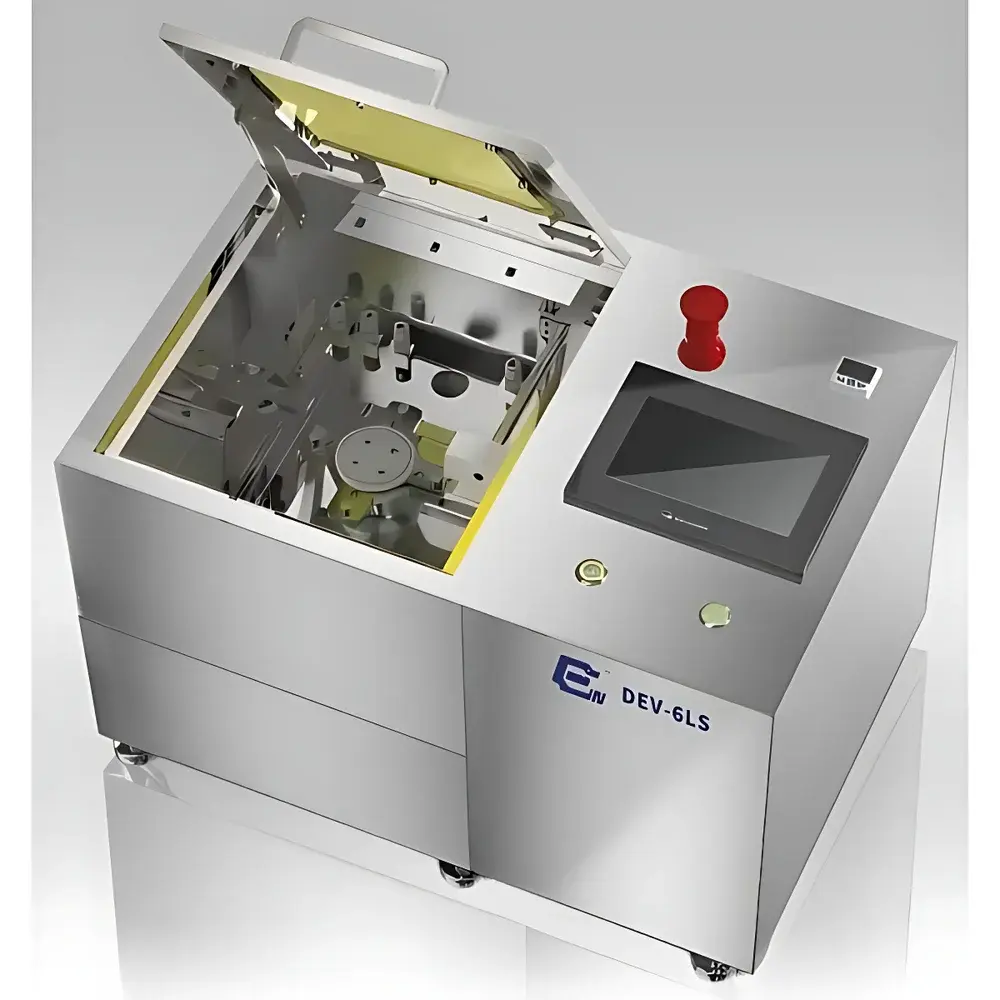
EWIN-TECH DEV-6LS Benchtop Semi-Automatic Developer
| Brand | EWIN-TECH |
|---|---|
| Origin | Shanghai, China |
| Manufacturer Type | OEM Manufacturer |
| Regional Category | Domestic (China) |
| Model | DEV-6LS |
| Pricing | Upon Request |
Overview
The EWIN-TECH DEV-6LS Benchtop Semi-Automatic Developer is a precision-engineered photoresist development system designed for R&D laboratories, pilot lines, and low-volume production environments in semiconductor fabrication, photovoltaics, microelectromechanical systems (MEMS), and optoelectronic device manufacturing. It operates on the principle of spin development—where controlled rotational motion, combined with programmable chemical dispensing and DI water rinse sequences, enables uniform removal of exposed (or unexposed) photoresist regions following UV or e-beam exposure. Unlike fully automated track systems, the DEV-6LS delivers process repeatability and metrological traceability at benchtop scale, making it ideal for process optimization, mask qualification, and failure analysis workflows where flexibility and rapid recipe iteration are critical.
Key Features
- High-Fidelity Spin Control: Equipped with an AC servo motor drive delivering 20–3000 rpm rotation range with ±1 rpm speed stability—ensuring consistent centrifugal force distribution across wafers up to 6 inches (150 mm) in diameter, essential for reproducible developer thickness profiles and edge bead removal.
- PLC-Based Process Automation: Integrated industrial-grade PLC governs all motion, fluid delivery, and timing logic. The system supports up to 50 user-defined recipes, each configurable with up to 20 sequential steps—including dispense duration, spin acceleration/deceleration ramps, dwell times, and multi-zone nozzle actuation.
- Programmable Dispense Arm: A motorized radial arm positions high-precision stainless-steel nozzles with sub-millimeter repeatability. Flow rate and dispensing height are adjustable per step; dual-channel capability allows independent delivery of developer solution and deionized water for inline dilution or sequential processing.
- Dedicated Rinse & Dry Sequence: Post-development DI water spray—delivered via dedicated nozzles with pulse-width modulation—is followed by high-speed spin-dry (up to 3000 rpm) to minimize residue formation and pattern collapse risk, particularly relevant for sub-100 nm resist architectures.
- Integrated Vacuum Monitoring & Safety Interlocks: Real-time vacuum pressure sensing at chuck interface prevents wafer slippage or lift-off during high-speed spin. Digital threshold setting and lower-limit alarm activation ensure immediate shutdown if vacuum integrity falls below specification—compliant with SEMI S2-0201 safety guidelines.
Sample Compatibility & Compliance
The DEV-6LS accommodates standard silicon, glass, quartz, and compound semiconductor substrates ranging from 50 mm (2″) to 150 mm (6″) in diameter. Chuck design supports both flat and notch alignment, with optional vacuum port configurations for porous or warped substrates. All wetted components—including tubing, valves, and nozzles—are constructed from chemically resistant materials (e.g., PTFE, PVDF, 316L SS) compatible with common developers such as TMAH, KOH, and organic solvents (e.g., PGMEA-based strippers). The system meets CE marking requirements and adheres to ISO 9001-certified manufacturing practices. While not a GMP-certified tool, its audit-ready recipe logging and parameter locking support GLP-compliant documentation for qualification studies under ISO/IEC 17025 or internal QC protocols.
Software & Data Management
Operation is managed through a 7-inch capacitive touchscreen HMI running embedded Linux OS. Each executed run logs timestamped metadata—including recipe ID, actual RPM profile, dispense volume estimates (based on calibrated flow time), vacuum status, and error codes—to internal flash memory (16 GB). Data export is supported via USB 2.0 in CSV format for integration with LIMS or statistical process control (SPC) platforms. Optional Ethernet connectivity enables remote monitoring and basic SCADA integration using Modbus TCP. Audit trail functionality records operator login/logout events and recipe modification history—aligned with FDA 21 CFR Part 11 principles for electronic records, though formal validation support requires customer-specific IQ/OQ documentation.
Applications
- Photoresist development in MEMS and NEMS fabrication processes requiring precise line-width control and sidewall profile fidelity.
- Process window characterization for advanced lithography nodes (i-line, KrF, ArF), including dose-to-clear and focus-exposure matrix analysis.
- Mask shop defect review—rapid rework of test wafers after exposure tool calibration or reticle inspection.
- Solar cell texturing and anti-reflective coating patterning using lift-off or etch-stop resist schemes.
- Research-scale fabrication of flexible electronics, OLED backplanes, and quantum dot arrays where batch size and material cost constrain full-track deployment.
FAQ
What substrate sizes does the DEV-6LS support?
Standard configuration supports 50 mm (2”), 76.2 mm (3”), 100 mm (4”), and 150 mm (6”) wafers. Custom chucks for non-standard geometries (e.g., rectangular glass substrates) are available upon request.
Is the system compatible with aqueous and solvent-based developers?
Yes—the fluid handling system is validated for TMAH (0.26–2.38 wt%), KOH, and common organic developers (e.g., AZ® 300 series, Shipley Microposit®). Material compatibility documentation is provided for each chemical class.
Can recipes be password-protected or locked for production use?
Yes—user roles (Operator, Technician, Administrator) can be assigned with granular permissions for recipe editing, parameter adjustment, and system calibration access.
Does the DEV-6LS include exhaust or fume hood integration?
The unit is designed for installation inside Class 1000 cleanroom-compatible fume hoods. Optional ducting ports and static pressure compensation are available to interface with facility exhaust systems meeting SEMI F47 standards.
What maintenance intervals are recommended?
Daily: Nozzle inspection and DI water filter check. Quarterly: Chuck vacuum seal replacement and motor encoder calibration verification. Annual: Full PLC firmware update and sensor recalibration traceable to NIST-certified references.