
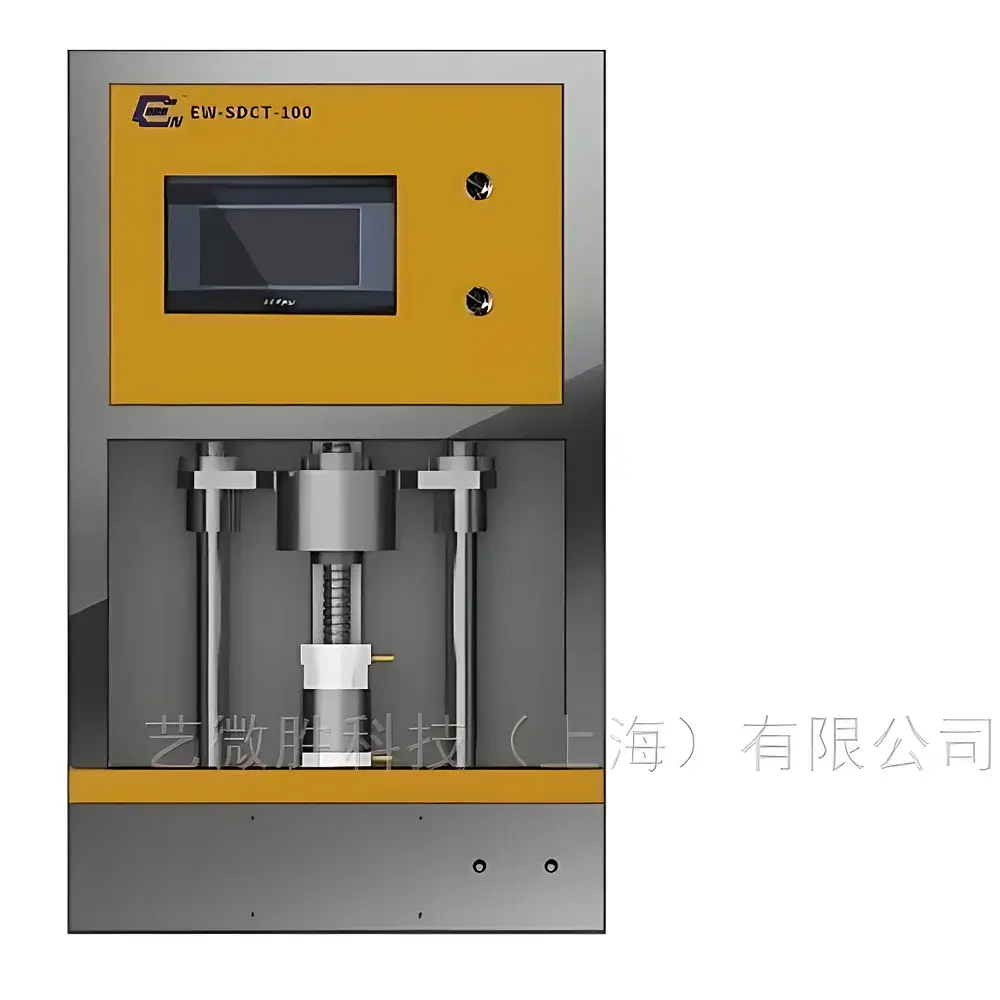
EWIN-TECH EW-SDCT-100 Automated Compression System for Solid-State Electrolytes
| Brand | EWIN-TECH |
|---|---|
| Origin | Shanghai, China |
| Manufacturer Type | Direct Manufacturer |
| Country of Origin | China |
| Model | EW-SDCT-100 |
| Pricing | Available Upon Request |
Overview
The EWIN-TECH EW-SDCT-100 Automated Compression System is an engineering-grade test platform specifically developed for mechanoelectrochemical characterization of solid-state electrolytes (SSEs), ceramic-polymer composite membranes, and battery separators. It operates on the principle of programmable uniaxial compression coupled with in-situ ionic conductivity measurement under controlled mechanical boundary conditions. Unlike conventional static pressure fixtures, this system integrates a high-resolution servo-driven actuator with PID-closed-loop force regulation, enabling precise, repeatable, and time-resolved application of compressive loads ranging from 0.1 MPa to 10 MPa (configurable upper limit depending on fixture geometry and sample dimensions). Its core purpose is to quantitatively correlate interfacial contact mechanics—particularly solid–solid electrode/electrolyte contact quality—with electrochemical response parameters including bulk ionic conductivity, interfacial charge-transfer resistance, and long-term impedance evolution. This capability addresses a critical experimental gap in solid-state battery R&D: the lack of standardized, instrumented platforms capable of decoupling mechanical stress effects from intrinsic material transport properties.
Key Features
- Servo-motor-driven compression mechanism with ±0.5% full-scale force accuracy and sub-Newton resolution, ensuring reproducible load application across repeated cycles.
- Programmable multi-step pressure profiles (ramp-hold-relax sequences) synchronized with external electrochemical workstations via digital I/O or analog voltage interface.
- Modular fixture architecture supporting interchangeable anvil sets for disk-shaped (Ø10–25 mm), pelletized, and thin-film samples; optional quartz or stainless-steel anvils compatible with inert-atmosphere glovebox integration.
- Expandable environmental control modules: Peltier-based temperature regulation (−20 °C to +80 °C, ±0.3 °C stability), humidity-controlled chamber (10–90% RH, ±2% RH accuracy), and vacuum-compatible sealing options.
- Real-time force–displacement–impedance data fusion: native timestamp alignment between mechanical actuation signals and AC impedance spectroscopy (EIS) or DC polarization outputs.
- Compliance with ISO 17025 traceability requirements for force calibration; documented uncertainty budgets available upon request for GLP-compliant reporting.
Sample Compatibility & Compliance
The EW-SDCT-100 accommodates rigid and semi-rigid solid electrolyte materials including sulfides (e.g., Li₆PS₅Cl), oxides (e.g., LLZO, LATP), polymer-ceramic composites (e.g., PEO–LLZO), and functionalized separators. Sample thickness range: 0.2–3.0 mm; maximum diameter: 25 mm. All wetted surfaces are electropolished stainless steel or chemically inert ceramics to prevent parasitic side reactions. The system supports ASTM D790 (flexural modulus), ISO 6892-1 (tensile/compression testing principles), and IEEE 1625/1725 (battery component mechanical qualification) methodologies. Force transducers are calibrated per ISO/IEC 17025-accredited procedures, and firmware logs include audit-trail metadata compliant with FDA 21 CFR Part 11 requirements for electronic records.
Software & Data Management
Control and acquisition are managed through EWIN-TECH’s proprietary SDCT Control Suite v3.2—a Windows-based application supporting scriptable test sequences, real-time dashboard visualization (force vs. time, displacement vs. load, impedance Nyquist overlays), and export to HDF5, CSV, or MPT formats. Raw data files embed embedded metadata (user ID, timestamp, calibration certificate IDs, environmental setpoints) to satisfy ALCOA+ data integrity criteria. Optional API integration enables bidirectional communication with commercial potentiostats (BioLogic, Gamry, Metrohm Autolab) and LIMS systems. All software modules undergo annual cybersecurity review per IEC 62443-3-3 standards.
Applications
- Quantifying pressure-dependent ionic conductivity activation energy in garnet-type SSEs.
- Evaluating interfacial resistance hysteresis during cyclic compression–relaxation in sulfide-based cells.
- Correlating anvil surface roughness and applied pressure with EIS-derived grain-boundary vs. interfacial resistance contributions.
- Accelerated aging studies under combined thermo-mechanical stress (e.g., 60 °C + 5 MPa + 30% RH) to simulate pouch-cell stack conditions.
- Validating finite-element models of contact mechanics at cathode/SSE interfaces using experimentally derived pressure–contact-area–resistance curves.
FAQ
Can the EW-SDCT-100 be integrated into a glovebox environment?
Yes—optional sealed feedthroughs for power, signal, and pneumatic lines enable full operation inside argon- or nitrogen-filled gloveboxes (O₂/H₂O < 0.1 ppm).
Does the system support simultaneous temperature and humidity control?
Yes—dual-module configuration allows independent regulation of T and RH while maintaining active compression, with cross-talk compensation algorithms embedded in firmware.
Is force calibration traceable to national metrology institutes?
All standard configurations include NIST-traceable calibration certificates issued by CNAS-accredited laboratories; extended calibration intervals require user-performed verification per ISO 376 Annex B.
What electrochemical techniques are natively supported?
The system provides hardware-level synchronization triggers for EIS, DC polarization, galvanostatic intermittent titration (GITT), and cyclic voltammetry—no third-party adapters required.
Can custom fixture geometries be designed for non-standard samples?
Yes—EWIN-TECH offers OEM mechanical design services with turnaround times of ≤6 weeks for validated CAD-reviewed fixtures meeting ASME BPE or ISO 8502-9 surface finish specifications.





