
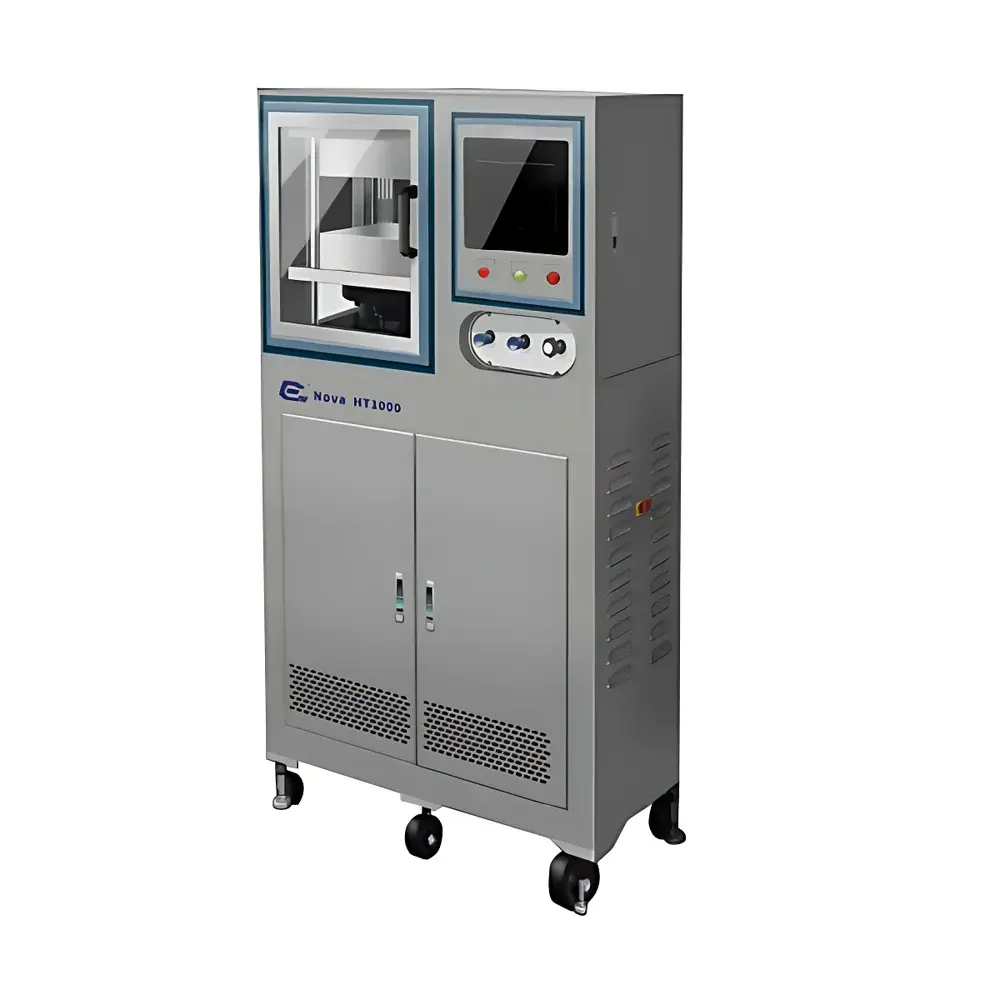
EWIN-TECH Nova HT1000 Membrane Electrode Assembly (MEA) Hot Press
| Key | Brand: EWIN-TECH |
|---|---|
| Origin | Shanghai, China |
| Manufacturer Type | Direct Manufacturer |
| Product Origin | Domestic (China) |
| Model | Nova HT1000 |
| Heating Plate Temperature Range | Up to 300 °C |
| Maximum Applied Force | 200 kN (20 tonf) |
| Max. Platen Size | 300 × 300 mm |
| Positional Speed Control Resolution | 0.01 mm/s |
| Platen Material | SKD11/SKD61 Chromium-Molybdenum Alloy with Mirror-Finish Chrome Plating |
| Cooling System | Pressure-Controlled Automatic Water-Cooling Circuit |
| Control Mode | Manual & Programmable Multi-Stage Velocity Profile |
Overview
The EWIN-TECH Nova HT1000 Membrane Electrode Assembly (MEA) Hot Press is an electromechanically actuated thermal lamination platform engineered for precision fabrication of proton exchange membrane fuel cell (PEMFC) and solid oxide fuel cell (SOFC) membrane electrode assemblies. Unlike conventional hydraulic hot presses, the Nova HT1000 employs a closed-loop servo-electric drive system to deliver deterministic force application, eliminating fluid compressibility effects and enabling sub-millimeter positional repeatability. Its operational principle integrates programmable thermal profiling (via upper platen heating only), controlled mechanical consolidation under sustained load, and synchronized active cooling—ensuring consistent interfacial bonding between catalyst-coated membranes (CCMs), gas diffusion layers (GDLs), and sealing gaskets. Designed for R&D laboratories and pilot-scale MEA prototyping, the system supports process development aligned with DOE Fuel Cell Technologies Office (FCTO) guidelines and ISO 14687–2 purity and durability validation protocols.
Key Features
- Servo-electric actuation with 0.01 mm/s speed resolution, enabling smooth, jerk-free compression profiles critical for avoiding catalyst layer delamination or membrane thinning.
- Upper platen heating up to 300 °C with ±1.5 °C temperature uniformity across the active zone (measured per ASTM E220), supporting thermoplastic binder activation and polymer electrolyte membrane annealing.
- High-strength SKD11/SKD61 chromium-molybdenum alloy platens, hardened to HRC60 and mirror-chrome plated, achieving flatness ≤ 5 µm over 300 × 300 mm—essential for uniform pressure distribution during large-area MEA lamination.
- Integrated pressure-regulated water-cooling circuit that automatically engages post-compression, maintaining thermal gradient control to prevent residual stress-induced warpage in multi-layer laminates.
- Multi-stage programmable operation mode: users define discrete velocity, force, dwell time, and temperature segments—enabling replication of complex industrial lamination cycles such as pre-heat → ramp → hold → cool-down.
- Real-time dynamic monitoring of displacement, applied force, and platen temperature with timestamped data logging compliant with FDA 21 CFR Part 11 audit trail requirements when paired with validated software configuration.
Sample Compatibility & Compliance
The Nova HT1000 accommodates standard MEA configurations including 5 cm², 25 cm², and 100 cm² active areas, as well as custom tooling up to 300 × 300 mm. It supports both dry and solvent-assisted lamination processes involving Nafion™, Fumapem®, and hydrocarbon-based membranes. The system complies with IEC 61000-6-2/6-4 for electromagnetic compatibility and meets CE machinery directive 2006/42/EC safety requirements. All thermal and mechanical parameters are traceable to national metrology standards via factory calibration certificates (NIST-traceable reference sensors included). For GMP-aligned environments, optional IQ/OQ documentation packages support qualification against USP Analytical Instrument Qualification and ISO/IEC 17025 clause 5.5.2.
Software & Data Management
Control is executed via a Windows-based HMI with embedded real-time OS, offering dual-mode interface: manual jog operation for setup and fully parameterized recipe execution. Each program stores full cycle metadata—including force-displacement curves, thermal transients, and event timestamps—in CSV and SQLite formats. Exported datasets are compatible with MATLAB, Python (pandas), and JMP for statistical process control (SPC) analysis. Audit logs record user login, parameter changes, and run completion status with digital signature capability. Optional OPC UA server integration enables seamless connection to LabVantage, SAP QM, or MES platforms for centralized batch record management.
Applications
- Development and optimization of low-Pt and Pt-free catalyst layers for PEMFC MEAs.
- Thermal lamination of anion exchange membranes (AEMs) with quaternized polyphenylene backbones.
- Consolidation of metal-supported SOFC anodes under inert atmosphere (when integrated with glovebox-compatible loading fixtures).
- Process validation for automotive-grade MEA manufacturing per SAE J2380 and GMW15922 specifications.
- Accelerated stress testing (AST) sample preparation where controlled interfacial adhesion directly impacts failure mode analysis.
FAQ
What is the maximum recommended operating temperature for continuous use?
The upper platen is rated for continuous operation at 280 °C; 300 °C is permissible for short-duration (<15 min) process steps.
Can the system be integrated into a nitrogen-purged glovebox environment?
Yes—custom feedthroughs for power, Ethernet, and cooling lines are available; external controller enclosure options meet IP54 rating for inert-atmosphere integration.
Is force calibration performed in-house prior to shipment?
Each unit undergoes full-load calibration using certified deadweight standards traceable to CNAS-accredited laboratories; calibration certificate included.
Does the software support automated pass/fail criteria based on force-displacement thresholds?
Yes—user-defined acceptance windows can trigger audible alerts and abort sequences if real-time metrics deviate beyond preset tolerances.
What maintenance intervals are recommended for the servo drive and cooling system?
Servo motor grease replenishment every 5,000 hours; cooling circuit descaling and filter replacement every 12 months under typical lab usage (8 hrs/day, 5 days/week).



