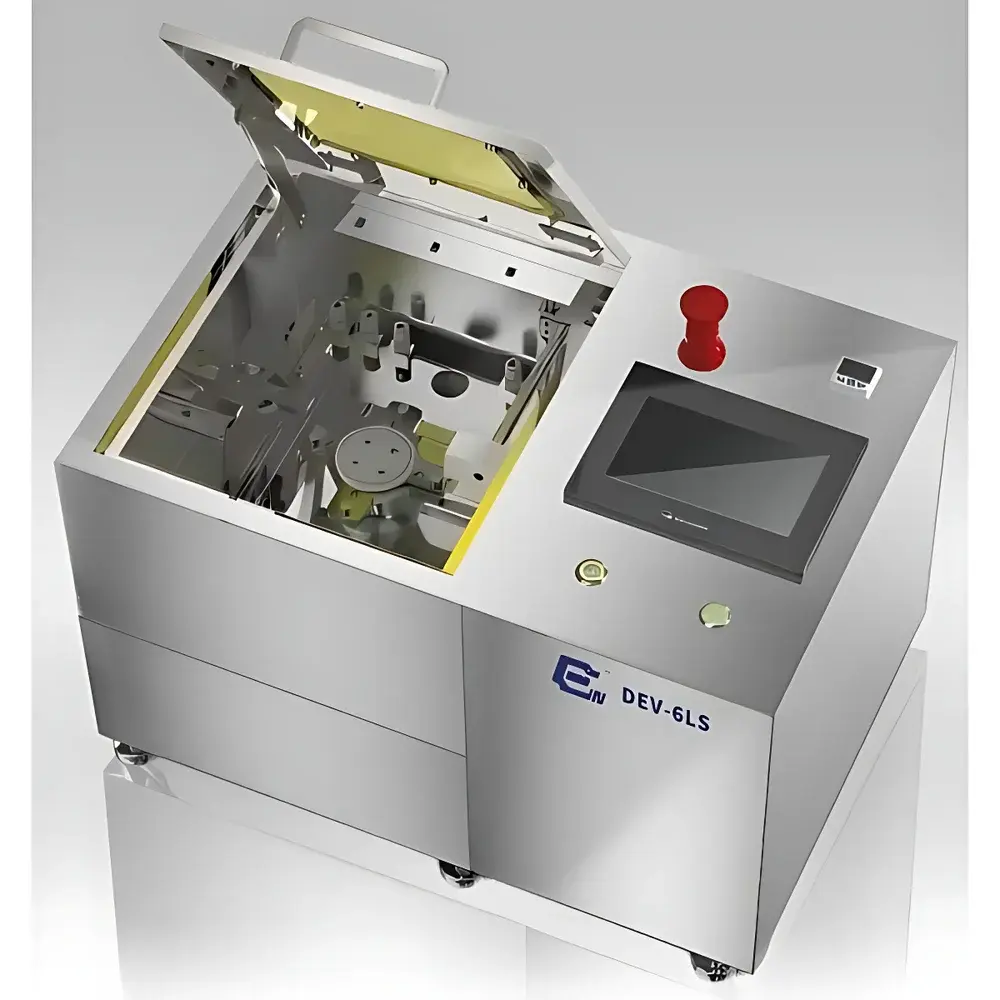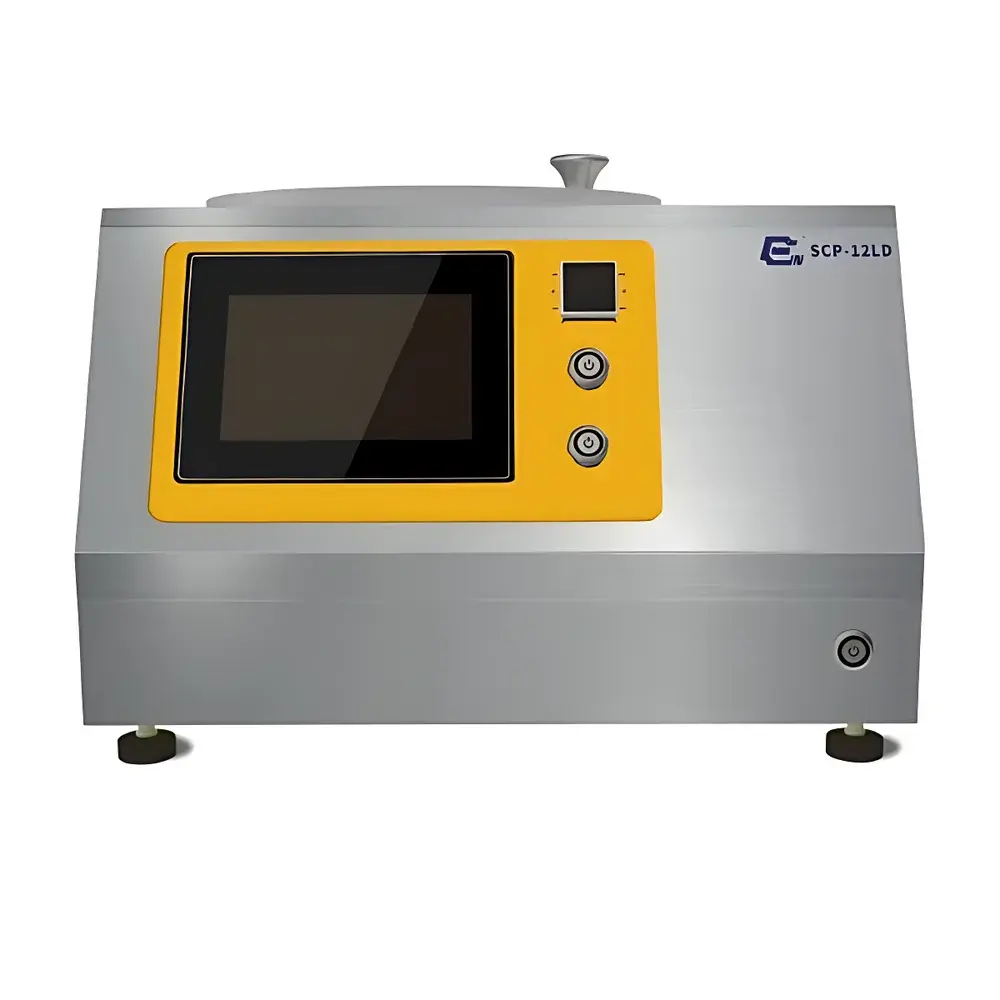
EWIN-TECH SCP-12LD Benchtop Spin Coater
| Brand | EWIN-TECH |
|---|---|
| Origin | Shanghai, China |
| Manufacturer Type | Original Equipment Manufacturer (OEM) |
| Product Origin | Domestic (China) |
| Model | SCP-12LD |
| Pricing | Upon Request |
Overview
The EWIN-TECH SCP-12LD Benchtop Spin Coater is a precision-engineered thin-film deposition instrument designed for semiconductor fabrication, photovoltaic R&D, and advanced optoelectronic device manufacturing. It operates on the principle of centrifugal force-driven spin coating—where a liquid precursor (e.g., photoresist, polymer solution, or functional ink) is dispensed onto a rotating substrate, enabling controlled solvent evaporation and uniform film formation through radial acceleration and viscous shear. Engineered for reproducible nanoscale thickness control, the SCP-12LD supports substrates up to 300 mm (12-inch) diameter, meeting critical process requirements in front-end-of-line (FEOL) lithography, MEMS passivation, and perovskite solar cell layer deposition. Its rigid mechanical architecture, combined with closed-loop servo motion control and vacuum chuck stabilization, ensures minimal runout (<5 µm TIR) and high inter-run repeatability—key performance criteria for GLP-compliant process development labs and pilot-line integration.
Key Features
- High-precision servo motor drive system with speed range of 20–5000 rpm and ±1 rpm speed stability under load—enabling precise control over film thickness (typically 50 nm to 5 µm, dependent on solution viscosity and spin profile)
- Programmable multi-step spin protocols: up to 50 user-defined recipes, each supporting up to 20 sequential steps (dispense, pre-spin, acceleration, main spin, edge rinse, dry spin)
- Vacuum-based substrate clamping with real-time negative pressure monitoring and automatic shutdown upon vacuum loss—preventing wafer ejection (“fly-out”) and ensuring operator safety per ISO 13857 mechanical safety guidelines
- Corrosion-resistant stainless-steel chassis and chemically inert PTFE-coated spin bowl—designed for compatibility with common solvents (e.g., PGMEA, acetone, IPA, xylene) and minimizing particle generation in Class 100–1000 cleanroom environments
- 7-inch industrial-grade capacitive touchscreen HMI with intuitive icon-based navigation, recipe import/export via USB, and password-protected parameter editing tiers (Operator/Engineer/Admin)
- Manual spray dispensing module with adjustable nozzle height, flow rate, and dwell time—supporting both static and dynamic dispense modes for non-uniform substrates or localized coating applications
Sample Compatibility & Compliance
The SCP-12LD accommodates rigid flat substrates including silicon wafers (up to 300 mm), fused silica, quartz, glass (e.g., Corning Eagle XG), sapphire, and flexible metal foils (when mounted on carrier plates). Substrate thickness range: 0.1–2.0 mm. The system complies with CE marking requirements (2014/30/EU EMC Directive, 2014/35/EU LVD Directive) and meets IEC 61000-6-2/6-3 immunity/emission standards. Vacuum interlock logic and emergency stop circuitry conform to ISO 13850. For regulated environments, optional audit trail logging (with timestamped user actions and parameter changes) supports FDA 21 CFR Part 11 readiness when paired with validated software configurations.
Software & Data Management
The embedded PLC-based controller stores all operational logs—including recipe execution history, motor current profiles, vacuum pressure traces, and fault codes—in non-volatile memory. Data export is supported in CSV format via USB 2.0 port for offline statistical process control (SPC) analysis. Optional Ethernet interface enables remote monitoring and integration into MES platforms via Modbus TCP protocol. Firmware updates are performed via signed binary files to ensure integrity; version history and change logs are retained in system diagnostics.
Applications
- Photolithography: Uniform photoresist (e.g., AZ® series, Shipley S18xx, TOK TF series) coating on Si, GaAs, and SOI wafers for mask alignment and UV exposure
- Advanced packaging: Redistribution layer (RDL) dielectric spin-on-glass (SOG) and polyimide application
- Perovskite & organic PV: Sequential spin-casting of precursor layers (e.g., PbI₂, CH₃NH₃I) with anti-solvent quenching synchronization
- Microfluidics: PDMS and SU-8 microchannel mold fabrication
- Research-scale thin-film studies: Metal oxide sol-gel coatings (TiO₂, ZnO), graphene oxide dispersion, and conductive polymer (PEDOT:PSS) patterning
FAQ
What is the maximum substrate diameter supported by the SCP-12LD?
The system is mechanically and dynamically optimized for 300 mm (12-inch) wafers; smaller substrates (100 mm, 150 mm, 200 mm) are supported using compatible chucks.
Does the SCP-12LD support automated dispense integration?
Yes—while the standard configuration includes manual spray dispensing, an optional programmable syringe pump module with synchronized trigger output is available for closed-loop dispense timing.
Can the system be integrated into a Class 10 cleanroom environment?
The unit meets ISO Class 5 airborne particle limits when operated inside laminar flow hoods; its PTFE bowl and sealed motor housing minimize outgassing and particulate shedding.
Is vacuum chuck compatibility available for non-silicon substrates?
Standard vacuum chucks accommodate flat, non-porous materials; custom porous ceramic or electrostatic chucks can be supplied for low-permeability substrates such as thin-film glass or flexible PET.
What maintenance intervals are recommended for long-term reliability?
Vacuum filter replacement every 6 months; PTFE bowl inspection and cleaning after each solvent class change; annual calibration of speed feedback loop and vacuum sensor against NIST-traceable references.