
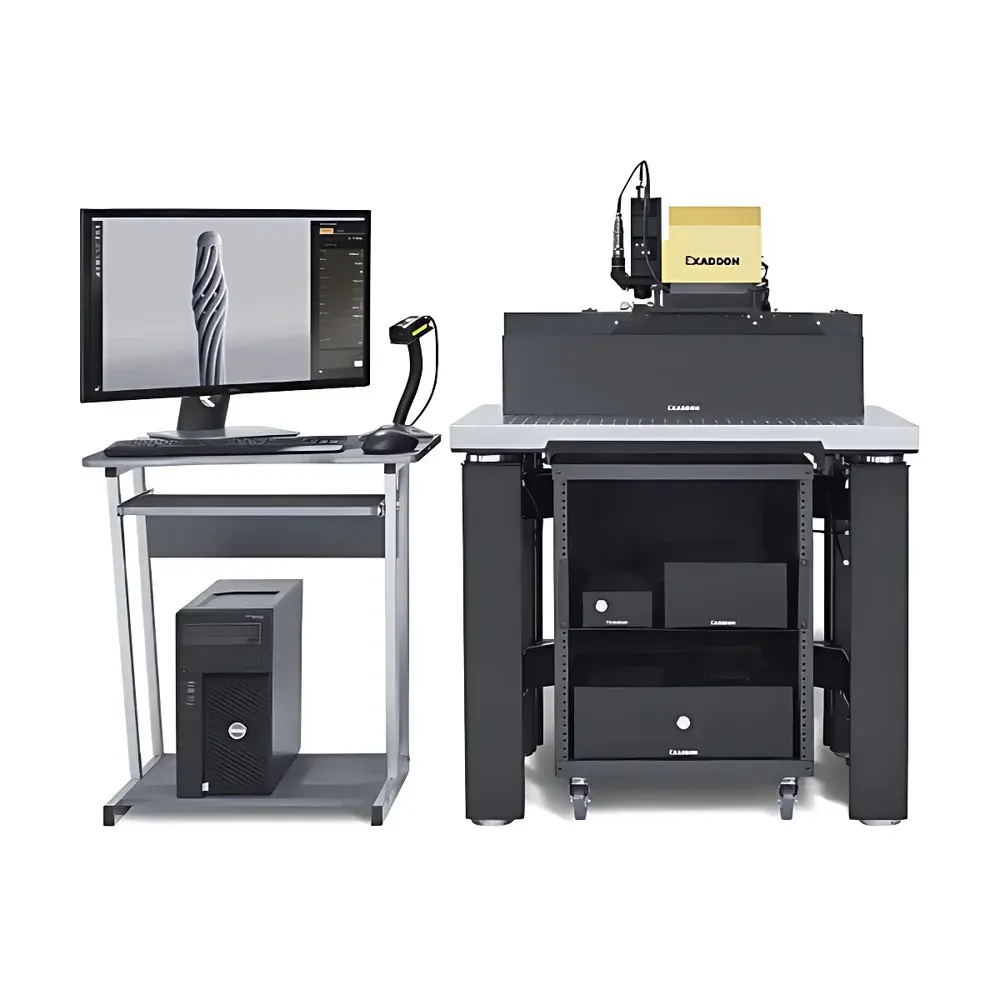
Exaddon CERES Micro- and Nanoscale Pure Metal 3D Printer
| Brand | Exaddon |
|---|---|
| Origin | United Kingdom |
| Model | CERES |
| Printing Resolution | <1 µm |
| Print Materials | Cu, Au, Ni, Ag, Pt |
| XY Positioning Accuracy | ±250 nm |
| Z Positioning Accuracy | ±5 nm |
| Maximum Build Area (Standard) | 25 × 25 mm |
| Max. Print Speed | 200 µm/s |
| Operating Environment | Ambient Temperature, No Post-Processing Required |
| Core Technology | Template-Free Electrochemical Deposition (ECD) |
Overview
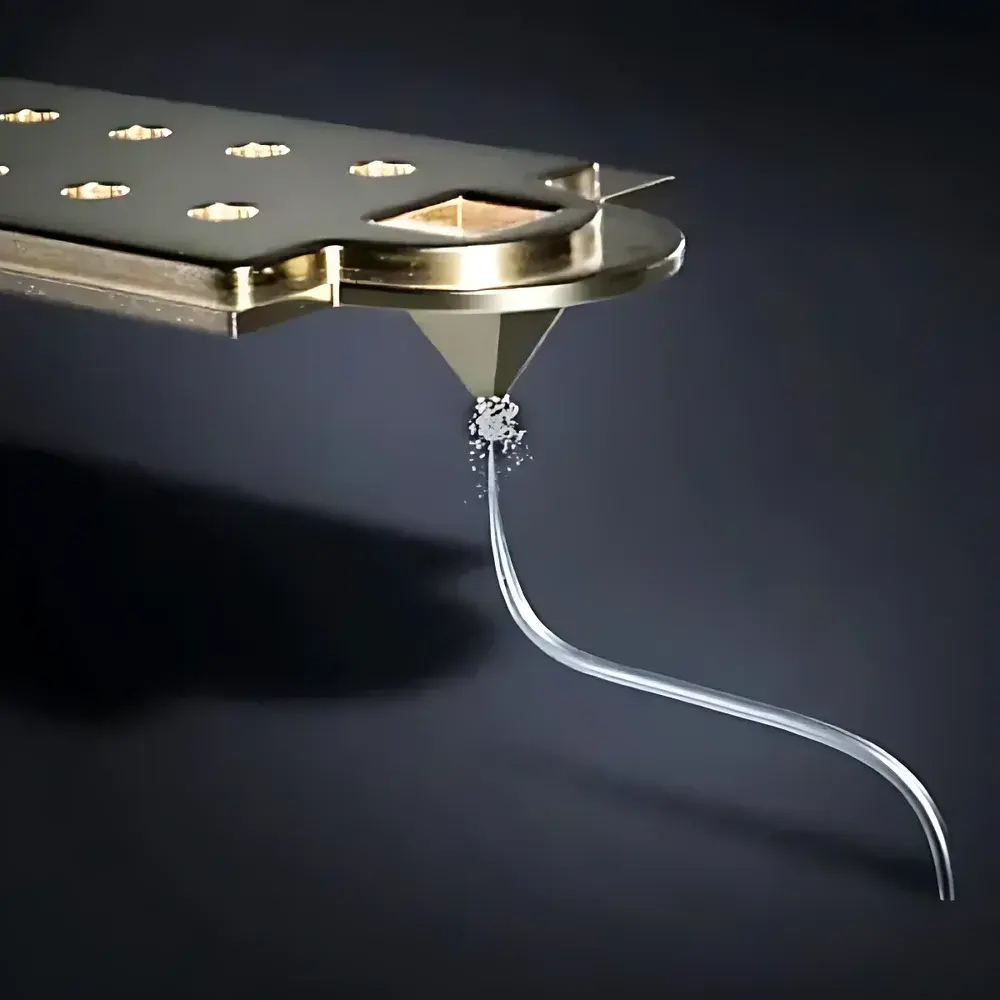
The Exaddon CERES Micro- and Nanoscale Pure Metal 3D Printer is a benchtop additive manufacturing platform engineered for direct-write fabrication of freestanding, high-purity metallic microstructures at submicron resolution. Unlike conventional laser- or heat-based metal AM systems, CERES employs template-free electrochemical deposition (ECD) — a localized, room-temperature process that deposits metal ions from an electrolytic precursor solution onto a conductive substrate via a nanoscale capillary probe. This mechanism eliminates thermal stress, phase segregation, and support-structure dependency, enabling true overhang printing, hollow architectures, and monolithic integration directly onto functional substrates such as silicon wafers, MEMS devices, or photonic chips. Designed for research-intensive environments, CERES bridges the gap between nanofabrication lithography and macro-scale metal printing, supporting reproducible fabrication of features ranging from 250 nm to 300 µm in lateral dimension — with full control over geometry, crystallinity, and stoichiometry.
Key Features
- Sub-1 µm feature resolution with ±250 nm XY and ±5 nm Z closed-loop positioning accuracy
- Ambient-temperature operation: no laser, no furnace, no sintering, no post-processing
- Support-free printing of悬垂 (overhanging), hollow, and interlocked geometries — including coils, lattices, micro-pillars, and needle arrays
- Dual high-resolution optical cameras with computer-aided alignment for real-time tip calibration, automatic pipette loading, and on-substrate registration (e.g., direct electrode printing on pre-patterned ICs)
- Modular liquid handling system compatible with multiple electrochemical precursors: aqueous and non-aqueous electrolytes containing Cu²⁺, Au⁺, Ni²⁺, Ag⁺, and Pt²⁺ ions
- Integrated optical force feedback loop ensuring consistent meniscus stability and deposition fidelity across varying surface topographies
- Scalable build envelope: standard 25 × 25 mm stage; custom platforms up to 100 × 70 mm available upon request
Sample Compatibility & Compliance
CERES is compatible with conductive substrates including Si/SiO₂ wafers, ITO-coated glass, gold-plated PCBs, and flexible metal foils. Non-conductive surfaces may be used with optional conductive seed layers. The system supports ASTM F2792-12a (Standard Terminology for Additive Manufacturing) nomenclature for microscale AM processes and aligns with ISO/IEC 17025 requirements for measurement traceability in research labs. All electrochemical protocols are documented per GLP principles, and raw deposition logs (timestamped voltage/current/position data) are retained for auditability. While not FDA-cleared as a medical device, CERES-fabricated structures have been validated in peer-reviewed studies for biocompatible electrode applications (e.g., neural probes, biosensor interconnects) under ISO 10993-5 cytotoxicity testing frameworks.
Software & Data Management
CERES is operated exclusively through CAPA — a proprietary, cross-platform software suite built on Python-based scientific computing libraries and Qt-based GUI architecture. CAPA provides intuitive path planning, layer-by-layer script generation, real-time process monitoring (including current-voltage curves and tip-to-substrate distance tracking), and automated calibration routines. All print jobs generate structured HDF5 files containing metadata (material, bath composition, deposition parameters), trajectory coordinates, and synchronized sensor streams. CAPA supports export to common CAD formats (STEP, STL) and integrates with MATLAB and Python via documented RESTful API endpoints. The online user manual — hosted on Exaddon’s secure documentation portal — is version-controlled, searchable, and updated quarterly to reflect firmware enhancements, new material profiles, and validated workflows (e.g., multi-material co-deposition, graded alloy printing).
Applications
- 5G & mmWave RF Components: Direct-write of high-conductivity copper antennas, impedance-matched feedlines, and reconfigurable metamaterial unit cells on LTCC or quartz substrates
- MEMS & NEMS: Fabrication of monolithic actuators, resonant sensors, and release-free suspension beams without sacrificial etching
- Photonics & Plasmonics: Subwavelength gold nanoantennas and plasmonic waveguides with controlled grain boundaries and minimal surface roughness (Ra < 2 nm)
- Biomedical Devices: Customizable microelectrode arrays for chronic neural recording, microfluidic interconnects, and drug-eluting stent scaffolds
- Nuclear Physics Instrumentation: Radiation-hardened micro-collimators, neutron-absorbing boron-doped nickel structures, and cryogenic-compatible signal traces
FAQ
Does CERES require vacuum or inert atmosphere operation?
No. CERES operates under ambient laboratory conditions. Electrolyte handling is performed in open-air microfluidic cartridges with integrated humidity control; nitrogen purging is optional for oxygen-sensitive baths (e.g., Pt deposition).
Can CERES print multi-material or alloy structures?
Yes — via sequential or co-deposition modes using independently controlled capillaries and bath reservoirs. Binary alloys (e.g., Cu–Ni) and gradient compositions have been demonstrated in published literature; ternary systems are under active validation.
What is the typical conductivity of printed copper structures?
Measured bulk-equivalent conductivity reaches 87% IACS (International Annealed Copper Standard), verified by four-point probe measurements on freestanding microwires ≥5 µm in diameter.
Is remote system monitoring supported?
Yes. CAPA includes secure SSH tunneling and TLS-encrypted web dashboard access for real-time status, job queue management, and diagnostic log retrieval — compliant with institutional IT security policies.
Are maintenance contracts and application support included?
Exaddon offers tiered service agreements covering preventive maintenance, calibration certification, and dedicated application engineering support — including workflow development for novel material systems or substrate integration challenges.



