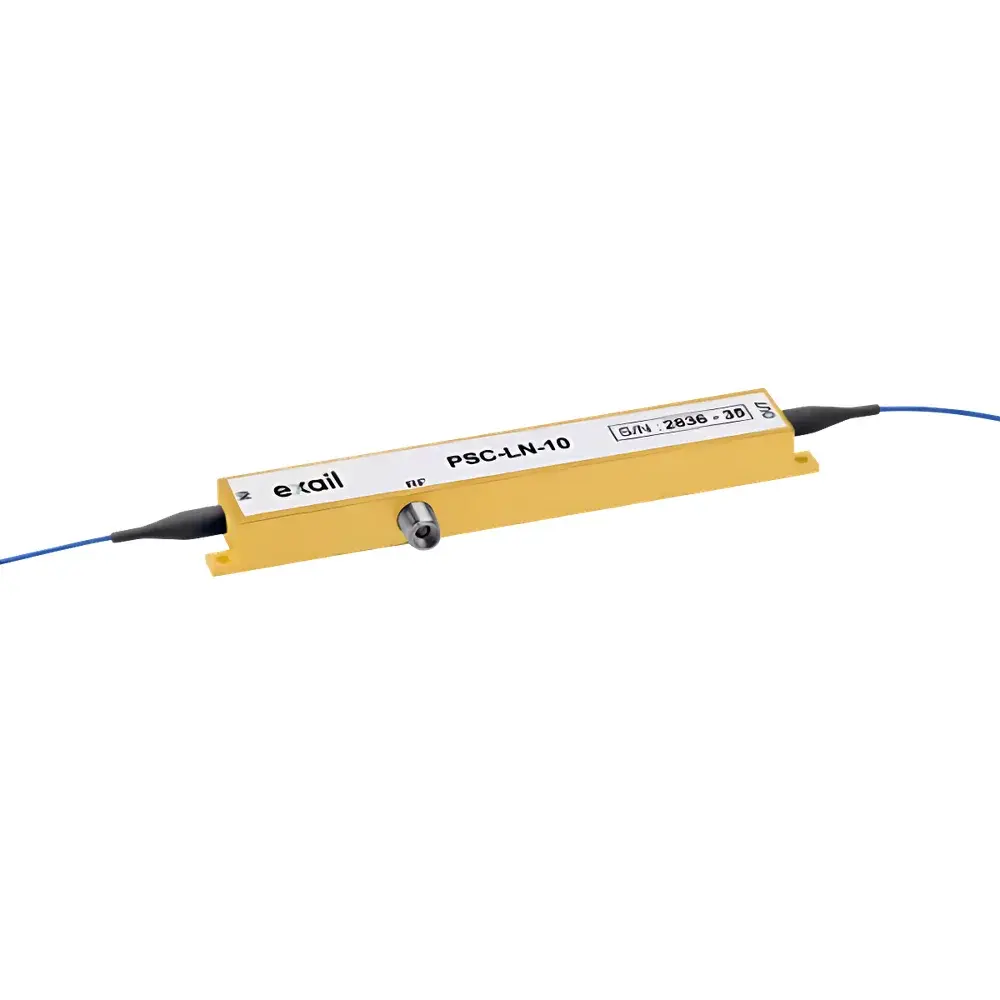
Exail PSW-LN-0.1 High-Speed Lithium Niobate Polarization Switch
| Brand | Exail |
|---|---|
| Origin | France |
| Model | PSW-LN-0.1 |
| Operating Wavelength | 1550 nm (standard), optional 1300 nm |
| Switching Frequency | up to 200 MHz |
| Substrate | Z-cut LiNbO₃ waveguide |
| Input/Output Polarization Alignment | Matched to PM fiber slow/fast axes |
| Insertion Loss | < 2.5 dB |
| Half-wave Voltage (Vπ) | < 4 V RF (typ. at 1550 nm) |
| Differential Group Delay (DGD) | < 0.5 ps |
| RF Input Impedance | 50 Ω |
| Operating Temperature | −5 °C to +70 °C |
| Storage Temperature | −40 °C to +85 °C |
Overview
The Exail PSW-LN-0.1 is a high-speed, integrated electro-optic polarization switch engineered for precision control of the state of polarization (SOP) in single-mode fiber-optic systems. Based on a Z-cut lithium niobate (LiNbO₃) planar lightwave circuit, it operates via the Pockels effect in a dual-mode waveguide architecture oriented at 45° relative to the crystal’s optical axis. Incident linearly polarized light is decomposed into orthogonal transverse electric (TE) and transverse magnetic (TM) modes. Application of a radio-frequency (RF) voltage across dedicated electrodes induces a controllable phase retardation between these modes, enabling deterministic rotation of the output SOP by 0° or 90°—fully aligned with the principal axes of polarization-maintaining (PM) fiber outputs. This enables true binary polarization switching at bandwidths up to 200 MHz, with sub-nanosecond rise/fall times under optimized drive conditions. The device functions equivalently to a voltage-tunable quarter- or half-wave plate, supporting both static polarization alignment and dynamic polarization keying protocols.
Key Features
- Ultra-low insertion loss (< 2.5 dB typical at 1550 nm), minimizing signal degradation in cascaded photonic systems
- Low RF half-wave voltage (Vπ < 4 V at 1550 nm), compatible with standard broadband RF amplifiers and reducing power supply complexity
- Minimal differential group delay (< 0.5 ps), preserving temporal coherence and pulse integrity in ultrafast and coherent applications
- Compact hermetically sealed TO-style package with integrated PM fiber pigtails (slow/fast axis labeled), enabling drop-in integration into OEM modules and test benches
- Stable operation over industrial temperature range (−5 °C to +70 °C), validated per Telcordia GR-468-CORE reliability standards
- RF port impedance matched to 50 Ω, ensuring minimal reflection and optimal power transfer from commercial RF sources
Sample Compatibility & Compliance
The PSW-LN-0.1 is designed for use with standard single-mode PM fiber (e.g., Panda or Bow-tie type) with 1550 nm or 1300 nm operational variants. It complies with IEC 61300-2-4 (fiber optic connector durability), IEC 61300-2-1 (vibration), and IEC 60068-2-30 (damp heat cycling). While not certified as a medical or safety-critical device, its construction adheres to RoHS 2011/65/EU and REACH (EC 1907/2006) material restrictions. For systems requiring regulatory traceability, Exail provides full MDS (Material Declaration Sheet) and RoHS CoC documentation upon request. The device is suitable for integration into platforms subject to GLP-compliant calibration workflows, though end-user validation of SOP switching repeatability and extinction ratio must be performed per internal SOPs aligned with ISO/IEC 17025 metrological practices.
Software & Data Management
The PSW-LN-0.1 is a passive electro-optic component requiring no embedded firmware or digital interface. Control is implemented externally via analog RF signal generation. For automated polarization management, users typically integrate it with programmable RF sources (e.g., Keysight MXG, Rohde & Schwarz SMA100B) and synchronization logic (TTL triggers, PXI timing modules). Exail recommends pairing the switch with its compatible Exail RF amplifiers (e.g., model RFA-20-18-200M) to ensure optimal Vπ linearity and harmonic suppression. Full characterization data—including S-parameter files (S2P), Vπ vs. wavelength curves, and thermal drift coefficients—is supplied in NIST-traceable CSV format with each unit. All performance specifications are verified using calibrated polarization analyzers (e.g., Thorlabs PAX1000) and stabilized tunable lasers (Yenista T100S-HP), with measurement uncertainty budgets documented per ISO/IEC Guide 98-3 (GUM).
Applications
- Polarization-shift keying (PolSK) modulation in high-speed optical communications (100 Gb/s+ coherent links)
- Dynamic polarization scrambling for polarization-dependent loss (PDL) and polarization mode dispersion (PMD) testing
- Fast SOP stabilization loops in interferometric sensors (e.g., fiber optic gyroscopes, distributed acoustic sensing)
- Time-resolved polarimetry in ultrafast spectroscopy setups requiring gated polarization selection
- Reconfigurable optical circuitry in photonic integrated testbeds and quantum optics experiments
- Automated calibration of polarization-sensitive detectors and modulators in production test environments
FAQ
What is the maximum recommended RF drive power to avoid nonlinear distortion or thermal damage?
The absolute maximum RF input power is +23 dBm (200 mW) into 50 Ω. Continuous operation above +20 dBm (>100 mW) requires active thermal management and is not advised for long-term reliability.
Can the PSW-LN-0.1 operate at wavelengths outside 1300 nm and 1550 nm?
No. Device design is optimized for low-loss operation within ±20 nm of the specified center wavelength. Off-band use results in increased Vπ, reduced extinction ratio, and potential modal instability.
Is DC bias required for stable SOP control?
No. The device operates in pure AC-coupled mode; no DC bias voltage is needed or supported. Static SOP alignment is achieved by setting the RF amplitude to zero or Vπ/2 levels.
Does Exail provide calibration certificates with NIST traceability?
Yes. Each unit ships with a factory calibration report including measured insertion loss, extinction ratio, Vπ, and DGD at 25 °C, traceable to NIST via Exail’s ISO/IEC 17025-accredited metrology lab.
What is the typical lifetime under continuous 200 MHz switching at rated RF voltage?
Based on accelerated life testing (MIL-STD-883H Method 1005.10), median operational lifetime exceeds 100,000 hours at 25 °C ambient and ≤ 80% of absolute maximum RF voltage rating.