
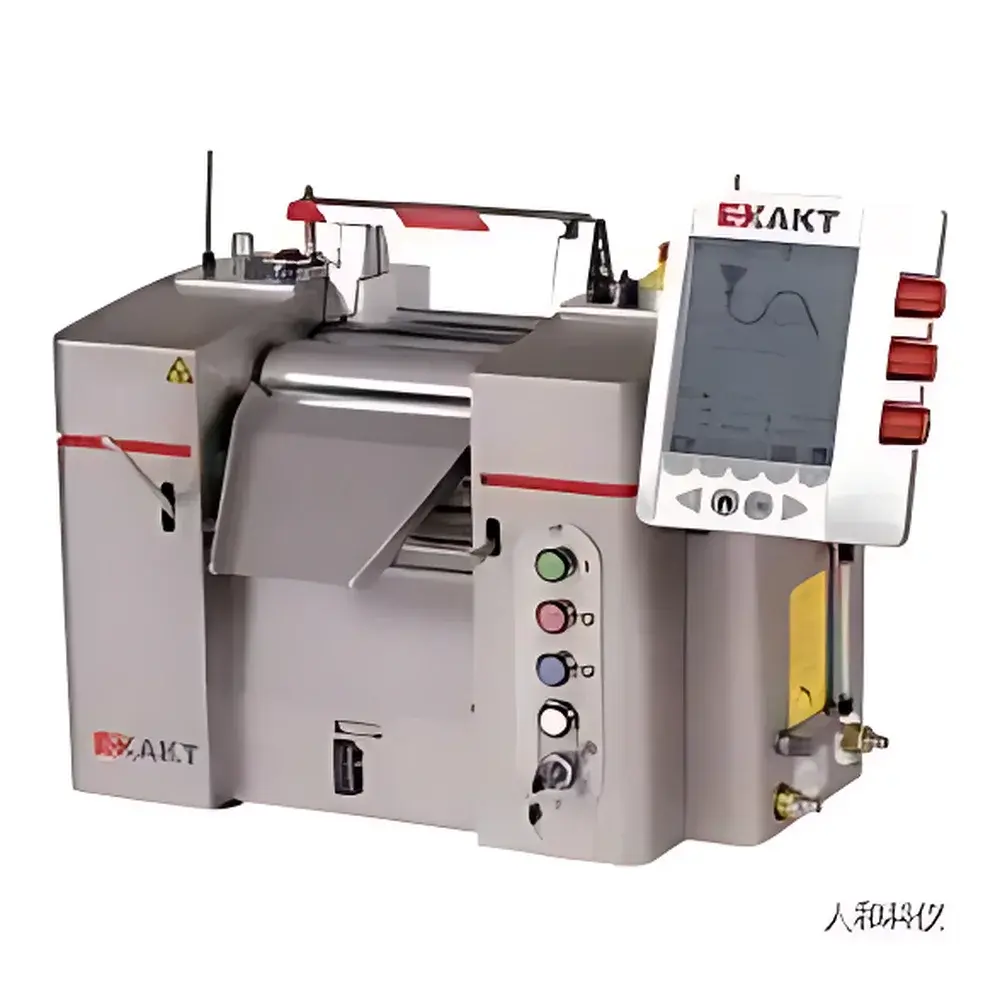
EXAKT 80Eplus Digital Electronic Three-Roll Mill
| Brand | EXAKT |
|---|---|
| Origin | Germany |
| Model | 80Eplus |
| Instrument Type | Three-Roll Mill |
| Sample Compatibility | Soft, paste-like, and viscous materials (e.g., inks, paints, cosmetics, battery slurries) |
| Feed Particle Size | 5–180 µm |
| Final Output Particle Size | ≤1 µm |
| Minimum Achievable Gap | 5 µm |
| Maximum Line Pressure | 26 N/mm (gap-dependent) |
| Throughput at 10 µm Gap | 10 mL–18 L/hr |
| Roller Surface Options | Chrome-plated steel, tungsten carbide, aluminum oxide, or silicon carbide |
| Dimensions (W × D × H) | 591 × 608 × 602 mm |
| Installed Footprint Recommendation (W × D) | 1200 × 700 mm |
| Weight | 112–125 kg |
| Cooling Interface | 10 mm inlet / 13 mm outlet |
| Max Inlet Coolant Temperature | 55 °C |
| Operating Ambient Temperature | 10–30 °C |
| Power Supply Option 1 | 3 × 380–420 V / 50–60 Hz, 1300 W |
| Power Supply Option 2 | 3 × 200–240 V / 50–60 Hz, 1300 W |
| Control Interface | 8.4″ color TFT touchscreen with real-time parameter logging (gap, torque, roller temperature, motor power, time stamp) |
Overview
The EXAKT 80Eplus Digital Electronic Three-Roll Mill is an industrial-grade dispersion and particle size reduction system engineered for precision, repeatability, and process transparency in R&D and pilot-scale production environments. Based on the fundamental principle of shear-induced dispersion—where material is subjected to controlled, high-shear stress between three counter-rotating, precisely aligned rollers—the 80Eplus delivers sub-micron particle deagglomeration and homogenization of soft, high-viscosity pastes and suspensions. Unlike conventional mechanical gap adjustment systems, the 80Eplus integrates a closed-loop digital servo control architecture that dynamically regulates roller position, torque response, and thermal load in real time. This enables consistent, traceable processing conditions across batches—critical for formulation development, QC validation, and regulatory documentation in industries governed by ISO 21501-4, ASTM D3331, or ICH Q5C guidelines.
Key Features
- Digital servo-controlled gap adjustment with resolution down to 1 µm and programmable range from 5 µm to 180 µm—enabling precise correlation between mechanical input and dispersion output.
- Real-time multi-parameter monitoring via an 8.4″ color TFT touchscreen: gap setting, actual roller temperature (via embedded Pt100 sensors), motor torque, power consumption, and elapsed processing time.
- Integrated data logging with USB export capability—supports CSV-formatted records compliant with GLP/GMP audit trail requirements (time-stamped, user-identifiable, non-editable).
- Two operational modes: gap mode (for fixed-shear optimization) and pressure mode (for variable-line-pressure applications up to 26 N/mm, dependent on gap and material rheology).
- Modular roller surface configuration—selectable from chrome-plated steel (standard), tungsten carbide (wear-resistant), aluminum oxide (chemically inert), or silicon carbide (ultra-hard, low thermal expansion)—to match material abrasivity and chemical compatibility.
- Passive cooling interface with standardized 10 mm inlet / 13 mm outlet ports; compatible with external chillers or facility glycol loops to maintain roller surface stability within ±0.5 °C during extended operation.
Sample Compatibility & Compliance
The 80Eplus is validated for processing soft, non-granular, and thermally sensitive dispersions—including aqueous and solvent-based pigment pastes, conductive battery electrode slurries, cosmetic emulsions, pharmaceutical ointments, and ceramic suspensions. Its design excludes impact or attrition mechanisms, eliminating contamination from media wear and preserving particle morphology. The system meets CE machinery directive 2006/42/EC and conforms to EN 60204-1 for electrical safety. Optional IQ/OQ documentation packages are available to support FDA 21 CFR Part 11–compliant validation in regulated manufacturing settings.
Software & Data Management
No proprietary software installation is required. All operational parameters are captured natively by the onboard controller and stored in internal memory with timestamped metadata. Data export is performed directly via USB flash drive in plain-text CSV format—ensuring full compatibility with LIMS, ELN, or statistical process control (SPC) platforms such as JMP or Minitab. Audit trails include operator ID (if configured), session start/stop times, parameter setpoints, deviations (e.g., thermal drift >2 °C), and system fault codes—all retained for ≥12 months without external server dependency.
Applications
- Development and scale-up of lithium-ion battery cathode/anode slurries requiring uniform particle distribution and minimized agglomerate reformation.
- High-gloss ink formulation where pigment deagglomeration below 1 µm directly impacts color strength, gloss retention, and jetting reliability in digital printing.
- Topical pharmaceutical suspensions demanding narrow particle size distribution (PSD) and absence of metallic leachates—supported by chemically inert roller options.
- Quality assurance testing of incoming raw materials (e.g., carbon black, titanium dioxide) under standardized shear history protocols.
- Academic research in colloidal science, where reproducible shear rate profiles (calculated from gap, roller speed, and Newtonian viscosity assumptions) enable direct correlation with rheological and optical characterization data.
FAQ
What is the minimum achievable particle size with the 80Eplus?
Under optimized conditions—including appropriate roller surface selection, coolant temperature control, and feed consistency—final particle size distribution (D90) can be consistently reduced to ≤1 µm, as verified by laser diffraction (ISO 13320) or electron microscopy.
Can the 80Eplus be integrated into an automated production line?
Yes—via optional analog I/O (0–10 V / 4–20 mA) and Modbus RTU over RS-485, enabling synchronization with PLCs for batch sequencing, interlock signaling, and centralized SCADA monitoring.
Is validation support available for GMP environments?
EXAKT provides factory-issued IQ/OQ templates, calibration certificates traceable to DKD/DAkkS standards, and guidance for PQ execution—including test protocols for gap accuracy, temperature uniformity, and throughput repeatability across three consecutive runs.
How does the cleaning mode ensure operator safety?
The cleaning mode automatically retracts rollers to maximum gap, reduces motor speed to <5 rpm, disables torque feedback, and locks emergency stop circuitry until manual confirmation—meeting Category 3 PLd (ISO 13849-1) functional safety requirements.
What maintenance intervals are recommended?
Daily visual inspection of coolant lines and roller surfaces; bi-weekly verification of gap calibration using certified gauge blocks; annual full lubrication and bearing preload check by EXAKT-certified service engineers.



