

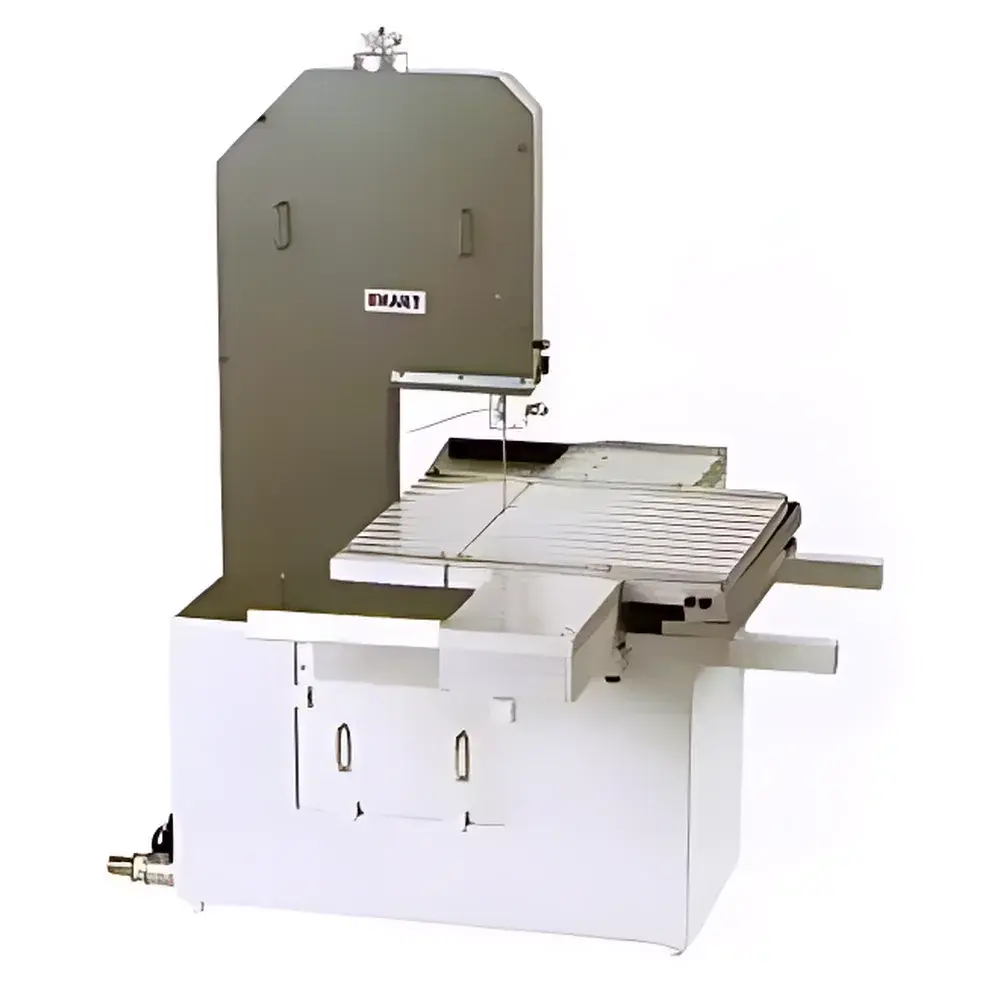
EXAKT E311CL Vertical Diamond Band Saw
| Brand | EXAKT |
|---|---|
| Origin | Germany |
| Model | E311CL |
| Instrument Type | Precision Diamond Band Saw |
| Maximum Cutting Dimensions (L×W×H) | 380 × 175 × 160 mm |
| Minimum Slice Thickness | 0.5–1.0 mm |
| Worktable Size | 400 × 400 mm |
| Max. Sample Size | 380 × 380 × 175 mm |
| Blade Speed | 10–800 m/min |
| Cutting Force Range | 1.0–8.0 N |
| Positioning Accuracy | ±0.02 mm |
| Flatness Tolerance (Load-Induced Deflection) | ±0.05 mm |
| Diamond Band Thickness | 0.3 mm |
| Cooling | Recirculating Water System |
| Dimensions (W×D×H) | 1000 × 1350 × 850 mm |
| Weight | 150 kg |
| Power Supply | 220 V, 50/60 Hz |
| Optional Accessories | Point-Contact (CP) Cutting Module, T-Slot Worktable, Mechanical Sample Clamping Fixtures |
Overview
The EXAKT E311CL Vertical Diamond Band Saw is a high-precision sample preparation instrument engineered for controlled, low-damage sectioning of hard and brittle materials—including ceramics, composites, geological specimens, sintered metals, dental prosthetics, and advanced biomaterials. Designed and manufactured in Germany, the E311CL employs a vertically oriented diamond-impregnated band blade to deliver orthogonal, planar cuts with minimal kerf loss and thermal distortion. Its core operating principle relies on continuous, tension-regulated band motion combined with programmable feed control and real-time force feedback—enabling reproducible slicing across heterogeneous microstructures without delamination or edge chipping. Unlike abrasive wheel cutters or wire saws, the diamond band geometry ensures uniform stress distribution along the cutting interface, making it particularly suitable for preparing thin sections (<1 mm) for subsequent SEM, TEM, or micro-CT analysis where dimensional fidelity and surface integrity are critical.
Key Features
- Vertical configuration optimized for operator ergonomics and consistent gravity-assisted chip removal.
- Precision-ground T-slot worktable (400 × 400 mm) with modular clamping system for rigid, vibration-damped sample fixation.
- Adjustable blade speed (10–800 m/min) and programmable cutting force (1.0–8.0 N) to match material hardness and desired surface finish.
- High-resolution linear encoders and servo-controlled Z-axis feed ensure positioning repeatability within ±0.02 mm and load-induced deflection ≤ ±0.05 mm.
- Integrated recirculating water cooling circuit with temperature monitoring and flow regulation to suppress localized heating and extend diamond band life.
- Optional Point-Contact (CP) cutting module for ultra-thin sectioning (down to 0.5 mm) with minimized lateral stress on fragile samples.
- Robust cast-iron frame with vibration-damping base, contributing to long-term mechanical stability under continuous laboratory use.
Sample Compatibility & Compliance
The E311CL accommodates samples up to 380 × 380 × 175 mm (L × W × H), with maximum vertical cutting height of 160 mm and width of 175 mm. It is routinely deployed in ISO 17025-accredited laboratories for sample preparation prior to ASTM C1327 (Vickers hardness testing), ISO 6474 (dental ceramic strength evaluation), and ASTM E3 (metallographic specimen preparation). The system supports GLP-compliant workflows through traceable parameter logging (speed, force, time, coolant flow) and optional audit-trail-enabled firmware upgrades. All wet-cutting operations comply with OSHA 1910.1050 (hazardous dust control) when used with appropriate local exhaust ventilation and PPE protocols.
Software & Data Management
While the E311CL operates via intuitive front-panel controls, optional PC-based software (EXAKT CutControl v3.x) enables full parameter scripting, batch job queuing, and digital log export in CSV or XML format. Each cutting session records timestamped metadata—including blade revolutions, cumulative cutting distance, thermal profile, and force deviation alerts—for integration into LIMS or electronic lab notebooks (ELN). The software architecture adheres to FDA 21 CFR Part 11 requirements when configured with user authentication, electronic signatures, and immutable audit trails—making it suitable for regulated environments in medical device R&D and pharmaceutical excipient characterization.
Applications
- Preparation of cross-sectional slices from lithium-ion battery electrodes for porosity and coating thickness analysis.
- Sectioning of fiber-reinforced polymer composites for interfacial adhesion assessment via micro-CT segmentation.
- Trimming of sintered zirconia dental crowns to standardized dimensions prior to biaxial flexure testing (ISO 6872).
- Production of wafer-like specimens from geological core samples for petrographic thin-section mounting.
- Controlled decapsulation of encapsulated MEMS devices for failure analysis without substrate cracking.
- Routine metallographic sectioning of heat-treated alloys where carbide segregation must be preserved during cut-in.
FAQ
What types of diamond bands are compatible with the E311CL?
The system uses proprietary EXAKT diamond-impregnated band blades with 0.3 mm thickness and configurable grit sizes (ranging from 45 µm to 125 µm), all designed for optimal wear resistance and cut quality on non-ferrous and ceramic substrates.
Is the E311CL suitable for cutting silicon wafers?
Yes—when equipped with fine-grit (45–60 µm) diamond bands and CP module, it achieves sub-micron flatness on <100> and <111> oriented silicon wafers, provided coolant flow and feed rate are optimized per ASTM F1591.
Can the machine be integrated into an automated sample prep line?
Via RS-232 or Ethernet interface (optional), the E311CL supports external PLC triggering and status reporting, enabling synchronization with robotic sample loaders and downstream polishing stations.
What maintenance intervals are recommended for routine operation?
Blade tension calibration every 200 hours; coolant filter replacement every 500 hours; linear guide lubrication every 1,000 hours; annual metrological verification of Z-axis encoder accuracy per ISO 230-2.
Does EXAKT provide application-specific validation documentation?
Yes—application notes, IQ/OQ protocols, and material-specific SOPs (e.g., for Ni-based superalloys or hydroxyapatite scaffolds) are available upon request for GMP-aligned installations.



