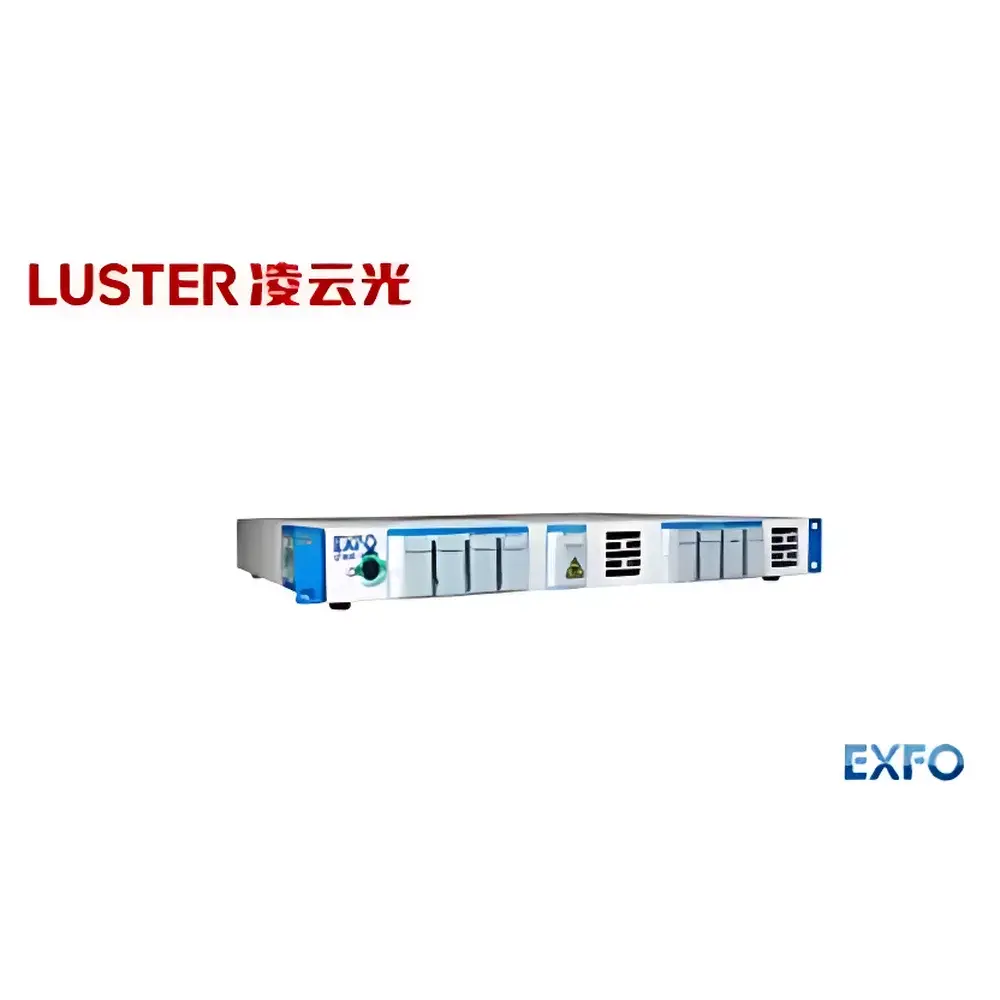
EXFO CT440 Passive Optical Component Analyzer
| Brand | EXFO |
|---|---|
| Origin | Canada |
| Model | CT440 |
| Wavelength Range | 1240–1680 nm (SMF) |
| Wavelength Resolution | 1–250 pm |
| Wavelength Accuracy | ±5 pm |
| Dynamic Range | 65 dB (single sweep) |
| Polarization-Dependent Loss (PDL) Measurement | Optional (CT440-PDL) |
| Polarization-Maintaining (PM) Capability | Optional (CT440-PM) |
| Detector Channels | 4 integrated photodetectors |
| Tunable Laser Source (TLS) Support | Up to 4 synchronized EXFO T100S-HP series lasers |
| Rack Mount | 1U (19-inch standard) |
| Software Interface | GUI + DLL-based remote control |
| Compliance | Designed for GLP/GMP-aligned optical test environments, compatible with ASTM F2714 and IEC 61300-3-29 for passive component characterization |
Overview
The EXFO CT440 Passive Optical Component Analyzer is an engineered solution for high-precision spectral characterization of passive optical devices used in modern fiber-optic networks. Operating on the principle of tunable laser source (TLS)-based swept-wavelength interferometry, the CT440 delivers calibrated insertion loss (IL), polarization-dependent loss (PDL), and wavelength-dependent transmission profiles across the full telecommunications spectrum—from 1240 nm to 1680 nm. Its architecture integrates four synchronized photodetectors with real-time power normalization via an internal reference photodiode, enabling accurate IL measurements independent of TLS output power drift. Unlike conventional optical spectrum analyzers or basic power-meter-based setups, the CT440 employs coherent detection principles—particularly in its heterodyne mode—to resolve multi-wavelength interference patterns, supporting advanced applications such as multi-channel wavelength metering and cavity-length metrology. Designed for R&D labs, wafer-level testing facilities, and module qualification lines, the CT440 meets the stringent repeatability and traceability requirements of optical component manufacturing under ISO/IEC 17025 and Telcordia GR-1221-CORE guidelines.
Key Features
- Full-band spectral coverage (1240–1680 nm) with single-instrument continuity—no external switching required when cascading up to four EXFO T100S-HP-series TLS units
- ±5 pm absolute wavelength accuracy maintained across all scan speeds, validated post-wavelength referencing using certified gas absorption cells or stabilized HeNe benchmarks
- Simultaneous four-channel detection enables parallel measurement of multi-port devices (e.g., 1×N splitters, WSS modules, ROADM subassemblies)
- Configurable sampling resolution from 1 pm to 250 pm—optimized for both narrowband filter profiling and broadband attenuation mapping
- Integrated real-time power normalization eliminates dependence on TLS stability; IL accuracy remains ±0.5 dB over –30 dBm to –60 dBm input range
- Compact 1U rack-mount form factor (19-inch standard) supports high-density lab deployment and automated test cell integration
- Heterodyne detection capability (with ≥2 TLS inputs) allows conversion into a multi-wavelength interferometric wavemeter for SUT coherence length analysis
Sample Compatibility & Compliance
The CT440 supports characterization of industry-standard passive optical components including thin-film filters (TFF), arrayed waveguide gratings (AWG), fused-fiber couplers, planar lightwave circuit (PLC) splitters, wavelength-selective switches (WSS), reconfigurable optical add-drop multiplexers (ROADM), and optical isolators. Optional PM and PDL configurations extend compatibility to polarization-sensitive devices such as Mach-Zehnder modulators (MZM), lithium niobate-based switches, and polarization-maintaining fiber pigtails. All variants comply with IEC 61300-3-29 (insertion loss measurement), IEC 61300-3-31 (PDL measurement), and ASTM F2714 (optical component spectral characterization). The system’s firmware and control software support audit trails and electronic signatures per FDA 21 CFR Part 11 when deployed in regulated GMP environments.
Software & Data Management
The CT440 is operated via EXFO’s proprietary LightCommander™ software—a Windows-based GUI offering intuitive TLS orchestration, scan parameter definition (start/stop wavelength, resolution, averaging), real-time waveform visualization, and automated pass/fail filtering analysis. Built-in analytical tools include peak search, bandwidth calculation (3 dB, 20 dB), ripple estimation, and group delay derivation via Hilbert transform. For integration into automated test systems, the instrument exposes a comprehensive DLL API with C#, Python, and LabVIEW example code—enabling direct linkage to MES platforms, statistical process control (SPC) dashboards, or custom calibration workflows. All measurement data are stored in vendor-neutral HDF5 format with embedded metadata (wavelength calibration timestamp, TLS serial number, environmental sensor logs), ensuring long-term traceability and third-party tool interoperability.
Applications
- Wafer-level testing of photonic integrated circuits (PICs) requiring sub-picometer spectral resolution and polarization-resolved response
- Final qualification of DWDM multiplexers/demultiplexers against ITU-T G.694.1 channel spacing specifications
- PDL validation of polarization-diverse components in coherent transceivers and quantum photonics modules
- Characterization of ultra-narrowband optical filters used in LIDAR and sensing applications
- Calibration and verification of tunable laser sources using heterodyne beat-note analysis
- Research-grade spectral metrology in university photonics labs and national metrology institutes
FAQ
What wavelength calibration standards does the CT440 support?
The CT440 accepts external wavelength references including acetylene (C₂H₂) and hydrogen cyanide (HCN) gas absorption cells, as well as fiber-coupled HeNe lasers traceable to NIST or PTB primary standards.
Can the CT440 measure group delay without additional hardware?
Yes—the built-in phase retrieval algorithm computes group delay from complex transmission spectra acquired in heterodyne mode, provided the TLS offers sufficient coherence length and phase stability.
Is the CT440 compatible with non-EXFO tunable lasers?
While optimized for EXFO T100S-HP series lasers, the CT440 accepts third-party TLS units via analog/digital synchronization triggers and GPIB/LAN interfaces—subject to wavelength reporting accuracy and scan linearity validation.
How is measurement uncertainty quantified for PDL measurements?
PDL uncertainty follows IEC 61300-3-31 Annex B: it is derived from six-state Mueller matrix acquisition, detector linearity, and polarization state generator repeatability—typically < ±0.05 dB for devices with PDL > 0.2 dB.
Does the 1U rack-mount version sacrifice thermal or mechanical stability?
No—the CT440 1U variant uses thermally isolated optical benches, passive heat-sink design, and vibration-damped mounting to maintain ±5 pm wavelength stability over 8-hour continuous operation at 23 ±2 °C.