
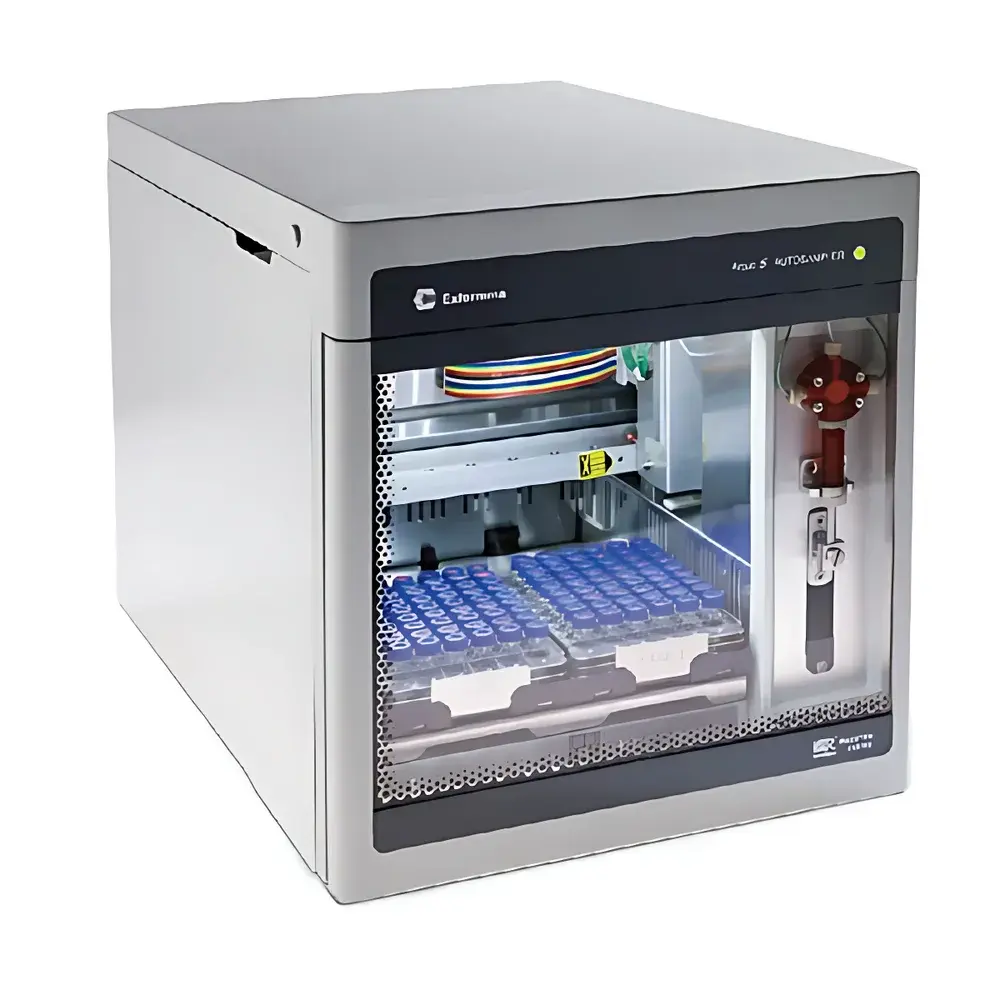
EXFORMMA ARCUS 5 Multifunctional Liquid Chromatography Autosampler
| Brand | EXFORMMA |
|---|---|
| Origin | Hong Kong |
| Manufacturer Type | Authorized Distributor |
| Product Category | Domestic (PRC-manufactured) |
| Model | ARCUS 5 |
| Instrument Type | HPLC/UHPLC Autosampler |
| Sample Capacity | Up to 108 × 2 mL vials (configurable with 10 mL, 4 mL, or 96-well PCR plates) |
| Max Operating Pressure | 40 MPa |
| Injection Volume Range | 0.1–1000 µL (standard configuration: 0.1–120 µL) |
| Syringe Volume | 200 µL (resolution: 0.1 µL) |
| Sampling Modes | Full-loop, Partial-loop, and Needle-into-loop (NIL) / Zero-dead-volume sampling |
| Vial Height Limit | ≤52 mm (including septum and cap) |
| Pump Lifetime | ≥1,000,000 injections |
| Compliance | Designed for GLP/GMP environments |
Overview
The EXFORMMA ARCUS 5 Multifunctional Liquid Chromatography Autosampler is an engineered solution for high-throughput, high-reproducibility sample introduction in HPLC and UHPLC workflows. Built upon a precision fluidic architecture, it employs a wear-resistant ceramic-plunger syringe pump to deliver accurate, low-variability injections across the full 0.1–1000 µL range—enabling both trace-level quantitation and preparative-scale analysis without hardware reconfiguration. Its modular tray system accommodates diverse container formats—including standard 2 mL vials (up to 108 positions), 10 mL and 4 mL wide-mouth vials, and dual 96-well PCR plates—while maintaining consistent thermal stability and positional accuracy under pressures up to 40 MPa. The ARCUS 5 operates as a standalone unit or integrates seamlessly with major third-party chromatography platforms (e.g., Agilent 1260/1290, Waters ACQUITY/UPLC, Shimadzu Nexera, Thermo Vanquish) via industry-standard RS-232, USB, or TTL I/O protocols.
Key Features
- High-durability 200 µL syringe pump with sub-microliter resolution (0.1 µL) and ≥1,000,000 injection lifetime—eliminating routine plunger seal replacement.
- Triple-sensor fault detection system: real-time monitoring of needle position, pressure transients, and flow continuity to prevent mis-puncturing, capillary occlusion, and solvent leakage.
- Three selectable sampling modes—full-loop, partial-loop, and zero-dead-volume needle-in-loop (NIL)—minimizing carryover (<0.005%) and enabling true sample conservation.
- Intelligent tray recognition: automatic detection of installed tray type (2 mL, 4 mL, 10 mL, or 96-well plate) and geometry, with dynamic coordinate mapping for positional repeatability < ±0.1 mm.
- Optimized injection cycle time: <12 s for 10 µL injection (including wash, load, and inject) at ambient temperature; further reduced under column oven-synchronized operation.
- Robust mechanical design compliant with ISO 13485-aligned manufacturing practices; all wetted surfaces constructed from chemically inert PEEK, sapphire, and stainless steel 316L.
Sample Compatibility & Compliance
The ARCUS 5 accepts vials with heights up to 52 mm—including crimp-top, screw-cap, and snap-cap configurations with standard silicone/PTFE septa. Its universal mounting interface supports integration into regulated laboratories requiring documentation integrity: the embedded firmware logs all critical events (e.g., injection sequence, error flags, maintenance alerts) with timestamps and operator IDs. When paired with validated CDS software (e.g., OpenLab CDS, Empower, Chromeleon), the system meets audit trail, electronic signature, and data retention requirements stipulated in FDA 21 CFR Part 11, EU Annex 11, and ICH GCP guidelines. It is routinely deployed in QC/QA labs performing method validation per USP <621>, ASTM D7097, and ISO 17025-accredited testing.
Software & Data Management
The ARCUS 5 is controlled exclusively via its native Windows-based ARCUS Control Suite—a lightweight, installer-free application supporting method-driven scheduling, multi-step dilution/mixing sequences, and conditional logic (e.g., “inject only if peak area > X”). All acquisition parameters—including dwell time, wash solvent selection, rinse cycles, and post-injection needle park position—are programmable and exportable as XML templates for cross-platform method transfer. Raw event logs are stored in SQLite format with SHA-256 hash verification; optional integration with LIMS via HL7 or CSV batch export enables automated sample tracking and result reconciliation.
Applications
- Routine pharmaceutical assay and dissolution testing requiring strict compliance with USP <621> and ICH Q2(R2) linearity/precision criteria.
- Environmental analysis of priority pollutants (e.g., PAHs, PCBs, pesticides) where low-fg-level reproducibility and matrix-compatible dilution protocols are essential.
- Biopharmaceutical characterization—including mAb aggregation profiling and peptide mapping—leveraging NIL-mode injection to preserve labile analytes.
- Food safety screening (e.g., mycotoxins, veterinary drug residues) using multi-component gradient methods with automated internal standard spiking.
- Academic and contract research laboratories performing method development with variable injection volumes, complex sample preparation trees, and long unattended runs (>72 h).
FAQ
Does the ARCUS 5 support cold storage for thermally labile samples?
No—ambient-temperature operation only. For refrigerated sample handling, external cooled trays or integration with a separate temperature-controlled rack is required.
Can the ARCUS 5 perform online derivatization prior to injection?
Not natively. However, its TTL-triggered auxiliary port supports synchronization with external reactors or mixing tees when configured in external-loop mode.
Is firmware upgrade capability available over-the-air?
Firmware updates require local installation via USB drive and must be performed by authorized service personnel to maintain calibration traceability.
What validation documentation is provided with the instrument?
Each unit ships with Factory Acceptance Test (FAT) report, Certificate of Conformance, and IQ/OQ protocol templates aligned with ASTM E2500 and EU GMP Annex 15.
How is carryover verified during operational qualification?
Carryover assessment follows USP <621> Procedure B: three consecutive injections of a high-concentration standard followed by three blank injections, with acceptance criterion ≤0.05% of initial response.






