
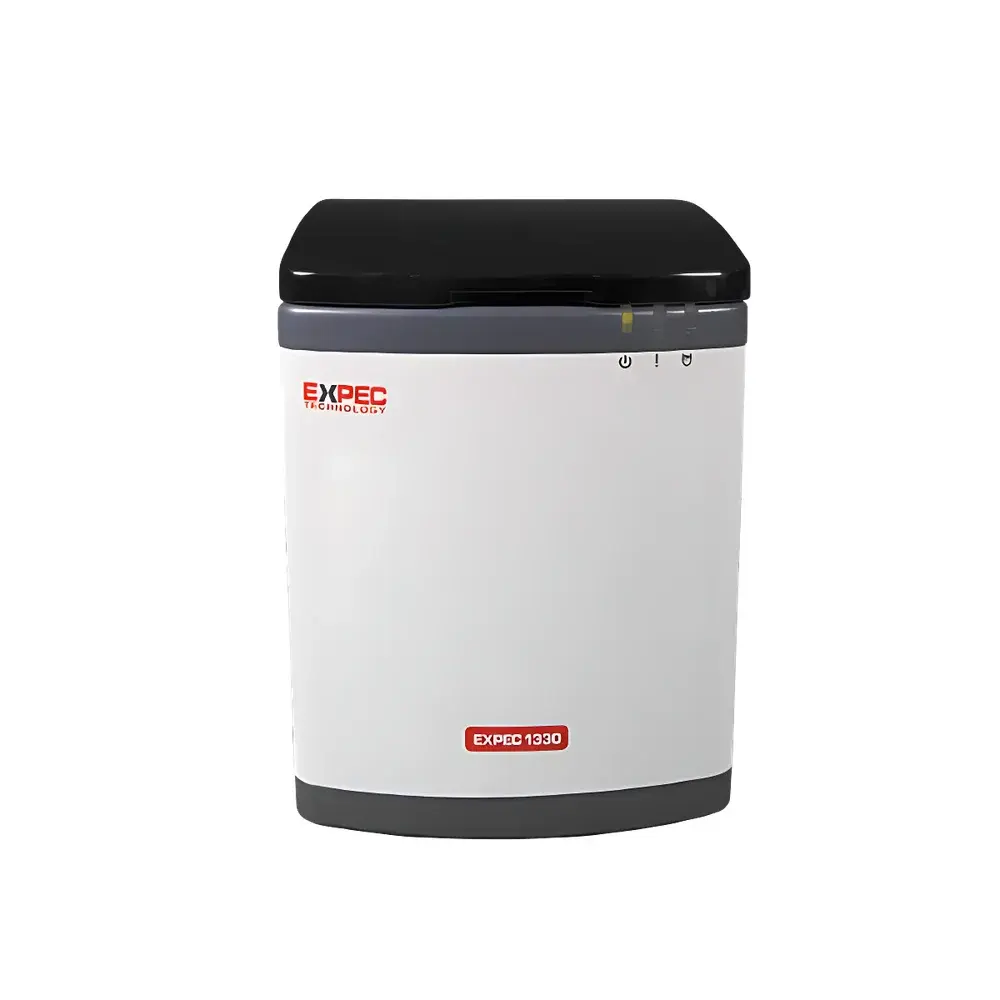
EXPEC 1330 Portable Near-Infrared Spectrometer
| Brand | EXPEC |
|---|---|
| Origin | Zhejiang, China |
| Manufacturer Type | Authorized Distributor |
| Product Category | Domestic |
| Model | EXPEC 1330 |
| Instrument Type | Portable |
| Detection Principle | Grating-scanning NIR spectroscopy with InGaAs detector |
| Measurement Time | ≤3 s per sample |
| Sample Forms | Granular, flake, and powdered materials |
| Connectivity | Wi-Fi, USB, Bluetooth (optional) |
| Power Supply | AC adapter or optional rechargeable Li-ion battery |
| Compliance | Supports ASTM E1655, ISO 12099, and GB/T 37878–2019 for NIR calibration transfer and performance validation |
Overview
The EXPEC 1330 Portable Near-Infrared Spectrometer is an engineered field-deployable analytical instrument designed for rapid, non-destructive quantification of key compositional parameters in agricultural and industrial bulk materials. Based on grating-scanning near-infrared spectroscopy (780–2500 nm), the system employs a thermoelectrically cooled indium gallium arsenide (InGaAs) linear array detector to deliver high signal-to-noise ratio (SNR) spectral acquisition under variable ambient conditions. Unlike dispersive or FT-NIR systems, the EXPEC 1330 utilizes a precision optical bench with motorized diffraction grating and synchronized slit scanning—enabling reproducible wavelength registration and robust spectral fidelity across repeated measurements. Its compact, shock-resistant chassis meets IP54 environmental rating standards, making it suitable for operation in grain elevators, oilseed processing lines, feed mills, and field laboratories where vibration, dust, and temperature fluctuation are common.
Key Features
- Non-contact, non-destructive analysis: No sample grinding, drying, or chemical reagents required—preserves sample integrity for downstream testing or archival.
- Rotating sample stage: Motorized 360° turntable ensures homogeneous illumination and mitigates heterogeneity bias in granular or particulate samples (e.g., soybeans, rapeseed, corn kernels).
- Onboard diagnostic suite: Real-time optical path monitoring, dark-current compensation, and built-in NIST-traceable reference standards enable daily performance verification without external calibration kits.
- Multi-instrument model portability: Implements standardized PLS regression coefficient transfer protocols compliant with ASTM E1655 Annex A4, allowing quantitative models developed on one EXPEC 1330 to be deployed across a fleet with <±0.15% RMSEP deviation for moisture and oil content.
- Modular power architecture: Operates via 100–240 VAC input or optional 14.4 V/8.8 Ah rechargeable lithium-ion battery pack (rated for ≥6 hours continuous use at 25°C).
- Embedded spectral preprocessing engine: Includes Savitzky-Golay smoothing, multiplicative scatter correction (MSC), and first-derivative transformation—applied in real time prior to PLS prediction.
Sample Compatibility & Compliance
The EXPEC 1330 accommodates solid-phase samples in natural or minimally processed forms—including whole grains, cracked seeds, pelleted feed, crushed oilseeds, and milled flour—without requiring particle size reduction beyond standard industry practice (<2 mm nominal diameter). It complies with methodological requirements outlined in ISO 12099:2017 (Animal feeding stuffs — General guidelines for the determination of constituents by near-infrared spectrometry) and supports validation workflows aligned with AOAC Official Method 2011.03 for NIR-based moisture and protein analysis in cereals. Instrument firmware includes audit trail logging (user ID, timestamp, spectral acquisition parameters, model version) to support GLP-compliant environments. Data export formats include CSV, JCAMP-DX, and XML, enabling traceability within LIMS-integrated quality management systems.
Software & Data Management
The instrument ships with EXPEC NIR Manager v3.x—a Windows-based desktop application supporting full spectral acquisition, chemometric model development (using integrated Unscrambler®-compatible PLS algorithms), and remote device configuration. Cloud-enabled firmware updates and model library synchronization are facilitated through secure HTTPS endpoints, with TLS 1.2 encryption and role-based access control (RBAC) for multi-user deployments. All raw interferograms and processed spectra are stored with embedded metadata (instrument ID, operator, GPS coordinates if enabled, ambient humidity/temperature from onboard sensors). Software-generated reports conform to FDA 21 CFR Part 11 requirements when configured with digital signature modules and electronic record retention policies.
Applications
- Grain & Oilseed Procurement: Real-time moisture, oil, protein, and fatty acid profile (e.g., oleic acid % in sunflower or high-oleic soy) assessment at intake points to enforce contractual specifications.
- Feed Manufacturing: In-line verification of formulation consistency across batching cycles; detection of adulteration (e.g., urea in soybean meal) via spectral residual analysis.
- Oil Refining: Monitoring free fatty acid (FFA) and peroxide value trends during degumming and deodorization using secondary correlation models trained on reference titration data.
- Plant Breeding Programs: High-throughput phenotyping of seed composition traits across thousands of breeding lines—integrated with pedigree and genomic data in breeding management platforms.
- Storage Quality Monitoring: Longitudinal tracking of starch gelatinization index and mycotoxin surrogate markers (e.g., ergosterol-related bands) in silo-stored wheat and barley.
FAQ
Does the EXPEC 1330 require annual factory recalibration?
No—its internal reference standard and self-diagnostic routines enable user-performed performance qualification (PQ) according to ISO/IEC 17025 clause 6.5.2. Factory recalibration is recommended only after physical impact or optical component replacement.
Can existing laboratory NIR models be transferred to the EXPEC 1330?
Yes, provided the source instrument uses grating-scanning optics and reports spectra in absorbance mode (log10(1/R)). Model adaptation requires spectral resampling to the EXPEC 1330’s native 2 nm resolution grid and application of slope/offset correction via standardization samples.
Is spectral data export compatible with third-party chemometrics software?
Yes—raw and preprocessed spectra are exportable in JCAMP-DX v5.01 format, fully readable by Pirouette, GRAMS/AI, and MATLAB-based PLS toolboxes.
What environmental conditions limit operational use?
Operating range: 5–40°C ambient temperature, 20–80% RH non-condensing. Extended exposure above 40°C may trigger thermal drift compensation; below 5°C requires 15-minute warm-up before measurement.
How is measurement repeatability verified onsite?
Using the included certified polystyrene and polyethylene reference disks, users perform daily repeatability checks per ASTM D7420—reporting standard deviation of water peak area (1940 nm) over ten consecutive scans.





