
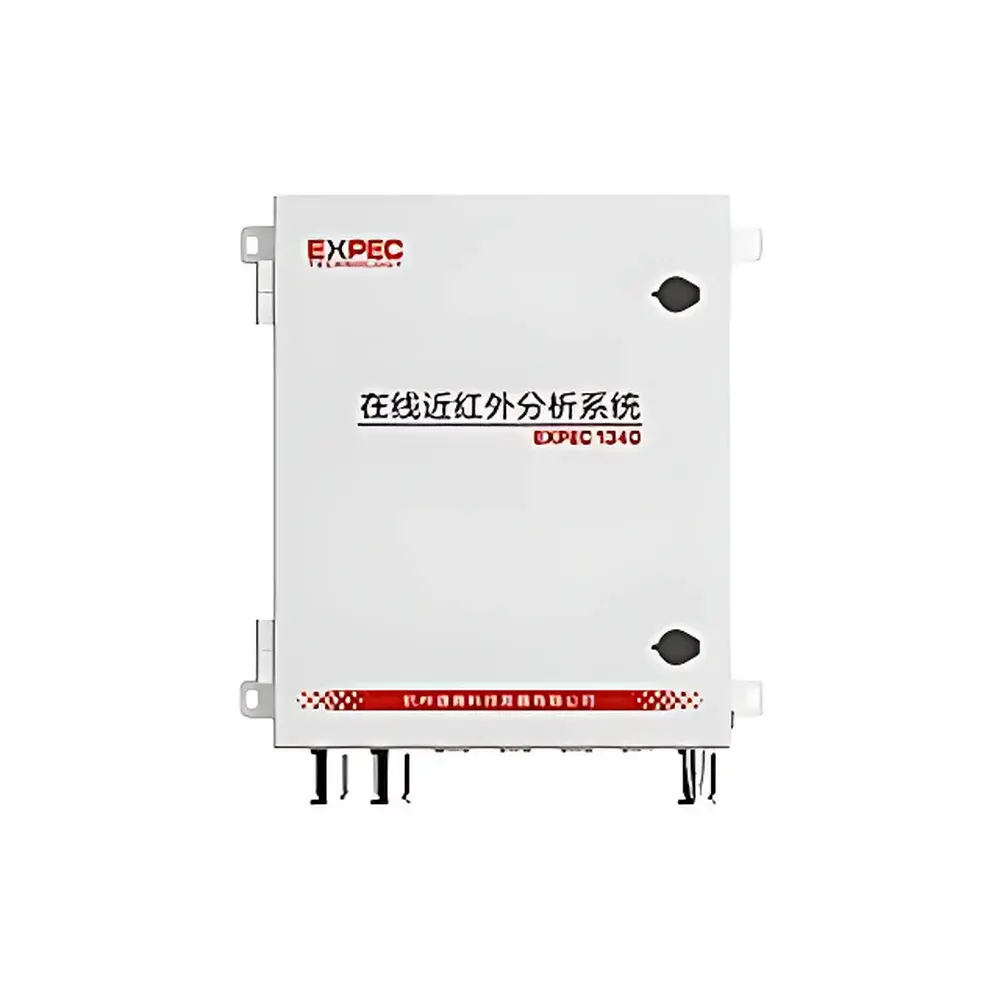
EXPEC 1340 Online Near-Infrared Spectrometer
| Brand | EXPEC (Puyu Technology) |
|---|---|
| Origin | Zhejiang, China |
| Model | EXPEC 1340 |
| Instrument Type | Online NIR Spectrometer |
| Optical Design | Grating Scanning |
| Application Domain | Feed Production, Grain & Oil Processing, Brewing Industry |
| Measurement Principle | Diffuse Reflectance / Transmission NIR Spectroscopy |
| Sampling Interface | Customizable Process Probe |
| Connectivity | Ethernet, Fiber Optic, 4–20 mA Analog Output |
| Enclosure Rating | IP65 |
| Data Acquisition Rate | 5 Hz |
| Alarm Logic | Dual-level (Primary/Secondary) Thresholding |
| Software Integration | C# DLL for Custom SCADA/MES Integration |
| Built-in Reference Standard | Yes |
| Self-Diagnostic & Auto-Calibration | Yes |
| Compliance Context | Designed for GLP-aligned process analytical technology (PAT) deployment |
Overview
The EXPEC 1340 Online Near-Infrared Spectrometer is an industrial-grade process analytical instrument engineered for real-time, non-destructive compositional monitoring in continuous manufacturing environments. It operates on the principle of near-infrared spectroscopy (NIR), specifically utilizing diffuse reflectance and/or transmission measurement modes depending on probe configuration and sample matrix. The system employs a grating-based scanning optical architecture to acquire spectral data across the relevant NIR region—typically spanning 900–2500 nm—enabling quantitative determination of key chemical and physical parameters such as moisture, protein, fat, starch, and fiber content. Unlike laboratory-based benchtop spectrometers, the EXPEC 1340 is purpose-built for integration into production control loops, delivering high-frequency spectral acquisition (up to 5 spectra per second) with minimal latency. Its design adheres to the core tenets of Process Analytical Technology (PAT) as defined by FDA Guidance for Industry (2004), supporting Quality-by-Design (QbD) frameworks through continuous data generation and actionable feedback to distributed control systems (DCS) or programmable logic controllers (PLC).
Key Features
- Real-time spectral acquisition at 5 Hz, enabling rapid detection of process drift or material inconsistency
- Modular, split-system architecture: optically sensitive spectrometer unit housed remotely from the process-integrated probe—enhancing thermal stability, reducing mechanical stress, and simplifying maintenance access
- Custom-engineered process probes compatible with diverse pipeline geometries, pressure ratings, and sanitary requirements (e.g., tri-clamp, flanged, or immersion configurations)
- Robust industrial enclosure rated IP65, suitable for dusty, humid, or temperature-variable plant-floor environments
- Analog output interface (4–20 mA) for direct integration with legacy DCS/SCADA platforms without protocol translation
- Dual-channel alarm logic supporting independent upper/lower thresholds for primary (critical) and secondary (warning) process limits
- Onboard self-diagnostic routines and automated calibration verification using integrated reference standards—reducing manual intervention and ensuring long-term measurement traceability
- Software development toolkit provided as a C#-compatible dynamic-link library (DLL), facilitating native integration with custom MES, LIMS, or dashboard applications
Sample Compatibility & Compliance
The EXPEC 1340 is validated for use with heterogeneous, flowing particulate and semi-solid matrices common in feed milling, grain drying, malt handling, and distillery mash lines. Its probe-based sampling eliminates the need for offline sample preparation, preserving representative material state (e.g., particle size distribution, bulk density, surface moisture). While not certified to ISO/IEC 17025 for accredited testing, the instrument supports compliance with Good Manufacturing Practice (GMP) and Good Laboratory Practice (GLP) documentation workflows via configurable audit trails, user-access controls, and electronic record retention when deployed with compatible host software. Its analog and digital I/O interfaces align with ISA-88 and ISA-95 automation standards for batch and continuous process integration.
Software & Data Management
The EXPEC 1340 does not include a proprietary full-featured GUI but delivers raw and pre-processed spectral data streams via TCP/IP or Modbus TCP. End users implement chemometric modeling externally using industry-standard tools (e.g., Unscrambler®, Pirouette, or Python-based scikit-learn workflows). The included C# DLL provides low-level access to spectral buffers, alarm status registers, diagnostic flags, and calibration metadata—enabling deterministic synchronization with time-stamped process variables. All data exports comply with ASTM E1382-22 (Standard Guide for Use of Near-Infrared Spectroscopy in Process Control) for spectral data formatting and metadata tagging.
Applications
- Feed compound production: Real-time monitoring of crude protein, lysine, and moisture in pelleted or crumbled feed streams
- Grain receiving and drying: In-line quantification of kernel moisture and protein during elevator intake and dryer discharge
- Brewing malt house operations: Tracking diastatic power proxies and extract potential during kilning and storage
- Distillery grain mashing: Feedback control of enzymatic hydrolysis efficiency via soluble sugar and dextrin profiles
- Oilseed crushing lines: Estimation of residual oil content and meal protein concentration post-expeller
FAQ
Does the EXPEC 1340 support multivariate calibration transfer between instruments?
Yes—calibration models developed on one unit can be ported to another via standardized spectral preprocessing and PLS regression coefficient files, provided probe geometry and optical path length are matched.
Is the system compliant with FDA 21 CFR Part 11 for electronic records?
The hardware itself is Part 11–neutral; compliance depends on the host application managing user authentication, audit trails, and electronic signatures—functions enabled via the provided DLL interface.
Can the probe operate under pressurized or vacuum conditions?
Probe housings are customizable to meet ASME B31.3 piping codes and can be rated for pressures up to 10 bar(g) or vacuum service upon engineering review.
What maintenance intervals are recommended for optical components?
Under typical industrial conditions, the spectrometer’s internal optics require no routine cleaning; probe windows should be inspected and cleaned per site-specific contamination risk assessment—typically every 2–6 months.
Is fiber optic cable length limited?
Standard multimode fiber delivery supports up to 100 meters; longer distances require single-mode fiber and signal amplification, subject to spectral resolution trade-offs.
Related Products






