
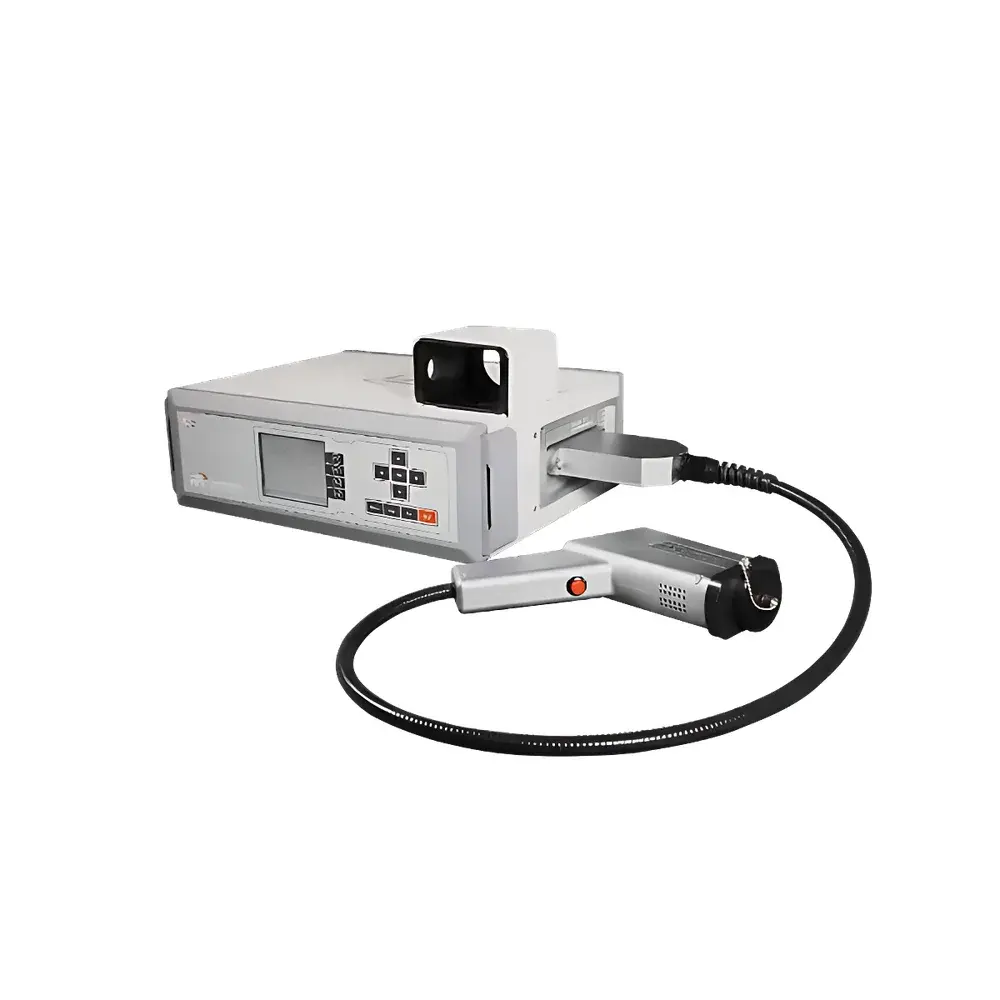
EXPEC 1350 Portable Near-Infrared Spectrometer
| Brand | EXPEC |
|---|---|
| Origin | Zhejiang, China |
| Manufacturer Type | Authorized Distributor |
| Product Category | Domestic |
| Model | EXPEC 1350 |
| Instrument Type | Portable |
| Wavelength Range | 1000–1800 nm |
| Weight | 6 kg |
| Power Supply | DC 19 V or Built-in Rechargeable Lithium Battery |
| Display | Integrated Full-Color LCD with Chinese UI |
| Data Storage | Internal High-Capacity Flash Memory |
| Connectivity | USB 2.0 |
| Software | RIMP (Remote Instrument Management Platform) |
| Sample Interface | Interchangeable Probes for Solids, Powders, Pastes, Tablets, and Liquids |
| Diagnostic Function | Onboard Reference Material & Self-Diagnostic Routine |
Overview
The EXPEC 1350 Portable Near-Infrared Spectrometer is an engineered field-deployable analytical instrument designed for rapid, non-destructive compositional assessment using diffuse reflectance and transmittance near-infrared spectroscopy. Operating across a calibrated spectral range of 1000–1800 nm, the system leverages second-overtone and combination band absorption features—primarily from C–H, O–H, and N–H functional groups—to quantify moisture, fat, protein, starch, sugar, and other key analytes in heterogeneous matrices. Its optical architecture incorporates a stable tungsten-halogen light source, thermoelectrically stabilized InGaAs detector array, and fixed grating monochromator to ensure spectral reproducibility under variable ambient conditions. Unlike benchtop NIR systems requiring sample homogenization or pelletization, the EXPEC 1350 enables direct measurement through contact or standoff probe configurations—eliminating preparation artifacts and preserving sample integrity. The device complies with fundamental principles outlined in ASTM E1655 (Standard Practices for Infrared Multivariate Quantitative Analysis) and supports method development workflows aligned with ISO 12099 (Animal Feeding Stuffs – Guidance on Calibration of NIR Instruments).
Key Features
- Field-ready portability: Weighing only 6 kg with integrated rechargeable lithium battery enabling >4 hours of continuous operation without external power
- Real-time multivariate analysis: Simultaneous quantification of up to 8 chemical/physical parameters within ≤30 seconds per measurement
- Robust optical design: Sealed optical path with anti-vibration mounting and temperature-compensated detector electronics for consistent performance across −10 °C to +50 °C operating environments
- Intuitive human-machine interface: Full-color LCD display with native Chinese-language menu navigation, contextual help prompts, and touch-responsive soft keys
- Modular sampling flexibility: Quick-swap probe interface supporting fiber-optic reflectance probes (contact/diffuse), immersion probes (liquids), and transmission cells (clear solutions)
- Embedded diagnostic capability: Pre-loaded certified reference materials enable automated wavelength accuracy verification and signal-to-noise ratio validation prior to each session
- Secure data governance: Local storage of raw spectra, calibration models, and result logs with timestamping and operator ID tagging; USB export supports CSV and JCAMP-DX formats
Sample Compatibility & Compliance
The EXPEC 1350 accommodates diverse physical forms without preprocessing: intact fruit surfaces, ground cereal grains, powdered pharmaceutical excipients, viscous dairy products, and clarified oil samples. Its probe-based geometry conforms to ASTM D6134 (Standard Test Method for Determination of Moisture in Solid Biofuels by NIR) and supports method transfer from laboratory-grade instruments per AOAC Official Method 2014.02 (NIR Determination of Protein in Wheat Flour). All firmware and RIMP software modules adhere to GLP-compliant audit trail requirements—including immutable record of calibration updates, user logins, and spectral acquisition parameters. While not FDA 21 CFR Part 11 certified out-of-the-box, the system architecture permits configuration for electronic signature enforcement and role-based access control when deployed in regulated QC environments.
Software & Data Management
RIMP (Remote Instrument Management Platform) serves as the primary desktop application for EXPEC 1350 data handling. It provides full spectral preprocessing (Savitzky–Golay smoothing, multiplicative scatter correction, first/second derivative transformation), PLS regression model building and validation, and cross-instrument model portability. Users may import legacy calibration sets from OPUS, Unscrambler, or GRAMS platforms via standardized .jdx or .spc exports. RIMP supports scheduled remote diagnostics, over-the-air firmware updates, and encrypted cloud synchronization (optional add-on module). Audit logs retain full traceability of all modeling actions—including latent variable selection, outlier rejection criteria, and RMSECV metrics—satisfying internal QA documentation standards.
Applications
- Agriculture & Horticulture: Real-time monitoring of apple soluble solids content (°Brix), pear firmness prediction, and citrus maturity index mapping during orchard scouting
- Food & Feed Quality Control: On-line verification of soybean oil iodine value, corn gluten meal protein content, and rendered animal fat free fatty acid levels at receiving docks
- Tobacco Industry: Field-side grading of air-cured leaf moisture post-harvest and quantitative assessment of nicotine and reducing sugars during fermentation
- Materials Science Research: Identification of polymer blends in post-consumer plastic waste streams and rapid screening of lignin/cellulose ratios in biomass feedstocks
- Phytochemistry & Herbal Medicine: Discriminant analysis of adulterated herbal powders (e.g., Panax ginseng vs. Panax quinquefolius) using spectral fingerprint libraries
FAQ
What spectral resolution does the EXPEC 1350 achieve across its 1000–1800 nm range?
The instrument delivers an effective optical resolution of ≤10 nm FWHM, optimized for robust chemometric modeling rather than high-resolution molecular fingerprinting.
Can calibration models developed on lab-based FT-NIR instruments be transferred directly to the EXPEC 1350?
Yes—provided the spectral format is converted to compatible wavelength grids and preprocessing steps are harmonized; RIMP includes a model translation utility for common benchtop platforms.
Is the built-in battery replaceable in the field?
The lithium-ion pack is user-serviceable using standard Torx tools; replacement kits include recalibration certificates traceable to NIM (National Institute of Metrology, China).
Does the system support compliance with ISO/IEC 17025 accreditation requirements?
All hardware specifications, uncertainty budgets, and verification procedures align with ISO/IEC 17025:2017 Clause 5.5 (Equipment); full documentation packages are available upon request for laboratory accreditation audits.
Related Products





