
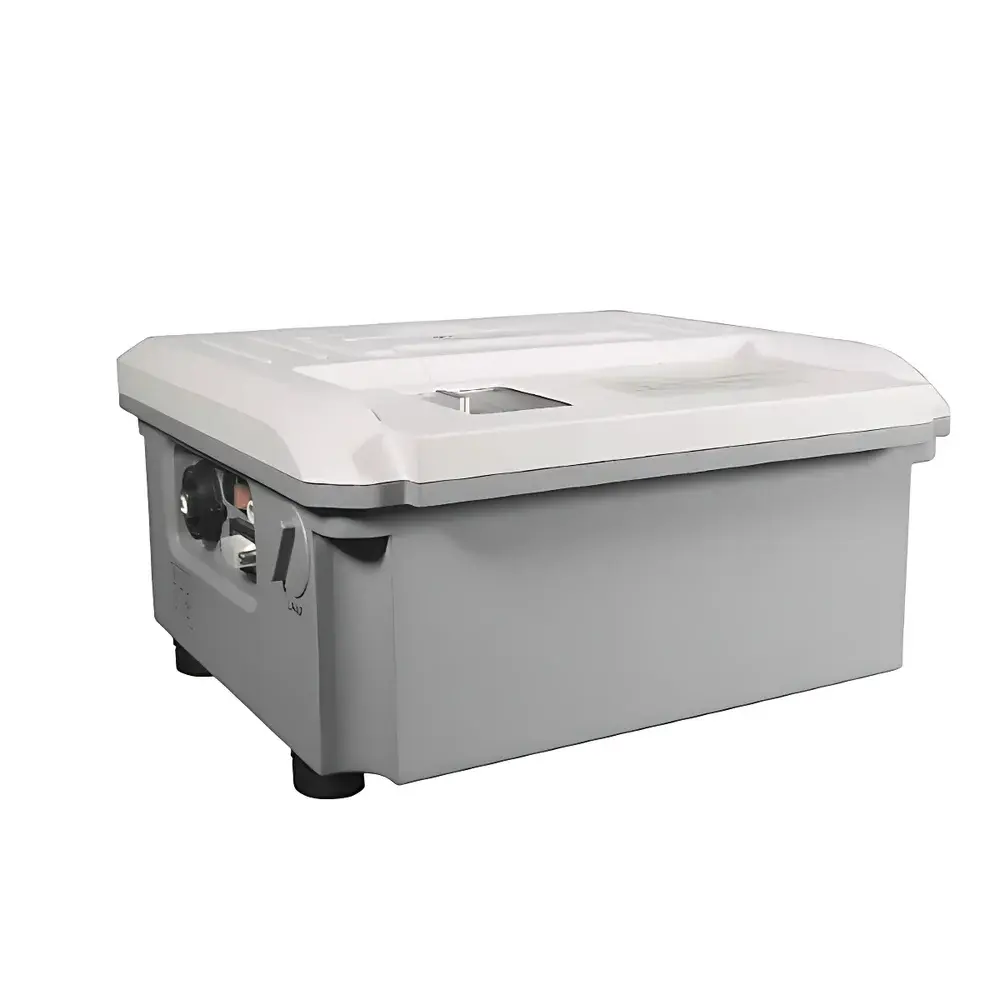
EXPEC 1360 Portable Near-Infrared Spectrometer
| Brand | EXPEC (Puyu Technology) |
|---|---|
| Origin | Zhejiang, China |
| Model | EXPEC 1360 |
| Instrument Type | Portable |
| Compliance | Meets GB/T and ASTM D7462/D8073 for fuel analysis |
| Operating Temperature Range | −5 °C to 50 °C |
| Temperature Control Range | 15–60 °C |
| Temperature Stability | ±0.2 °C |
| Measurement Time | ≤10 s per sample |
| Software Interface | Fully localized Chinese GUI with integrated modeling, calibration, and data management modules |
| Connectivity | Ethernet and Wi-Fi enabled for NIR network integration, remote diagnostics, model updates, and instrument health monitoring |
Overview
The EXPEC 1360 Portable Near-Infrared Spectrometer is an engineered solution for rapid, non-destructive chemical analysis of liquid hydrocarbon fuels and related industrial fluids in field, mobile, and laboratory environments. Based on diffuse reflectance and transmission near-infrared spectroscopy (NIR, 900–2500 nm), the system quantifies key quality parameters—including octane number (RON/MON), cetane index, distillation endpoints (T10/T50/T90), sulfur content, ethanol concentration, urea purity, and water contamination—without solvent use or sample preparation. Its optical architecture employs a thermoelectrically stabilized InGaAs detector array and a fixed-grating monochromator to ensure spectral reproducibility across environmental fluctuations. Designed for deployment in fuel terminals, refinery checkpoints, military logistics units, and roadside inspection stations, the EXPEC 1360 delivers analytical performance aligned with standardized test methods including GB/T 33648–2017 (gasoline ethanol content), GB/T 38361–2019 (diesel cetane index), ASTM D7462 (gasoline RON prediction), and ASTM D8073 (jet fuel thermal stability screening).
Key Features
- Sub-10-second measurement cycle: Full spectral acquisition, chemometric inference, and pass/fail reporting completed within 10 seconds per sample.
- Integrated precision temperature control: Dual-zone Peltier-based thermal regulation maintains sample cell and optical path at user-defined setpoints (15–60 °C) with ±0.2 °C stability—critical for minimizing thermal drift in hydrocarbon NIR absorbance bands.
- Military-grade mechanical robustness: Shock-tested per MIL-STD-810G (Method 516.6, Transit Drop) and vibration-rated for vehicular mounting; IP54-rated enclosure ensures operational integrity in dusty, humid, or intermittently wet conditions.
- Embedded chemometric workflow engine: On-device partial least squares (PLS) regression modeling, outlier detection, and spectral preprocessing (SNV, derivatives, multiplicative scatter correction) eliminate dependency on external PCs for routine QA/QC tasks.
- Network-ready architecture: Supports secure TLS-encrypted communication via Ethernet or 802.11n Wi-Fi to centralized NIR data servers, enabling automated model versioning, audit-trail logging (aligned with GLP/GMP documentation requirements), and over-the-air firmware updates.
Sample Compatibility & Compliance
The EXPEC 1360 is validated for direct analysis of undiluted liquid fuels—including gasoline (regular, premium, E10/E15/E85), diesel (ultra-low-sulfur, biodiesel blends), aviation turbine fuel (Jet A-1, JP-8), and aqueous solutions such as diesel exhaust fluid (DEF/AdBlue®). Sample introduction uses a sealed, quartz-flow-through cuvette with integrated temperature sensor and pressure-relief venting. All factory-supplied calibration models are developed using reference materials traceable to NIST SRMs or certified CRM standards (e.g., NIST 2723c for gasoline, NIST 2724b for diesel), and method validation reports comply with ISO/IEC 17025:2017 clause 7.2.2 (validation of non-standard methods). The instrument meets electromagnetic compatibility (EMC) requirements per GB/T 18268.1–2010 and safety standards per GB 4793.1–2007.
Software & Data Management
The embedded EXPEC NIR Suite v3.x provides a fully localized Chinese interface supporting multi-user role-based access (operator, supervisor, administrator), electronic signature capture (21 CFR Part 11 compliant when deployed with optional PKI module), and automatic generation of PDF-formatted test reports containing raw spectra, predicted values, confidence intervals, and QC flagging logic. All spectral data and calibration metadata are stored in SQLite databases with SHA-256 hash integrity verification. Remote synchronization enables centralized model repository management across fleets of instruments, while diagnostic telemetry logs (optical power, detector gain, thermal error residuals) support predictive maintenance scheduling.
Applications
- Fuel quality surveillance at retail dispensing points and bulk storage depots
- In-transit verification of fuel shipments prior to unloading
- Blending optimization and real-time process monitoring in terminal operations
- Regulatory compliance screening for sulfur, benzene, and oxygenate content per EU Fuel Quality Directive 98/70/EC and China’s GB 17930–2016
- On-site verification of AdBlue® urea concentration (32.5 ± 0.7 wt%) and contaminant levels (e.g., aldehydes, biuret)
<liMilitary field fuel certification per DEF STAN 91-91 (UK) or MIL-DTL-83133F (US)
FAQ
Does the EXPEC 1360 require annual recalibration against physical standards?
No—its optical path is factory-aligned and drift-compensated via internal reference measurements before each analysis cycle. However, periodic verification using certified reference materials (CRM) is recommended every 90 days per ISO 80000-1:2009.
Can custom PLS models be imported from third-party software such as Unscrambler or MATLAB?
Yes—the instrument accepts .nir and .cal files conforming to ASTM E1655-22 Annex A2 format, provided they include full metadata (wavelength grid, preprocessing steps, coefficient vectors, and uncertainty estimates).
Is the device compatible with LIMS integration?
Yes—via HL7 v2.5.1 or ASTM E1394-17 compliant ASCII export, supporting bidirectional exchange of sample IDs, results, and instrument status codes.
What is the expected lifetime of the InGaAs detector under continuous field operation?
Rated for ≥50,000 measurements at 25 °C ambient, with accelerated aging tests confirming >95% quantum efficiency retention after 24 months of simulated duty cycles.




