
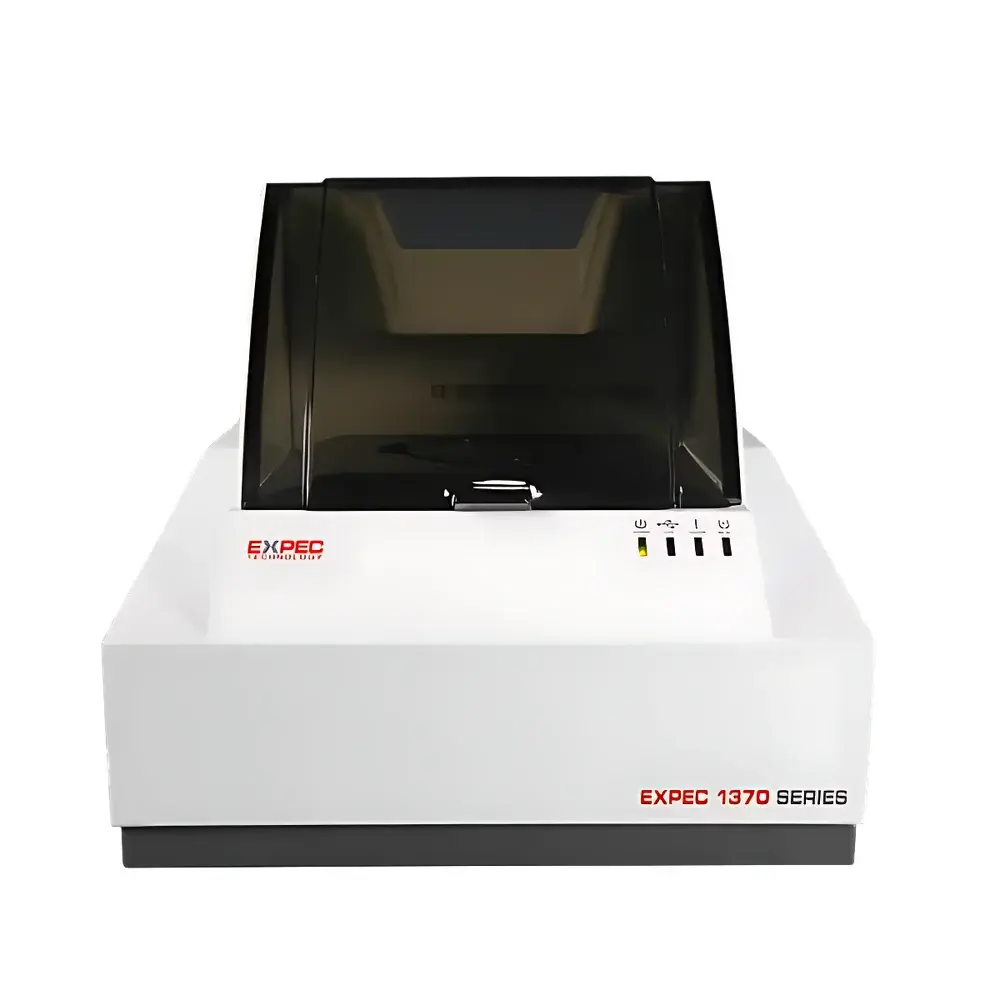
EXPEC 1370 Desktop Near-Infrared Spectrometer
| Brand | EXPEC |
|---|---|
| Origin | Zhejiang, China |
| Manufacturer Type | Authorized Distributor |
| Country of Origin | China |
| Model | EXPEC 1370 |
| Instrument Type | Laboratory Benchtop NIR Spectrometer |
| Detection Principle | Diffuse Reflectance NIR Spectroscopy |
| Typical Measurement Time | ≤10 s per sample |
| Detector | InGaAs Array |
| Optical System | Fixed Grating Monochromator |
| Wavelength Range | 900–1700 nm (standard configuration) |
| Compliance | Designed for GLP-compliant laboratory environments |
| Software | EXPEC NIR Analysis Suite with User Role Management (Admin/Operator/Reviewer) |
Overview
The EXPEC 1370 Desktop Near-Infrared Spectrometer is a robust, benchtop analytical instrument engineered for rapid, non-destructive quantitative analysis of organic compounds in solid and semi-solid samples. Operating on the principle of diffuse reflectance near-infrared spectroscopy (NIRS), it measures absorption features in the 900–1700 nm spectral region—where overtones and combination bands of C–H, N–H, and O–H bonds exhibit characteristic intensities correlating linearly with concentration. This enables simultaneous prediction of multiple quality parameters—including moisture, crude protein, crude fat, crude fiber, and ash content—without chemical reagents or sample digestion. The system is calibrated using reference methods (e.g., AOAC, ISO 14892 for feed analysis) and supports method transfer across instruments via standardized spectral preprocessing (SNV, derivatives, MSC). Its optical architecture integrates a fixed grating monochromator and thermoelectrically cooled InGaAs photodiode array detector, delivering high photon collection efficiency and signal stability under ambient lab conditions.
Key Features
- Diffuse reflectance optical path with rotating sample stage: Ensures representative measurement of heterogeneous materials (e.g., ground grains, pelleted feed, crushed forage) by averaging spectral response across multiple surface positions.
- Self-aligned light source module: Incorporates an integrated collimation and focusing mechanism; eliminates manual optical alignment during lamp replacement and maintains consistent beam geometry across instrument lifetime.
- Dedicated sample handling design: Accommodates granular, flaked, powdered, and pasty matrices without auxiliary accessories. Optional custom sample cups available for viscous or volatile samples (e.g., asphalt binders, molasses-based premixes).
- Integrated diagnostic suite: Built-in reference standards enable daily performance verification; real-time fault detection alerts users to deviations in lamp intensity, detector baseline drift, or wavelength calibration shift.
- Role-based software access control: Supports three-tier user permissions (Administrator, Analyst, Reviewer) compliant with internal audit requirements and aligned with FDA 21 CFR Part 11 data integrity expectations for electronic records.
Sample Compatibility & Compliance
The EXPEC 1370 accepts samples in standard 50-mm-diameter aluminum or quartz sample cups. Surface preparation is minimal: granules are leveled manually; powders are gently scraped flat; no pressing or pelletizing is required. The rotating stage minimizes operator-induced bias and improves repeatability for irregular particles (RSD < 1.2% for moisture in wheat flour, n=10). The system meets functional equivalency criteria outlined in ASTM E1655 (Standard Practices for Infrared Multivariate Quantitative Analysis) and supports validation protocols per ISO/IEC 17025:2017 for testing laboratories. While not certified for regulated pharmaceutical release testing, its architecture and documentation framework support GMP-aligned method validation in feed, food, and agrochemical QA/QC labs.
Software & Data Management
The EXPEC NIR Analysis Suite provides full lifecycle spectral management—from method development (PLS regression, outlier detection, spectral preprocessing) to routine operation and report generation. All calibrations store metadata including reference method details, instrument configuration, and analyst ID. Audit trails record every calibration update, result modification, and user login event. Raw spectra and processed results are exportable in ASTM E1309-compliant .jdx format and CSV for LIMS integration. Cloud backup and local encrypted database options ensure data sovereignty and continuity per ISO 27001-aligned IT policies.
Applications
Primary deployment domains include grain elevators and oilseed processing plants (soybean meal moisture/protein monitoring), compound feed mills (ingredient verification and blend uniformity assessment), dairy concentrate producers (lactose and fat profiling in whey powder), and forage testing laboratories (NDF/ADF estimation in alfalfa hay). Secondary applications span textile fiber identification (cotton/polyester blends), brewing adjunct analysis (starch gelatinization degree in malt), and petrochemical screening (hydrocarbon group-type analysis in lubricant base oils). Each application leverages pre-validated chemometric models developed in collaboration with industry partners and traceable to primary reference measurements.
FAQ
Does the EXPEC 1370 require annual factory recalibration?
No—its self-diagnostic system and built-in reference standards allow daily performance verification. Full recalibration is only necessary after major hardware service or when transferring methods between instruments.
Can I import third-party PLS models generated in Unscrambler or MATLAB?
Yes—the software accepts ASCII-based model files with defined spectral ranges, preprocessing steps, and coefficient vectors, provided they conform to the instrument’s native wavelength grid.
Is the rotating sample stage compatible with temperature-controlled accessories?
Not natively; however, ambient-temperature operation is validated for all listed applications. For low-temperature studies (e.g., frozen feed pellets), external environmental chambers may be used with custom mounting fixtures.
What regulatory documentation is supplied with the instrument?
A comprehensive Factory Acceptance Test (FAT) report, IQ/OQ protocol templates, and a traceable Certificate of Conformance are included. Installation Qualification support is available upon request.
How is spectral data security enforced during remote support sessions?
Remote access is initiated solely via customer-controlled VNC sessions with time-limited credentials; no data exfiltration capability exists in the support interface.
Related Products






