
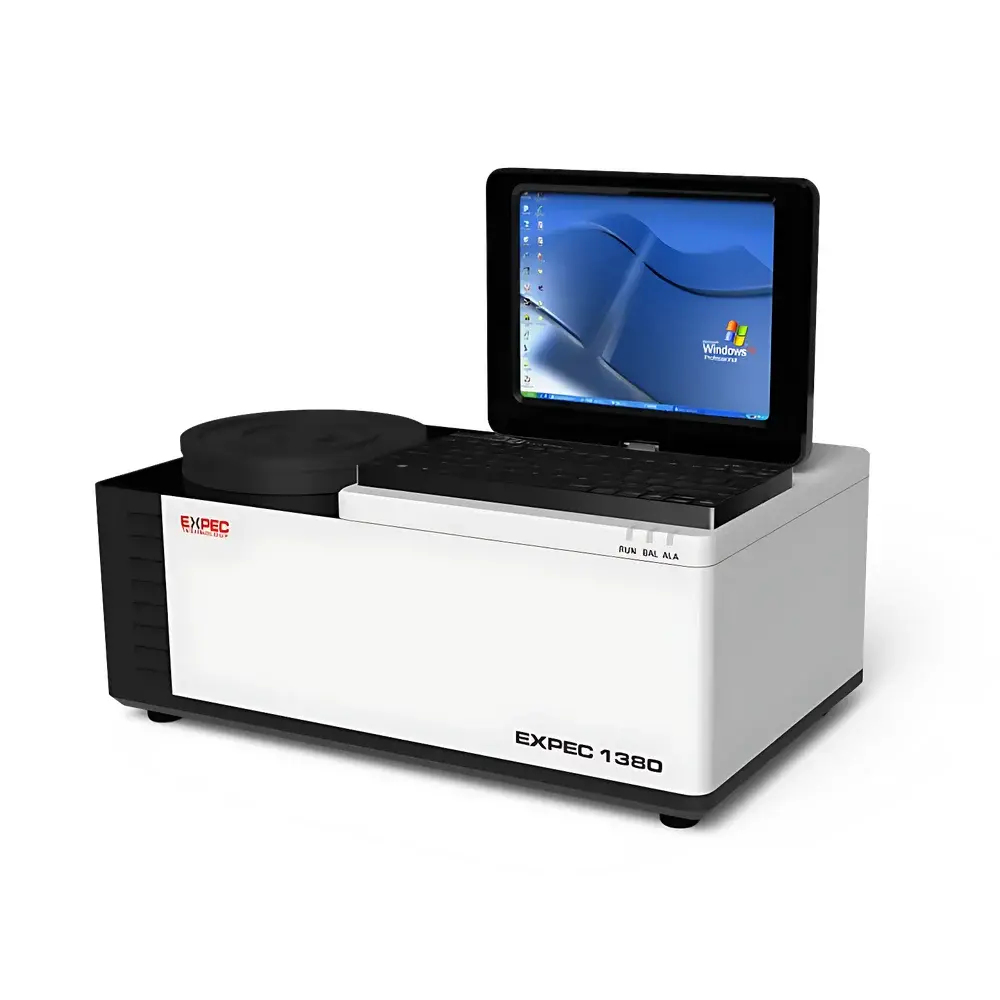
EXPEC 1380 Desktop Near-Infrared Spectrometer
| Brand | EXPEC |
|---|---|
| Origin | Zhejiang, China |
| Manufacturer Type | Authorized Distributor |
| Product Category | Domestic |
| Model | EXPEC 1380 |
| Pricing | Upon Request |
| Instrument Type | Laboratory Benchtop NIR Spectrometer |
| Detector | TEC-Cooled InGaAs |
| Optical System | Holographic Digital Grating |
| Sample Interface | Rotating Sample Carousel (Ø180 mm standard) |
| Measurement Principle | Diffuse Reflectance NIR Spectroscopy (900–1700 nm) |
| Data Acquisition Time | ≤10 s per sample |
| Built-in Computing | Integrated Industrial PC |
| Compliance Support | ASTM E1655, ISO 12099, USP <857>, GLP/GMP-ready audit trail capability |
Overview
The EXPEC 1380 Desktop Near-Infrared Spectrometer is an industrial-grade benchtop analytical instrument engineered for rapid, non-destructive quantitative analysis of bulk agricultural and processed commodities. It operates on the principle of diffuse reflectance near-infrared spectroscopy (NIRS) in the 900–1700 nm spectral range, where molecular overtones and combination vibrations of C–H, N–H, and O–H bonds generate characteristic absorption features. The system employs a high-stability tungsten-halogen light source with self-aligning optical module design—eliminating routine collimation adjustments—and couples it with a holographic digital grating monochromator for precise wavelength dispersion. Detection is performed using a thermoelectrically cooled (TEC) indium gallium arsenide (InGaAs) photodiode array, delivering high quantum efficiency and low dark current to ensure exceptional signal-to-noise ratio (SNR > 10,000:1 at 16 scans). Its integrated industrial PC architecture enables standalone operation without external computing hardware, supporting real-time spectral acquisition, chemometric modeling, and result visualization directly on the 10.1-inch capacitive touchscreen interface.
Key Features
- Modular rotating sample carousel with three interchangeable disc options (Ø180 mm, Ø100 mm, and Ø30 mm), enabling optimal surface coverage and representative sampling for heterogeneous granular materials such as whole grains, pellets, and meal.
- Patented calibration transfer algorithm ensures inter-instrument consistency across EXPEC 1380 units—reducing calibration drift by up to 50% compared to conventional NIR platforms—critical for multi-site quality control networks.
- Self-diagnostic firmware with built-in reference standards (e.g., polyethylene, ceramic tile) performs automated wavelength accuracy verification, detector linearity checks, and lamp intensity monitoring before each measurement cycle.
- Pre-configured chemometric models compliant with AOAC Official Method 988.12, AACC Method 39-01, and ISO 12099 for moisture, crude protein, crude fat, crude fiber, and amylose content in cereals, oilseeds, and feedstuffs.
- Source replacement requires no optical realignment due to factory-aligned, plug-and-play tungsten-halogen lamp modules with integrated collimating optics.
Sample Compatibility & Compliance
The EXPEC 1380 accommodates solid, semi-solid, and powdered samples—including unground wheat, soybean flakes, corn kernels, DDGS, and extruded pet food—without preparation or chemical reagents. Its Ø180 mm rotating sample disc ensures full-area spectral averaging, mitigating particle-size bias and improving repeatability (RSD < 0.8% for moisture in wheat at n = 10). The instrument meets functional requirements outlined in ISO/IEC 17025 for method validation and supports 21 CFR Part 11-compliant data integrity through optional software licensing, including electronic signatures, audit trails, and user-access controls. All factory-installed calibrations are traceable to NIST-traceable reference materials and documented per GLP/GMP Annex 11 principles.
Software & Data Management
The embedded EXPEC-NIR Manager software provides a validated, menu-driven environment for method development, model deployment, and routine analysis. It supports partial least squares (PLS) regression, principal component analysis (PCA), and Mahalanobis distance outlier detection. Raw spectra, second-derivative preprocessed data, and prediction reports are stored in vendor-neutral HDF5 format with embedded metadata (operator ID, timestamp, instrument serial number, calibration version). Export options include CSV, PDF, and LIMS-compatible XML output. Remote diagnostics and firmware updates are enabled via secure HTTPS-based connection to EXPEC’s technical support portal—no third-party cloud storage or telemetry.
Applications
- Grain & Oilseed Procurement: Real-time verification of moisture, protein, and oil content during elevator intake and warehouse receipt—aligned with USDA FGIS and GAFTA specifications.
- Feed Manufacturing: In-line raw material screening (soybean meal, corn gluten, fishmeal) and finished pellet QA per AAFCO nutrient profiles and EU Regulation (EC) No 1831/2003.
- Oil Refining: Monitoring free fatty acid (FFA) and peroxide value surrogates in crude palm, soy, and sunflower oils using validated PLS models trained on AOCS Cd 12b-92 reference methods.
- Starch Processing: Quantification of amylose/amylopectin ratio and damaged starch in milled rice and potato flour—supporting ISO 6647-1 and AACC Method 76-13.
FAQ
What spectral range does the EXPEC 1380 cover, and how is wavelength accuracy maintained?
The instrument operates from 900 to 1700 nm with ±0.5 nm wavelength reproducibility. Accuracy is verified automatically before each analysis using onboard polyethylene and ceramic standards; deviations trigger recalibration alerts.
Can the EXPEC 1380 be integrated into an existing LIMS or ERP system?
Yes—via configurable ODBC/JDBC drivers and RESTful API endpoints supporting JSON-formatted query responses for sample ID, predicted values, confidence intervals, and spectral metadata.
Is method transfer possible between different EXPEC 1380 units?
Yes—the instrument-specific calibration transfer protocol enables direct model portability with <2% RMSEP increase across instruments, validated per ASTM E1655 Section 10.3.
Does the system support regulatory audits under FDA or EU GMP guidelines?
When deployed with optional 21 CFR Part 11 mode enabled, it provides full audit trail logging, role-based access control, and electronic signature enforcement—fully aligned with Annex 11 and ICH GCP requirements.
What maintenance is required beyond lamp replacement?
No routine optical alignment or detector recalibration is needed. Lamp modules are field-replaceable in <90 seconds; all other subsystems (grating, detector, electronics) are sealed and warrantied for 36 months.



