
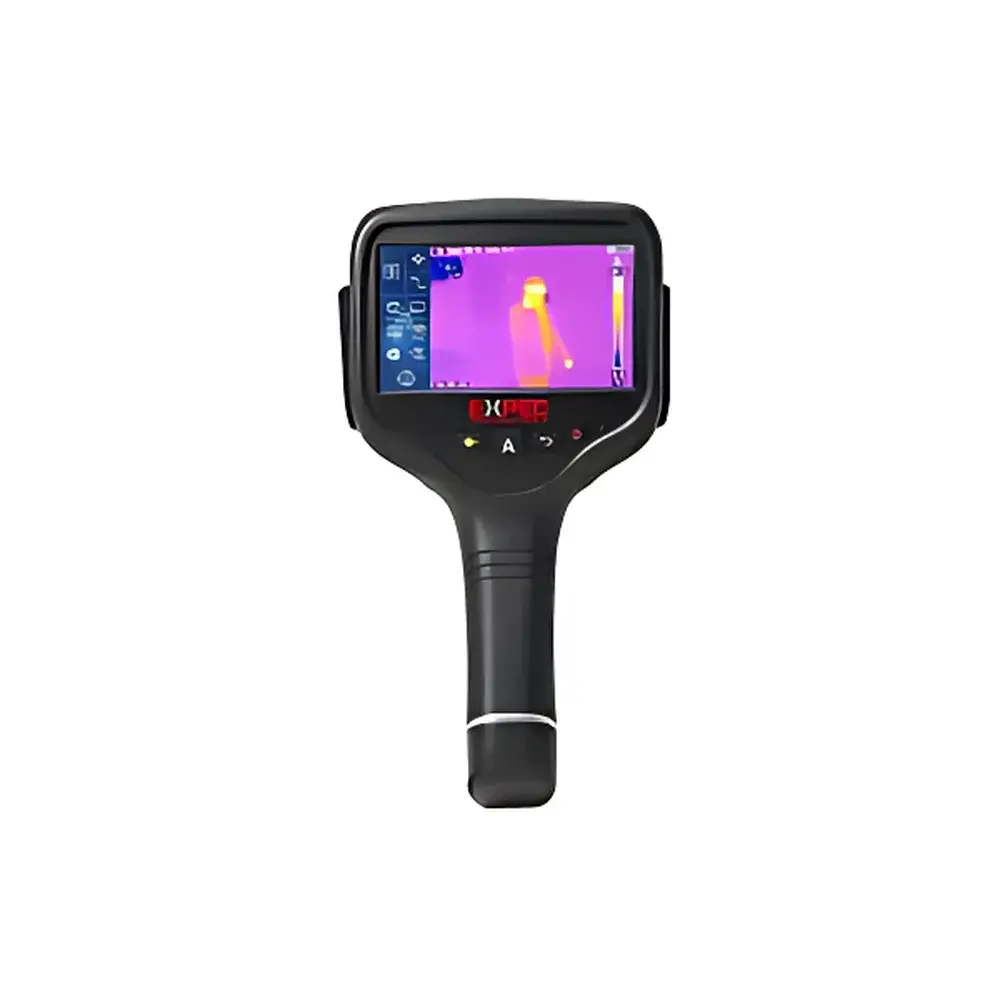
EXPEC 1810 Handheld Infrared Thermal Imaging Camera
| Brand | EXPEC |
|---|---|
| Origin | Zhejiang, China |
| Manufacturer Type | Authorized Distributor |
| Country of Origin | China |
| Model | EXPEC 1810 |
| Measurement Method | Non-contact |
| Detector Cooling | Uncooled |
| Display | High-resolution LCD touchscreen |
| Form Factor | Ergonomic handheld |
| Compliance | CE, RoHS, ISO 18434-1 (Condition Monitoring — Thermography), IEC 62906-5-2 (Laser-based thermographic systems) |
| Image Resolution Options | 384 × 288 or 640 × 480 IR pixels |
| Thermal Sensitivity (NETD) | < 50 mK typical |
| Temperature Range | –20 °C to +650 °C (extendable via optional calibration kits) |
| Frame Rate | ≥ 30 Hz (real-time imaging) |
| Accuracy | ±2 °C or ±2% of reading (whichever is greater), traceable to NIST standards |
| Emissivity Adjustment | 0.01–1.00 in 0.01 steps |
| Built-in Visible Light Camera | 5 MP autofocus with LED illumination |
| Storage | Internal 32 GB + microSD slot (up to 512 GB) |
| Battery Life | Up to 4.5 hours continuous operation (rechargeable Li-ion) |
Overview
The EXPEC 1810 Handheld Infrared Thermal Imaging Camera is an industrial-grade, uncooled microbolometer-based thermographic instrument engineered for precision non-contact temperature measurement and thermal pattern analysis. Utilizing a high-sensitivity vanadium oxide (VOx) focal plane array (FPA), the device operates across the long-wave infrared (LWIR) spectral band (7.5–14 µm), enabling reliable detection of subtle thermal gradients without external cooling mechanisms. Its core architecture supports real-time radiometric imaging at ≥30 Hz frame rate, delivering synchronized thermal and visible-light overlays for accurate spatial correlation. Designed for field-deployable reliability, the EXPEC 1810 complies with international thermography standards including ISO 18434-1 for condition monitoring and IEC 62906-5-2 for performance validation of infrared imaging systems. The instrument’s radiometric data output is traceable to NIST-traceable blackbody references, ensuring metrological integrity across maintenance, safety, and quality assurance workflows.
Key Features
- Ergonomic handheld design with IP54-rated enclosure for dust and splash resistance in industrial environments
- Dual-sensor fusion: 384 × 288 or optional 640 × 480 IR resolution paired with a 5 MP visible-light camera and integrated LED illumination
- Real-time radiometric video streaming with embedded temperature analytics, including spot, area, and line profile tools
- Multi-point emissivity compensation and reflected apparent temperature correction for material-specific accuracy
- Intelligent hotspot tracking with user-defined alarm thresholds and automatic annotation of thermal anomalies
- On-device image enhancement algorithms—including dynamic range expansion, noise suppression, and edge sharpening—for improved diagnostic clarity
- Rechargeable lithium-ion battery supporting up to 4.5 hours of continuous operation and hot-swappable capability
Sample Compatibility & Compliance
The EXPEC 1810 is validated for use across diverse material surfaces—including oxidized metals, painted substrates, composite insulation, electrical enclosures, and biological tissues—provided appropriate emissivity settings and environmental corrections are applied. It meets electromagnetic compatibility (EMC) requirements per EN 61326-1 and carries CE and RoHS declarations for deployment within EU-regulated facilities. For regulated industries, the device supports audit-ready reporting aligned with ISO/IEC 17025 laboratory accreditation frameworks and GLP-compliant documentation workflows. While not FDA-cleared for clinical diagnostics, its thermal measurement protocol adheres to ASTM E1934–22 guidelines for infrared inspection of electrical systems and building envelopes.
Software & Data Management
The EXPEC 1810 integrates seamlessly with EXPEC ThermoVision Suite v3.2—a Windows-based desktop application for post-acquisition analysis, report generation, and database archiving. All radiometric images retain full pixel-level temperature metadata (in .seq and .jpg+csv formats), enabling retrospective recalibration and comparative trending. The software supports automated compliance templates for IEEE 115, NFPA 70B, and ISO 55001 asset management protocols. Audit trails, user access controls, and electronic signature functionality comply with 21 CFR Part 11 requirements when deployed in GxP environments. Firmware updates are delivered via secure HTTPS channel with cryptographic signature verification.
Applications
- Preventive maintenance of medium-voltage switchgear, transformers, and busbar connections in utility and industrial power systems
- Thermal integrity assessment of building envelopes, roofing membranes, and HVAC ductwork per ASTM C1060 and ISO 6781-3
- In-process monitoring of lithium-ion battery cell formation, weld integrity, and thermal runaway precursors during manufacturing
- Hotspot detection in metallurgical furnaces, ladles, and continuous casting lines under high-ambient conditions
- Firefighting scene reconnaissance and concealed fire localization in structural voids and ceiling cavities
- Non-invasive screening support for elevated skin temperature detection in controlled access points (used as adjunctive tool only)
FAQ
Is the EXPEC 1810 calibrated before shipment?
Yes—each unit undergoes factory calibration using dual-temperature blackbody sources traceable to NIST standards, with full calibration certificate provided.
Can the device perform quantitative temperature measurements on reflective surfaces?
Yes, provided users input correct emissivity values and account for reflected apparent temperature using the built-in compensation wizard.
Does the thermal imaging software support batch analysis of time-series datasets?
Yes—ThermoVision Suite includes scripting modules (Python API) and trend analysis dashboards for longitudinal thermal behavior modeling.
What is the warranty coverage for the infrared detector?
The VOx microbolometer array is covered under a 3-year limited warranty against manufacturing defects, excluding physical damage or improper handling.
Is remote firmware update supported over Wi-Fi?
Firmware updates require USB connection to a host PC; Wi-Fi is reserved for live video streaming and file transfer—not system updates.




