
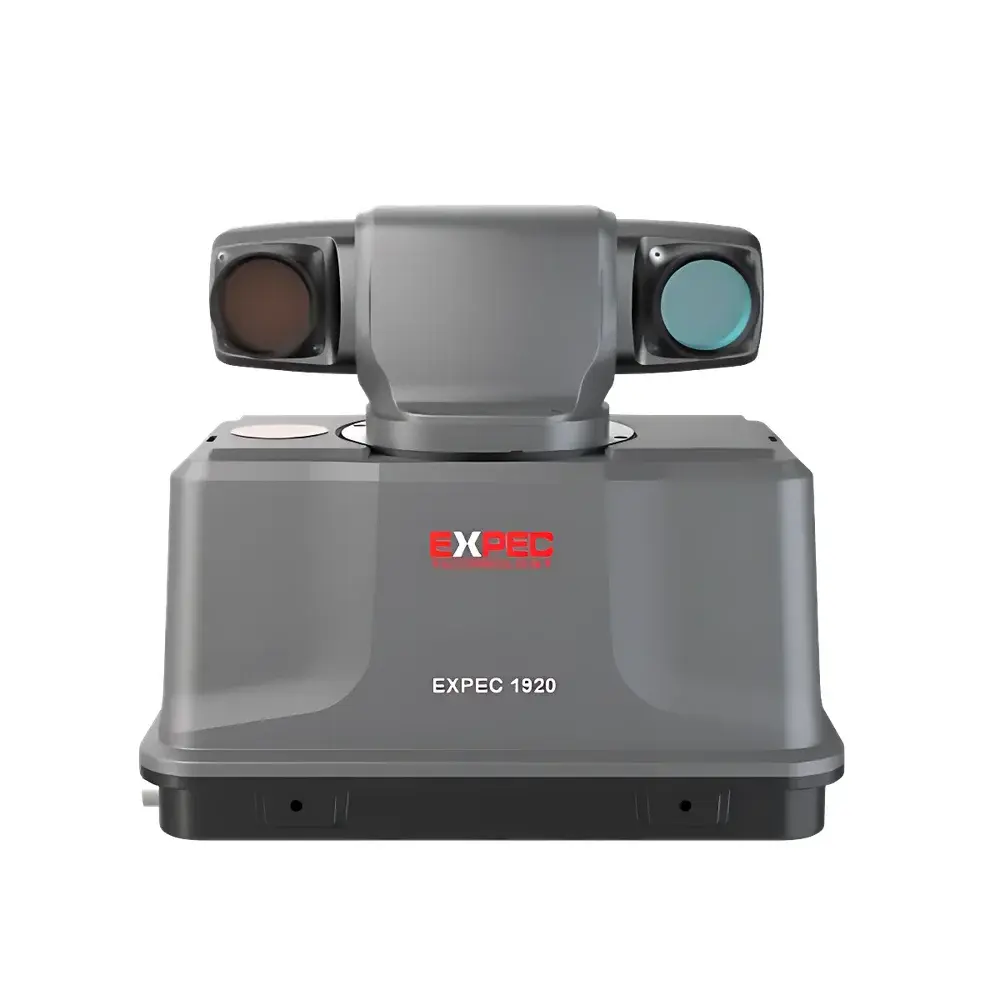
EXPEC 1920 Fourier Transform Infrared (FTIR) Open-Path Remote Gas Detection System
| Brand | EXPEC / Spectral Instruments |
|---|---|
| Origin | Zhejiang, China |
| Manufacturer Type | Authorized Distributor |
| Product Origin | Domestic (China) |
| Model | EXPEC 1920 |
| Pricing | Upon Request |
Overview
The EXPEC 1920 Fourier Transform Infrared (FTIR) Open-Path Remote Gas Detection System is an engineered solution for real-time, non-contact, wide-area atmospheric gas monitoring. It operates on passive FTIR remote sensing principles—detecting characteristic infrared absorption signatures emitted by gases in ambient thermal radiation—enabling identification and quantification of volatile chemical species without physical sampling. Unlike extractive or point-sensor systems, the EXPEC 1920 captures spectral radiance across a broad mid-infrared range (typically 650–4000 cm⁻¹), resolving molecular vibrational-rotational transitions with high spectral fidelity. Its core function is spatially resolved chemical imaging: overlaying gas concentration path-integrated data (in ppm·m units) onto co-registered visible and thermal infrared imagery, thereby delivering georeferenced plume mapping over distances up to 2 km. Designed for rapid deployment in dynamic field environments, it supports immediate hazard characterization—critical during industrial leak response, post-incident forensic analysis, fugitive emission surveys, and environmental compliance verification.
Key Features
- Passive FTIR spectroscopy architecture—no external IR source required; leverages natural thermal emission from target gases and background terrain.
- Integrated dual-imaging system: high-resolution visible camera (≥5 MP) and uncooled microbolometer thermal imager (640 × 480) for simultaneous contextual and thermal scene registration.
- Dual-axis precision gimbal: motorized azimuth (0–360° continuous) and elevation (−90° to +90°) scanning, enabling full hemispheric coverage and automated patrol modes.
- Cryogenically cooled MCT (Mercury Cadmium Telluride) detector stabilized at −200°C via Stirling-cycle cooler—ensuring low noise, high signal-to-noise ratio (SNR), and stable spectral baseline over extended operation.
- Onboard spectral library containing >400 analytes—including VOCs, toxic industrial chemicals (TICs), chemical warfare agent simulants, greenhouse gases, and common combustibles (e.g., CH₄, C₂H₄, NH₃, HCl, SO₂, CO, NO₂).
- Real-time spectral processing engine implementing multivariate algorithms (e.g., classical least squares, partial least squares regression) for quantitative path-concentration estimation and false-positive suppression.
- Modular mechanical design: total system mass <25 kg; compact footprint compatible with tripod mounting, vehicle roof integration (with vibration-damping base), or handheld operation using ergonomic support frame.
Sample Compatibility & Compliance
The EXPEC 1920 detects gaseous compounds in open-air environments—requiring no sample preparation, calibration gas cylinders, or consumables. It is inherently compatible with ambient air, stack effluents (under line-of-sight conditions), and vapor-phase releases from soil or liquid surfaces. The system adheres to foundational spectroscopic measurement standards including ISO 14956 (ambient air quality—evaluation of measurement strategies) and ASTM D6348 (standard test method for determination of gaseous compounds by FTIR). While not certified as a Class I Division 1 device, its optical head meets IP54 ingress protection rating for field durability. Data acquisition and reporting workflows support GLP-compliant documentation requirements, including timestamped spectral records, metadata logging (GPS, IMU, ambient T/RH), and audit-ready export formats (CSV, NetCDF, .SPA).
Software & Data Management
The proprietary EXPEC RemoteView™ software suite provides intuitive control, visualization, and post-processing capabilities. Real-time display includes fused RGB/thermal video feed overlaid with dynamic gas concentration heatmaps, plume centroid tracking vectors, and component-specific concentration contours. All raw interferograms and calibrated spectra are stored with embedded metadata (geotag, scan angle, detector temperature, optical path length). Export options include spectral libraries compliant with HITRAN and NIST databases, time-series concentration profiles, GIS-compatible KML layers, and PDF-formatted incident reports. Software architecture supports 21 CFR Part 11–aligned user access controls (role-based permissions), electronic signatures, and immutable audit trails for regulatory submissions.
Applications
- Emergency response: Rapid hazard assessment during chemical spills, refinery fires, or transportation accidents—identifying unknown plumes and prioritizing evacuation zones.
- Environmental compliance: Quantitative monitoring of fence-line emissions, landfill gas migration, and wastewater treatment off-gassing per EPA Method 320 and EU BREF guidelines.
- Industrial safety: Continuous perimeter surveillance of petrochemical facilities, LNG terminals, and chemical storage sites for early leak detection.
- Regulatory inspection: Supporting national environmental agencies in verifying VOC abatement efficiency and detecting unauthorized releases.
- Research applications: Atmospheric dispersion modeling validation, plume dynamics studies, and intercomparison campaigns with reference-grade analyzers.
FAQ
What detection limit does the EXPEC 1920 achieve for common gases like methane or ammonia?
Detection sensitivity is expressed as minimum detectable path-concentration (ppm·m); typical values range from 0.1–5 ppm·m depending on gas absorption strength, atmospheric conditions, and integration time—consistent with published performance of field-deployable passive FTIR systems.
Can the system operate effectively in rain, fog, or low-visibility conditions?
Performance degrades under heavy precipitation or dense fog due to infrared scattering; optimal operation occurs under clear to partly cloudy conditions with relative humidity 1 km.
Is spectral calibration traceable to national standards?
Yes—factory calibration uses NIST-traceable blackbody sources and certified gas cells; field recalibration is supported via built-in reference cavity and optional portable calibration kits.
Does the system require annual third-party certification for legal metrology use?
While not classified as a legal metrology instrument under OIML R127, users deploying it for regulatory enforcement should validate measurement uncertainty per ISO/IEC 17025 and maintain documented calibration history.
How is GPS and inertial data synchronized with spectral acquisitions?
An integrated GNSS receiver (GPS + BeiDou) and 9-axis IMU provide sub-100 ms timestamp alignment between position/orientation and each interferogram—enabling accurate geo-referencing of detected plumes.







