
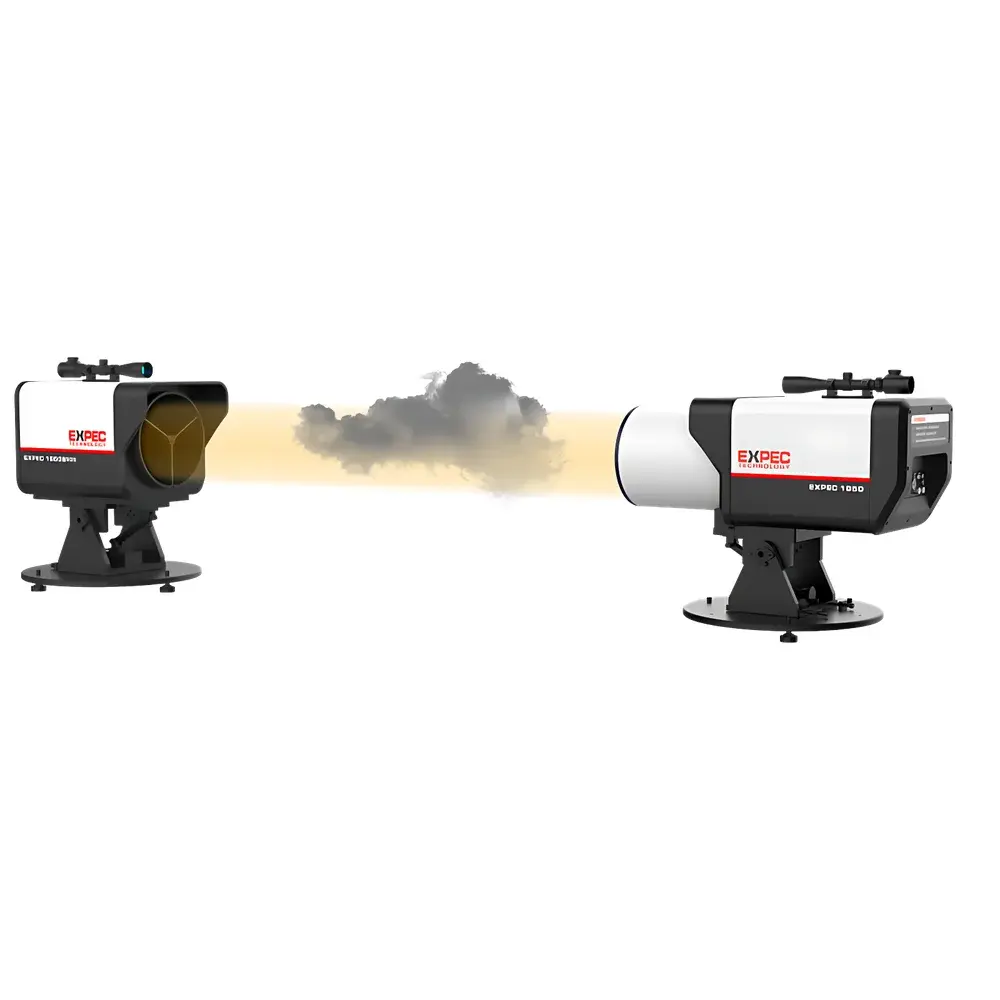
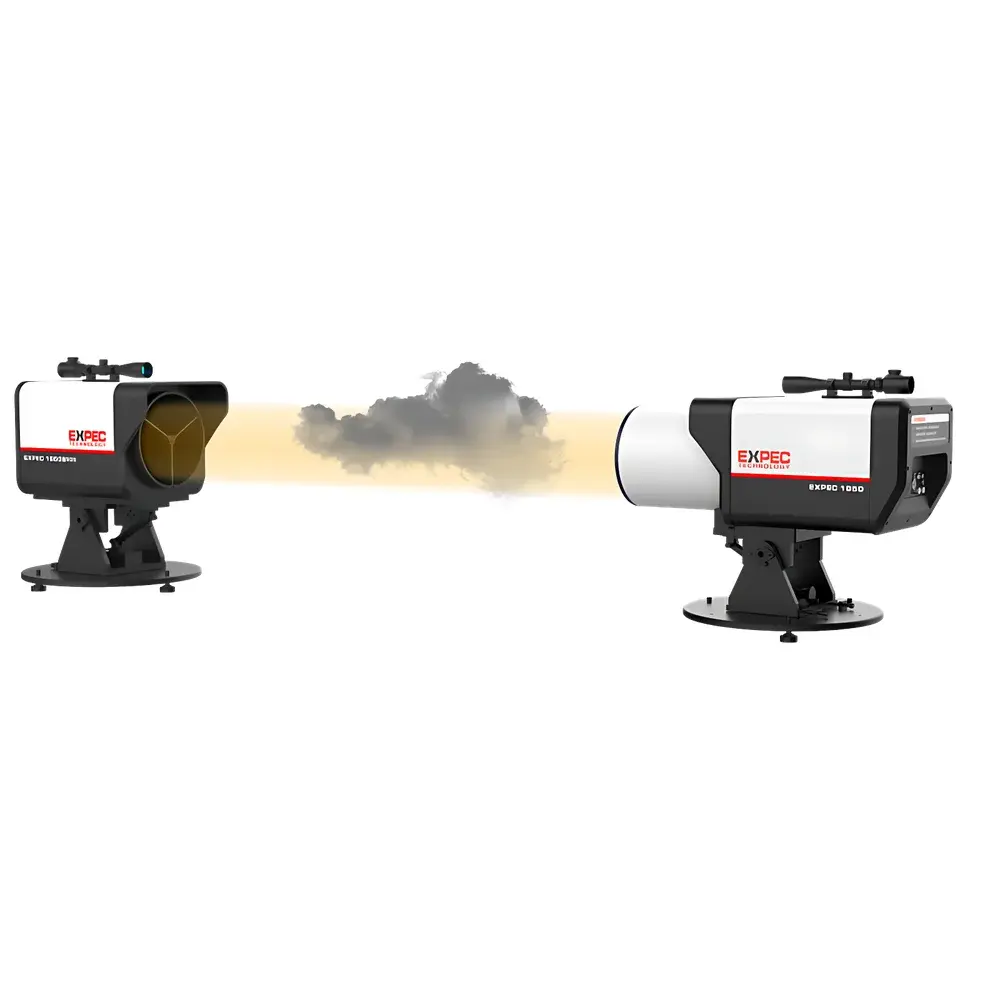
EXPEC 1950 Open-Path Fourier Transform Infrared (OP-FTIR) Gas Analyzer
| Brand | EXPEC / Spectrometer Technology |
|---|---|
| Origin | Zhejiang, China |
| Manufacturer Type | Authorized Distributor |
| Product Type | Online Fixed Installation |
| Model | EXPEC 1950 |
| Detection Principle | Open-Path Fourier Transform Infrared Spectroscopy |
| Detector | Stirling-Cooled MCT (Mercury Cadmium Telluride) |
| Measurement Range | ppb to % v/v (gas-dependent) |
| Optical Path Length | Adjustable (typically 10–500 m) |
| Spectral Resolution | ≤0.5 cm⁻¹ |
| Wavelength Range | 600–4000 cm⁻¹ (2.5–16.7 µm) |
| Data Output | Real-time qualitative & quantitative spectra, alarm-triggered reports, time-series concentration logs |
| Compliance | Designed for industrial environmental monitoring per ISO 14001, EPA Method 320, and ASTM D6348-19 guidance |
| Software | Embedded OP-FTIR analysis suite with spectral fingerprint library, auto-background correction, and neural network-based multicomponent deconvolution |
Overview
The EXPEC 1950 Open-Path Fourier Transform Infrared (OP-FTIR) Gas Analyzer is an engineered solution for continuous, non-contact, remote detection of multiple gaseous compounds across extended optical paths. Utilizing a collimated infrared beam transmitted through ambient air—without sampling probes or extraction systems—the instrument applies high-resolution FTIR spectroscopy to capture absorption spectra over the mid-infrared region (600–4000 cm⁻¹). This enables simultaneous identification and quantification of volatile organic compounds (VOCs), inorganic toxic gases (e.g., NH₃, HCl, HF, SO₂, NO₂, CO, CH₄), and greenhouse gases (e.g., N₂O, O₃) at trace to percent-level concentrations. Its open-path architecture eliminates inlet-line adsorption, condensation, and calibration drift associated with extractive systems—making it particularly suitable for monitoring fugitive emissions, plume dispersion, and perimeter boundary conditions in complex industrial environments.
Key Features
- True open-path configuration with transceiver-receiver separation: no retroreflector arrays required—reducing alignment complexity and long-term maintenance.
- Stirling-cooled MCT detector operating at ~77 K: delivers high signal-to-noise ratio (SNR) and thermal stability essential for sub-ppb detection limits and spectral reproducibility across temperature fluctuations.
- Modular mechanical design: hinged rear-access chassis allows rapid detector exchange and optical realignment without full disassembly; precision-machined detector mounting with multi-point mechanical registration ensures repeatable positioning after servicing.
- IP65-rated enclosure with internal purge port: maintains optical path integrity under high-humidity, particulate-laden, or chemically aggressive atmospheres—validated for operation in Class I, Division 2 hazardous locations when configured with optional explosion-proof housings.
- Adaptive spectral processing: integrated deep neural network (DNN) algorithm performs real-time spectral unmixing, background subtraction, and interference correction—trained on >2,000 reference gas spectra from the HITRAN and NIST databases.
Sample Compatibility & Compliance
The EXPEC 1950 is designed for ambient air matrix analysis without sample conditioning. It accommodates variable path lengths (10–500 m) via interchangeable telescope optics (f/4 to f/12 focal ratios) and supports both single-path and multi-leg optical fence deployments. The system complies with measurement principles outlined in EPA Method 320 (FTIR determination of organic and inorganic vapors) and aligns with ASTM D6348-19 for field-deployable IR gas analyzers. While not certified as a Class I medical device, its data structure and audit trail capabilities—including timestamped raw interferograms, processed spectra, and version-controlled calibration files—support GLP-compliant environmental reporting and regulatory submissions under ISO 14001 and EU Industrial Emissions Directive (IED) Annex VIII requirements.
Software & Data Management
The embedded Linux-based firmware hosts a dedicated OP-FTIR analysis engine supporting automated spectral acquisition (≥1 spectrum/sec), baseline correction, peak fitting, and multivariate regression against user-defined compound libraries. Data export conforms to netCDF-4 format with CF-1.8 metadata conventions, enabling direct ingestion into third-party platforms such as MATLAB, Python (SciPy/NumPy), or commercial environmental data management systems (EDMS). All configuration changes, alarm events, and detector diagnostics are logged with ISO 8601 timestamps and SHA-256 checksums. Optional remote access modules provide TLS 1.3-secured API endpoints compatible with MQTT and OPC UA protocols—facilitating integration into SCADA and IIoT infrastructure while preserving data lineage for FDA 21 CFR Part 11-aligned audit trails.
Applications
- Industrial perimeter monitoring: deployment as optical fence networks around chemical storage tanks, flare stacks, and loading/unloading zones to detect early-stage leaks of VOCs and acid gases.
- Environmental compliance verification: continuous stackless monitoring near fenceline sites to support LDAR (Leak Detection and Repair) programs and meet local air quality management plan (AQMP) reporting obligations.
- Emergency response triage: rapid setup for mobile or semi-permanent deployment during incident investigations—providing real-time speciation of unknown plumes without sample collection delays.
- Research-grade emission characterization: coupling with meteorological sensors (wind speed/direction, temperature, RH) to model dispersion patterns and quantify mass emission rates using inverse modeling techniques.
FAQ
What gases can the EXPEC 1950 detect simultaneously?
It identifies and quantifies up to 32 pre-configured target gases in a single spectrum acquisition—including CO, CO₂, CH₄, NH₃, HCl, HF, SO₂, NO, NO₂, O₃, N₂O, formaldehyde, benzene, toluene, and other C₁–C₅ hydrocarbons—subject to spectral interference constraints and path-length optimization.
Does the system require periodic calibration with standard gas cylinders?
No. As an open-path analyzer, it relies on absolute radiometric calibration and atmospheric background referencing rather than span-gas calibration. Field validation is performed using certified reference spectra and known-path absorption cells during commissioning and annual performance verification.
Can the EXPEC 1950 operate in rain, fog, or snow?
Yes. Its 10.6 µm CO₂ laser alignment subsystem and automatic signal attenuation compensation algorithms maintain operational continuity during light-to-moderate precipitation. Heavy fog or snowfall (>100 m visibility reduction) may trigger reduced confidence flags but does not damage hardware.
Is the software validated for regulated environments?
The core analysis engine is configurable for 21 CFR Part 11 compliance via optional electronic signature modules, audit log encryption, and role-based access control—though final validation remains the responsibility of the end-user’s QA department per GxP implementation protocols.
Related Products







