
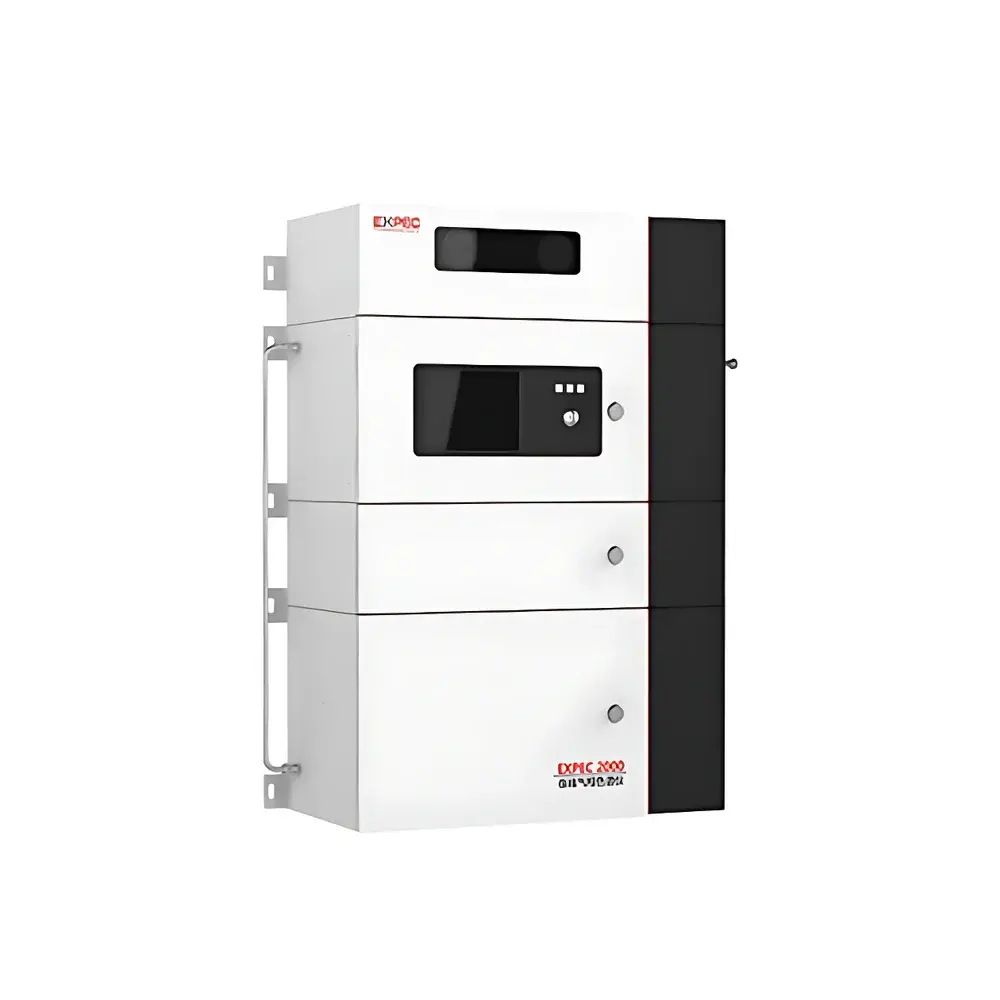
EXPEC 2000 Intrinsically Safe & Pressurized Online Gas Chromatograph for Continuous NMHC and BTEX Emission Monitoring
| Brand | EXPEC (Puyu Technology) |
|---|---|
| Origin | Zhejiang, China |
| Instrument Type | Online Gas Chromatograph |
| Detection Principle | GC-FID (Gas Chromatography with Flame Ionization Detection) |
| Explosion Protection | Ex d e ib px IIC T3/T4 Gb |
| Core Detector | Explosion-Proof FID |
| Sampling Method | High-Temperature Heated Probe + Heated Sample Line + Heated Pre-treatment Unit |
| Data Output | Real-time Temperature, Pressure, Flow Rate, Humidity, O₂ Content, NMHC, Benzene, Toluene, Ethylbenzene, Xylenes (BTEX) |
| Compliance | Designed for EPA Method 25A / ISO 12039 / HJ 1012-2018 Environments |
| Power Supply | 220 VAC ±10%, 50 Hz |
| Operating Ambient | –10 °C to +50 °C |
| Enclosure Rating | IP65 |
Overview
The EXPEC 2000 Intrinsically Safe & Pressurized Online Gas Chromatograph is a certified continuous emission monitoring system (CEMS) engineered for real-time quantification of non-methane hydrocarbons (NMHC) and benzene–toluene–ethylbenzene–xylenes (BTEX) in hazardous industrial exhaust streams. Built upon validated gas chromatographic separation coupled with flame ionization detection (GC-FID), the system delivers trace-level sensitivity and high reproducibility under demanding process conditions. Its fully integrated architecture includes a high-temperature heated sampling probe, thermostatically controlled sample transfer line (up to 180 °C), heated conditioning unit with particulate filtration, moisture removal, and flow regulation, followed by an on-board GC column oven and explosion-proof FID detector. All critical components—including the chromatograph chassis, detector housing, and internal electronics—are designed to meet dual-certified protection: intrinsic safety (ib) combined with pressurized enclosure (px) and flameproof (d) construction per IEC 60079-0, -1, -7, -11, and -13. This ensures operational integrity in Zone 1 and Zone 2 classified areas where flammable vapors (e.g., C1–C12 hydrocarbons) may be present at ignitable concentrations.
Key Features
- Explosion-Protected Chromatograph Architecture: Dual-mode protection (Ex d e ib px IIC T3/T4 Gb) applied across the entire analyzer enclosure, including column oven, detector chamber, and electronic control module—certified for use in petroleum refineries, chemical synthesis plants, and tank farm perimeters.
- Full-Path High-Temperature Conditioning: Sample handling train maintained continuously at ≥160 °C from probe tip to detector inlet, minimizing condensation, adsorption loss, and catalytic degradation of reactive aromatics (e.g., benzene, styrene) and light alkenes.
- Integrated Multi-Parameter Environmental Sensing: Simultaneous acquisition of stack temperature, static/dynamic pressure, volumetric flow rate (via differential pressure sensor), relative humidity, and oxygen concentration—enabling stoichiometric correction and dilution factor calculation per regulatory reporting requirements.
- Automated Safety Interlock System: Redundant hydrogen gas monitoring via intrinsically safe H₂ sensors; positive-pressure purge verification; automatic power cutoff upon alarm activation; and fail-safe restart logic compliant with IEC 61511 SIL 2 functional safety principles.
- Modular Pre-Treatment Subsystem: Includes sintered metal particulate filter (≤0.5 µm), Nafion™-based permeation dryer, and catalytic methanizer (optional) for speciated NMHC differentiation, all housed within a heated, explosion-rated cabinet.
Sample Compatibility & Compliance
The EXPEC 2000 is validated for gaseous matrices containing total hydrocarbon concentrations from 0.1 to 10,000 ppmv (as methane equivalent), with individual BTEX detection limits ranging from 0.05 to 0.5 ppmv depending on retention time and matrix interference. It supports direct analysis of raw flue gas, vent headers, vapor recovery lines, and storage tank breathing emissions without dilution. The system complies with Chinese standard HJ 1012–2018 for NMHC online monitoring, aligns with EPA Method 25A for total hydrocarbon measurement, and satisfies key elements of ISO 12039:2000 (stationary source emissions—determination of total organic carbon). Its data acquisition firmware supports audit-ready logging per GLP/GMP principles, including full electronic signature support, change history tracking, and 21 CFR Part 11–compliant user access control when deployed with optional secure software package.
Software & Data Management
Embedded Linux-based controller runs proprietary EXPEC CEMS Suite v3.x, providing local HMI touchscreen operation, method scheduling, calibration sequence automation (zero/span/gas standard injection), and diagnostics dashboard. All measurement data—including chromatograms, peak integration logs, calibration reports, and alarm event timestamps—are stored internally for ≥180 days and exported via Modbus TCP, OPC UA, or 4–20 mA analog outputs. The system natively supports integration into enterprise DCS/SCADA platforms and national environmental monitoring networks (e.g., China’s MEP Platform) through standardized XML/JSON RESTful API interfaces. Audit trail records include operator ID, action timestamp, parameter before/after change, and digital certificate validation—ensuring traceability during regulatory inspections.
Applications
- Continuous monitoring of fugitive and stack emissions from fluid catalytic cracking (FCC) units, hydrodesulfurization reactors, and ethylene cracker off-gas streams in petrochemical facilities.
- Real-time BTEX surveillance at loading arms, vapor recovery units (VRUs), and floating roof seal interfaces in bulk liquid terminals and oil depots.
- Compliance-grade NMHC measurement at flare pilot lines, solvent recovery vents, and wastewater treatment plant air emissions points subject to VOC abatement regulations.
- Source testing and performance verification of thermal oxidizers, regenerative thermal oxidizers (RTOs), and activated carbon adsorption systems under dynamic load conditions.
FAQ
What certifications does the EXPEC 2000 hold for hazardous area installation?
It carries ATEX and IECEx certification for Ex d e ib px IIC T3/T4 Gb, verified by nationally accredited laboratories in China and recognized under EU Directive 2014/34/EU.
Can the system operate without external zero air or calibration gas cylinders?
Yes—the integrated zero air generator produces hydrocarbon-free air (<0.01 ppmv THC) on demand; optional permeation tube-based span standards enable unattended multi-point calibration.
Is remote diagnostics and firmware update supported?
Yes—via secure TLS-encrypted SSH or VPN tunnel; updates require dual-authorized digital signature verification and generate immutable version-controlled logs.
How frequently does the system require preventive maintenance?
Under typical refinery service conditions, scheduled maintenance intervals are every 90 days for consumables (filters, FID jet, septa) and every 12 months for GC column reconditioning and detector alignment verification.
Does the system support speciated VOC reporting beyond BTEX?
With optional capillary column configuration and extended method library, it can quantify up to 32 priority VOCs per ASTM D6348–21, including chlorinated solvents, aldehydes, and terpenes.
Related Products





