
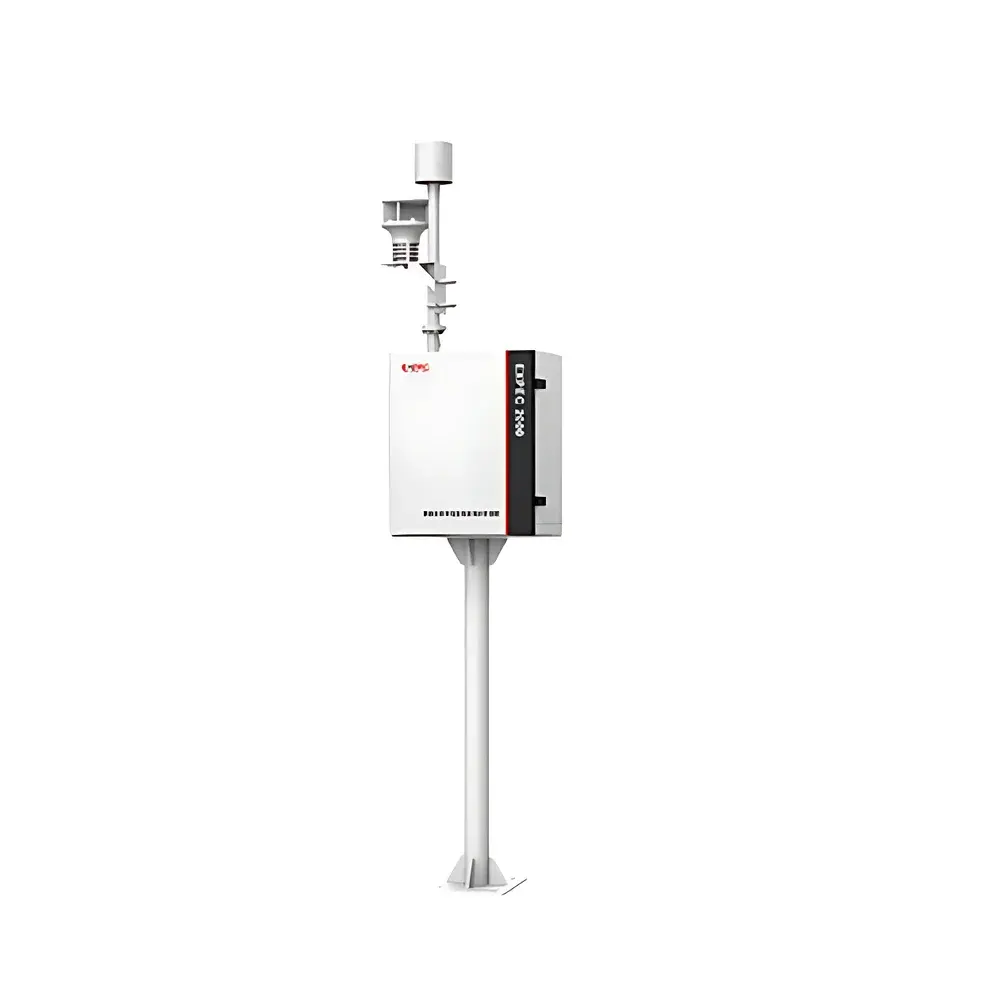
EXPEC 2000 (Model 112) Miniaturized Online Total Non-Methane Hydrocarbons (TNMHC) Analyzer
| Brand | EXPEC / Hangzhou Superspectra Technology Co., Ltd. |
|---|---|
| Origin | Zhejiang, China |
| Manufacturer Type | Authorized Distributor |
| Instrument Category | Domestic |
| Model | EXPEC 2000 (Spec. 112) |
| Instrument Type | Laboratory-Scale Gas Chromatograph with Online Monitoring Capability |
| Detection Principle | GC-FID (Gas Chromatography with Flame Ionization Detection) |
| Sample Introduction | Cryogenic Preconcentration + Thermal Desorption for TNMHC |
| Compliance | Technical Specification for Continuous Automatic Monitoring of Ambient Air TNMHC (Trial Version), China National Environmental Monitoring Centre, January 2021 |
| Installation Form | Wall-Mounted Enclosure |
| Onboard Gas Generation | Integrated Hydrogen Generator (for Carrier and Fuel Gas) |
| Detection Limit | ≤20 ppb (as Carbon) |
| Regulatory Alignment | ASTM D6348, ISO 11890-2, US EPA Method 25A, HJ 1012–2018 |
Overview
The EXPEC 2000 (Model 112) Miniaturized Online Total Non-Methane Hydrocarbons (TNMHC) Analyzer is a compact, wall-mountable gas chromatographic system engineered for unattended, real-time monitoring of non-methane hydrocarbon emissions in ambient air and fugitive emission sources. It implements a dual-path analytical strategy grounded in regulatory-compliant gas chromatography–flame ionization detection (GC-FID). Total hydrocarbons (THC) are first quantified via FID, while methane is selectively separated using a fixed-volume sampling loop and quantified independently on the same detector. TNMHC concentration is derived by arithmetic subtraction (TNMHC = THC − CH₄), ensuring traceability to primary standards. The system employs cryogenic preconcentration at −40 °C followed by rapid thermal desorption to enhance sensitivity for volatile organic compounds (VOCs) in the C₂–C₁₀ range. This architecture satisfies the methodological requirements specified in the “Technical Specification for Continuous Automatic Monitoring of Ambient Air Total Non-Methane Hydrocarbons (Trial Version)”, issued by the China National Environmental Monitoring Centre in January 2021 — a document aligned with internationally recognized principles of VOC speciation and quantification under low-concentration field conditions.
Key Features
- Regulatory-grade methodology: Dual-channel GC-FID configuration with dedicated cryofocusing trap for TNMHC and calibrated loop injection for methane, enabling compliant implementation of the direct subtraction protocol.
- Integrated hydrogen generation: Onboard PEM-based hydrogen generator supplies both carrier gas (H₂) and combustion fuel (H₂) to the FID, eliminating dependency on external gas cylinders and reducing operational overhead.
- Compact wall-mount enclosure: Dimensions optimized for space-constrained deployment—suitable for mounting on fencelines, utility poles, or building exteriors without requiring dedicated monitoring shelters or HVAC infrastructure.
- FID detector with intelligent diagnostics: Equipped with auto-ignition recovery, flame-out detection, and self-calibrating baseline stabilization; supports unattended operation over extended duty cycles (≥72 h between maintenance intervals).
- Low detection capability: Achieves a method detection limit (MDL) of ≤20 ppb as carbon under standard sampling conditions (100 mL sample volume, 30 min preconcentration), verified per HJ 1012–2018 validation protocols.
Sample Compatibility & Compliance
The EXPEC 2000 (112) is validated for continuous analysis of ambient air, stack effluents (diluted), and fence-line air across industrial zones. It accommodates sample matrices containing humidity up to 90% RH (non-condensing) and particulate loading ≤0.3 mg/m³ without filter clogging. All hardware and software workflows conform to data integrity requirements outlined in HJ 1012–2018 and support audit-ready logging per GLP/GMP-aligned practices. While not certified under U.S. EPA PS-8 or EN 15267, its measurement principle and performance envelope align with ASTM D6348 (standard test method for determination of VOCs in ambient air by GC-FID) and ISO 11890-2 (paints and varnishes – determination of VOC content – part 2: gas-chromatographic method). Raw chromatograms, integration parameters, and calibration history are retained with timestamped metadata for regulatory review.
Software & Data Management
The embedded control software provides local touchscreen operation and remote web-based access via HTTPS-secured interface. It supports automated daily zero/span verification using internal calibration gases (CH₄ in N₂, propane in air), configurable alarm thresholds (e.g., >100 ppb TNMHC), and scheduled reporting in CSV/Excel formats compliant with Chinese environmental information platforms (e.g., MEP Emission Monitoring Platform). Audit trails record all user actions—including method edits, calibration events, and manual integrations—with immutable timestamps and operator IDs. Data export includes raw signal files (.dat), processed results (.csv), and QC summary reports—structured for ingestion into enterprise LIMS or third-party environmental data management systems (EDMS). Firmware updates are delivered via signed OTA packages to ensure chain-of-custody integrity.
Applications
- Grid-based ambient air monitoring across chemical industrial parks, supporting source attribution and trend analysis at sub-kilometer resolution.
- Fugitive emission surveillance at perimeter boundaries of petrochemical refineries, ethylene crackers, and polymer manufacturing facilities.
- Real-time compliance verification for facility-level VOC emission limits under China’s “Three-Year Action Plan for Blue Sky Defense” and local environmental protection bureau mandates.
- Short-term campaign monitoring during process upsets, maintenance turnarounds, or odor complaint investigations—deployable within 2 hours without civil works.
- Supplemental verification for sorbent tube–based canister sampling programs, providing high-temporal-resolution context for time-integrated laboratory analyses.
FAQ
Does the EXPEC 2000 (112) require external hydrogen supply?
No. It incorporates an integrated PEM electrolytic hydrogen generator rated for continuous output of ≥30 mL/min at 99.999% purity, sufficient for both carrier and detector fuel requirements.
How is calibration traceability maintained?
Calibration gases are certified to GB/T 5274–2018 (equivalent to ISO 6142) and traceable to NIM (National Institute of Metrology, China); multi-point calibrations are logged with uncertainty budgets per HJ 1012–2018 Annex B.
Can the system operate in outdoor environments with temperature fluctuations?
Yes. The enclosure meets IP54 ingress protection and operates continuously across −10 °C to +45 °C ambient, with internal thermal management stabilizing column oven and detector temperatures to ±0.1 °C.
Is raw chromatographic data accessible for reprocessing?
Yes. Full-resolution FID voltage-time profiles (.dat) and peak tables (.csv) are stored locally for ≥90 days and exportable via USB or SFTP.
What cybersecurity measures are implemented?
Role-based access control (RBAC), TLS 1.2 encryption for web interface, disabled default credentials, and firmware signature verification prevent unauthorized configuration changes or data exfiltration.



