
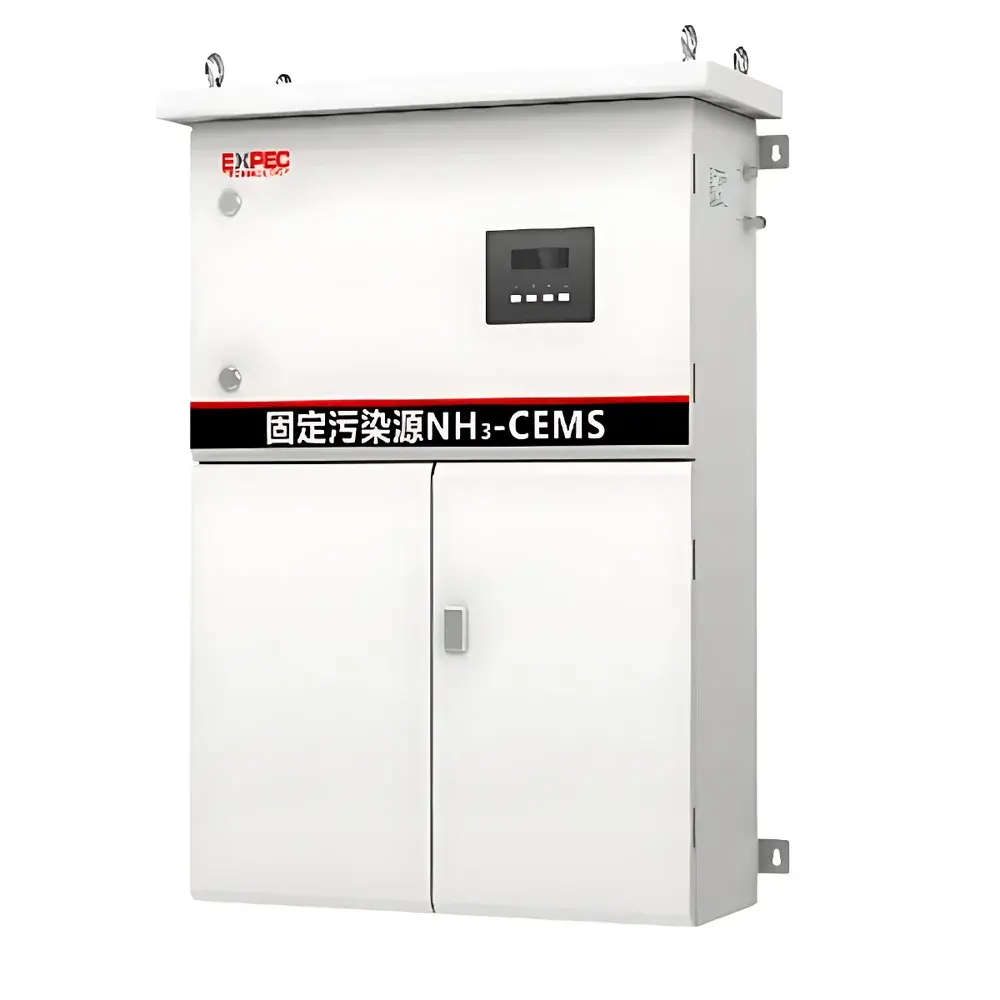
EXPEC 2000 NH₃ Fixed Emission Source Ammonia Online Monitoring System
| Brand | EXPEC (Puyu Technology) |
|---|---|
| Origin | Zhejiang, China |
| Manufacturer Type | Authorized Distributor |
| Country of Origin | China |
| Model | EXPEC 2000 NH₃ |
| Pricing | Available Upon Request |
Overview
The EXPEC 2000 NH₃ Fixed Emission Source Ammonia Online Monitoring System is an industrial-grade continuous emission monitoring system (CEMS) engineered for real-time, quantitative measurement of trace ammonia (NH₃) concentrations in flue gas streams. It employs Tunable Diode Laser Absorption Spectroscopy (TDLAS) coupled with Herriott multi-pass optical cavity enhancement—a well-established photometric technique grounded in Beer–Lambert law principles. This configuration enables highly selective detection of the NH₃ fundamental ro-vibrational absorption line near 1531.7 nm, minimizing spectral overlap with interfering species such as H₂O, CO₂, NO, and SO₂. Designed specifically for compliance-driven environments, the system delivers stable, interference-free quantification of NH₃ at sub-ppb (parts-per-trillion equivalent) detection limits under field conditions—critical for post-selective catalytic reduction (SCR) and selective non-catalytic reduction (SNCR) process control and regulatory reporting.
Key Features
- Herriott-type multi-reflection optical cell providing effective path lengths exceeding 30 meters, significantly enhancing absorbance signal-to-noise ratio and enabling reliable ppb-level NH₃ detection.
- Integrated wall-mount enclosure with compact footprint (< 600 mm × 450 mm × 300 mm), optimized for installation on elevated stack platforms or duct-mounted access points—reducing transport delay and adsorption losses during sampling.
- Fully heated sample conditioning system: entire gas path—including probe, filter, pump, and analyzer cell—is maintained above 180 °C via PID-controlled trace heating, eliminating condensation, ammonium salt formation, and surface adsorption artifacts.
- True in-situ TDLAS architecture with wavelength modulation spectroscopy (WMS) and second-harmonic (2f) detection, ensuring immunity to broadband attenuation (e.g., dust loading, particulate scattering) and baseline drift.
- Modular architecture supporting optional central display unit (CDU) with touchscreen interface, local data logging (≥30 days), Ethernet/RS485 communication, and Modbus TCP protocol for integration into plant DCS/SCADA systems.
Sample Compatibility & Compliance
The EXPEC 2000 NH₃ is validated for use with hot, humid, and particulate-laden flue gases typical of coal-fired power plants, cement kilns, waste incinerators, and chemical manufacturing stacks. It meets key performance criteria outlined in EPA Method 320 (for NH₃), EN 15267-3 (CEMS QAL1 certification framework), and ISO 14956:1998 (ambient air quality—performance criteria for automated measuring systems). While not pre-certified to US EPA PS-11 or MCERTS, its design adheres to functional requirements for QA/QC protocols including daily zero/span checks, linearity verification (5-point calibration), and audit trail logging per ISO/IEC 17025 and GLP-compliant data integrity practices. All firmware and calibration records support time-stamped, user-accessible audit logs compliant with 21 CFR Part 11 when deployed with validated software configurations.
Software & Data Management
Embedded firmware supports automated self-diagnostic routines—including laser wavelength stability monitoring, cavity alignment verification, and heater temperature redundancy validation. Data output includes primary NH₃ concentration (ppb/vol), auxiliary parameters (stack temperature, pressure, flow rate if interfaced), and diagnostic flags (e.g., “low signal”, “cavity misalignment”, “heater fault”). Raw spectral data and processed absorption profiles are exportable via USB or network transfer in CSV/ASCII format. Optional cloud-based remote monitoring platform provides role-based access control, configurable alarm thresholds (email/SMS), historical trend visualization, and automated report generation aligned with national emission reporting templates (e.g., China’s HJ 75-2017 and HJ 76-2017 standards).
Applications
- Post-SCR/SNCR ammonia slip monitoring in thermal power generation and industrial boilers.
- Real-time NH₃ concentration feedback for closed-loop reagent dosing optimization in denitrification systems.
- Compliance verification at stack outlets for pharmaceutical manufacturing (ICH Q5C, FDA guidance on residual solvents), semiconductor fabrication (SEMI F57), and coated packaging facilities subject to VOC/NH₃ co-emission regulations.
- Process troubleshooting in nitric acid production, caprolactam synthesis, and fertilizer granulation lines where NH₃ fugitive emissions impact catalyst lifetime and product purity.
- Research-grade emission characterization in pilot-scale combustion testing and low-NOₓ burner development programs.
FAQ
What is the minimum detectable NH₃ concentration under field operating conditions?
The system achieves a method detection limit (MDL) of ≤0.5 ppb (3σ, 1-minute average) in clean gas matrices; typical stack MDL ranges from 1–3 ppb depending on dust loading and optical transmission loss.
Does the system require periodic calibration with certified NH₃ standard gases?
Yes—daily zero/span verification using NIST-traceable NH₃-in-N₂ standards (0–10 ppm range) is recommended per HJ 76-2017 and internal QA procedures; full multi-point calibration every 30 days ensures long-term accuracy drift remains within ±2% FS.
Can the EXPEC 2000 NH₃ be integrated with existing CEMS infrastructure?
Yes—it supports analog 4–20 mA output, Modbus RTU/TCP, and optional Profibus DP interfaces, allowing seamless integration with third-party data acquisition units and central emission reporting gateways.
Is the analyzer suitable for high-dust applications without external filtration?
It incorporates a sintered metal probe filter (5 µm pore size) and heated cyclonic pre-separator; however, for >10 g/m³ dust loads, an upstream ceramic filter or electrostatic precipitator is advised to maintain optical window cleanliness and long-term reliability.
What maintenance intervals are recommended for routine operation?
Optical windows require cleaning every 90 days in moderate-dust environments; laser diode lifetime exceeds 25,000 hours; all heaters and sensors are field-replaceable with calibrated modules traceable to national metrology institutes.







