
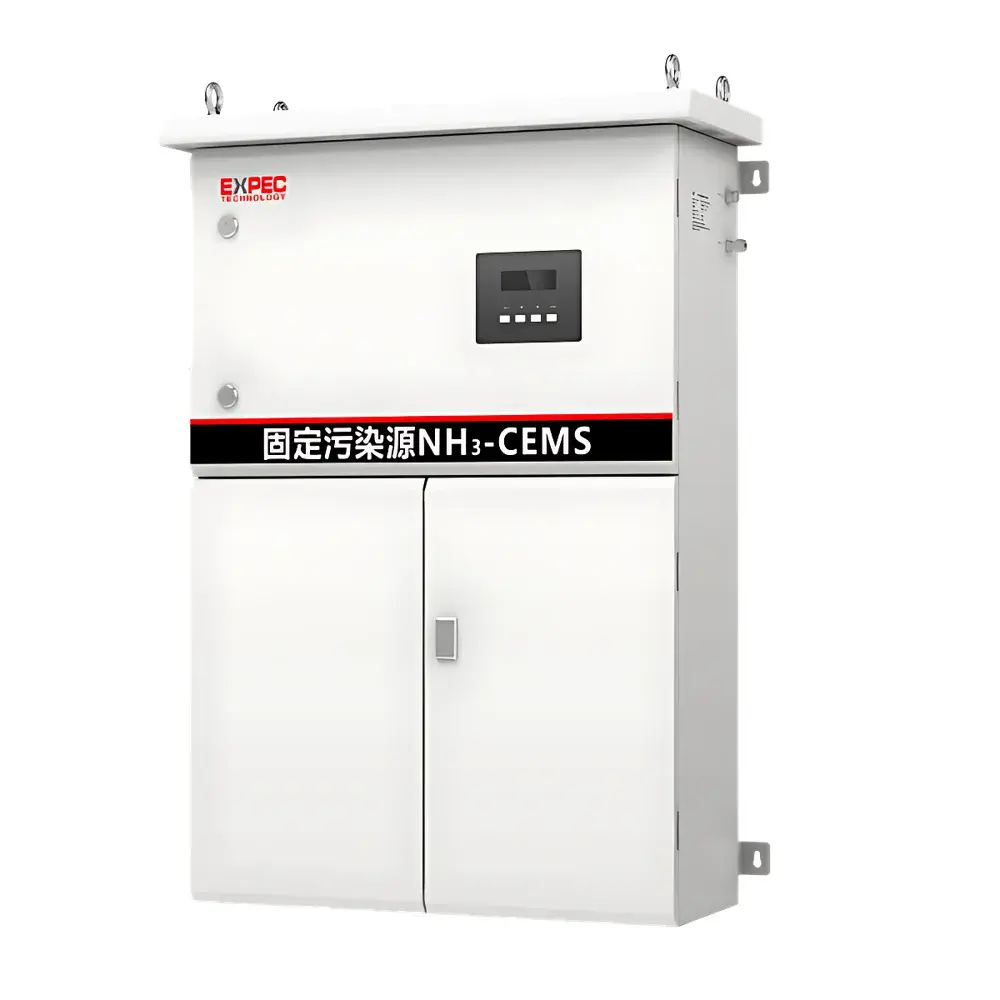
EXPEC 2000 NH₃ Fixed Source Ammonia Continuous Emission Monitoring System (CEMS)
| Brand | EXPEC |
|---|---|
| Origin | Zhejiang, China |
| Manufacturer Type | Original Equipment Manufacturer (OEM) |
| Country of Origin | China |
| Model | EXPEC 2000 |
| Pricing | Upon Request |
Overview
The EXPEC 2000 NH₃ Fixed Source Ammonia Continuous Emission Monitoring System is an engineered solution for real-time, trace-level ammonia (NH₃) quantification in flue gas streams from industrial combustion and selective catalytic reduction (SCR) or selective non-catalytic reduction (SNCR) processes. It employs Tunable Diode Laser Absorption Spectroscopy (TDLAS) — a physics-based, line-selective optical absorption technique — coupled with a Herriott-type multi-pass gas cell to achieve high-sensitivity, interference-free measurement. By exploiting the unique ro-vibrational absorption line of NH₃ near 1531.7 nm (or other temperature- and pressure-stabilized near-infrared transitions), the system delivers quantitative analysis grounded in Beer–Lambert law principles. Its design targets compliance-grade monitoring at emission stacks and ducts where sub-ppb to low-ppm NH₃ concentrations must be resolved under hot, humid, and particulate-laden conditions typical of post-SCR tailgas.
Key Features
- Herriott cavity-enhanced optical path: Achieves effective optical path lengths exceeding 30 meters within a compact cell, improving detection sensitivity by two to three orders of magnitude relative to single-pass configurations.
- Full-path high-temperature sampling: Integrated heated probe, thermostatically controlled sample line (≥180 °C), and heated gas cell eliminate condensation, adsorption, and catalytic loss of NH₃—critical for preserving analyte integrity during transport.
- True TDLAS selectivity: Utilizes narrow-linewidth tunable diode lasers scanned across a single, isolated NH₃ absorption line; inherently immune to spectral overlap from H₂O, CO₂, CO, NOₓ, and hydrocarbon interferences.
- Wall-mounted, space-optimized architecture: All-in-one enclosure enables direct mounting on stack platforms or duct access points—minimizing sample transport distance and thermal lag while reducing installation footprint and maintenance access complexity.
- Robust thermal and mechanical design: Engineered for continuous operation in ambient temperatures ranging from −20 °C to +50 °C and relative humidity up to 95% non-condensing, with IP65-rated housing for outdoor deployment.
Sample Compatibility & Compliance
The EXPEC 2000 NH₃ CEMS is validated for use with flue gases containing particulate loadings ≤100 mg/m³, moisture content up to 20 vol%, and operating pressures between 80–120 kPa (abs). It meets the functional requirements of Chinese HJ 1013–2018 and HJ 75–2017 standards for CEMS performance evaluation and quality assurance. While not pre-certified to EN 15267 or US EPA PS-18, its TDLAS methodology and metrological traceability align with ISO/IEC 17025 principles for analytical instrumentation. Data logging supports audit-ready records compliant with GLP/GMP environmental data integrity expectations, including time-stamped calibration logs, zero/span verification events, and fault diagnostics.
Software & Data Management
The embedded controller runs a real-time Linux-based firmware with dual-channel analog output (4–20 mA), Modbus RTU/TCP, and optional Ethernet/IP interface. The local HMI provides intuitive status visualization, alarm configuration, and manual calibration initiation. Remote access is supported via secure SSH or TLS-enabled web interface (HTTPS), enabling remote diagnostics, firmware updates, and historical trend review. Data export conforms to CSV and XML formats compatible with central SCADA, DCS, or EMS platforms. Audit trails include user login history, parameter changes, and calibration actions—supporting basic 21 CFR Part 11 readiness through configurable electronic signatures and role-based access control.
Applications
This system is deployed across regulated industrial sectors requiring precise post-control NH₃ slip monitoring: coal- and gas-fired power plants with SCR/SNCR systems; petrochemical refineries and ethylene crackers; pharmaceutical manufacturing facilities using ammonia-based synthesis or cleaning; semiconductor fabrication cleanrooms with NH₃ purge lines; cement kilns with alternative fuel firing; and packaging printing operations employing aqueous ammonia in ink formulations. It serves both regulatory reporting (e.g., China’s “Blue Sky Defense Campaign” enforcement) and internal process optimization—enabling dynamic reagent dosing control and catalyst health assessment.
FAQ
What is the typical detection limit for NH₃ under field conditions?
The system achieves a method detection limit (MDL) of ≤0.5 ppb (v/v) for NH₃ in dry, filtered reference gas; field MDLs range from 1–5 ppb depending on stack temperature, moisture, and particulate loading.
Does the system require periodic span gas calibration?
Yes—zero and span verification is recommended at least every 7 days per HJ 75–2017; automated zero/span cycles can be scheduled via software with external gas delivery modules.
Can it operate without a conditioned sample extraction system?
No—the system requires full-path heating and does not support cold-wet extraction; integration with a dedicated heated probe and sample conditioning unit is mandatory.
Is cross-sensitivity to ammonium salts or aerosols addressed?
The optical measurement is specific to gaseous NH₃ only; however, upstream filtration (e.g., sintered metal or ceramic filter at ≥180 °C) is required to prevent deposition of NH₄HSO₄ or NH₄NO₃ aerosols in the gas cell.
What maintenance intervals are recommended for long-term reliability?
Laser source lifetime exceeds 24,000 hours; optical windows require inspection every 6 months; heated line insulation and thermocouple calibration should be verified annually per preventive maintenance protocol.
Related Products







