
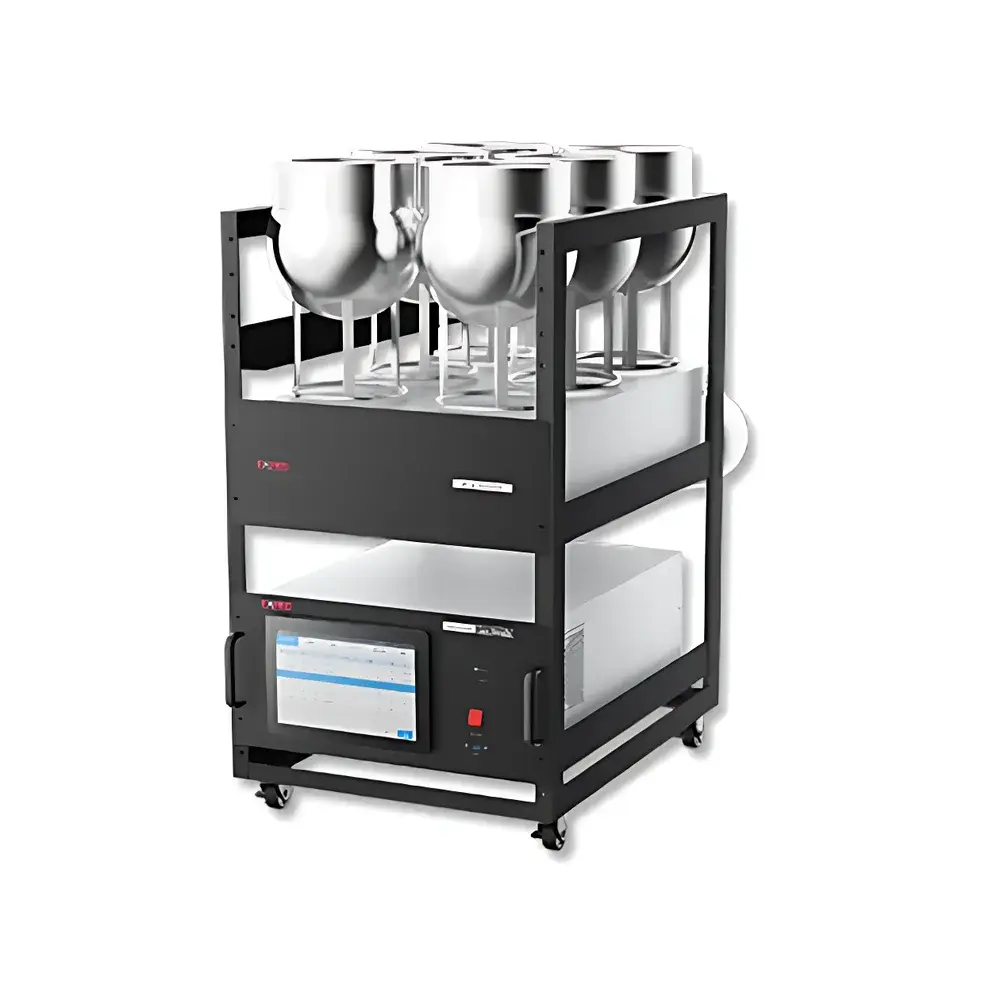
EXPEC 271 SUMMA Canister Automated Sampling System
| Brand | EXPEC (Puyu Technology) |
|---|---|
| Origin | Zhejiang, China |
| Model | EXPEC 271 |
| Sampling Principle | Negative-Pressure Passive Draw |
| Flow Range | 0.2–500 mL/min |
| Response Time for Instantaneous Retention | ≤60 s after threshold exceedance |
| Channel Configuration | Dual independent sampling channels |
| Standard Sampling Positions | 8 (expandable to 16) |
| Flow Path Treatment | Electropolished stainless steel with SilcoNert®/Sulfinert® inert coating and active heating (60–120 °C) |
| Compliance | Designed to meet HJ 759–2015 requirements for ambient VOC monitoring |
Overview
The EXPEC 271 SUMMA Canister Automated Sampling System is an engineered solution for unattended, quantitative collection of volatile organic compounds (VOCs) from ambient air, indoor environments, and occupational settings. It operates on a negative-pressure passive draw principle: the SUMMA canister—pre-evacuated to ultra-high vacuum (typically <1 mTorr)—creates a pressure differential that draws ambient air through an inert, heated flow path without mechanical pump contact. This eliminates pump-induced contamination, catalytic degradation, or flow pulsation artifacts commonly observed in positive-pressure systems. The core architecture prioritizes sample integrity via full-path inertization, thermal management, and valve-driven flow control—ensuring minimal adsorption, negligible memory effects, and high reproducibility across repeated deployments. The system is purpose-built for regulatory-grade VOC monitoring campaigns requiring trace-level accuracy (sub-pptv detection limits post-analysis), long-term unattended operation, and audit-ready chain-of-custody documentation.
Key Features
- Dual-Channel Parallel & Staggered Operation: Two fully independent sampling modules enable simultaneous parallel sampling for statistical validation or sequential staggered acquisition—allowing one channel to collect while the other undergoes canister replacement, leak-checking, or calibration gas introduction—eliminating sampling downtime.
- Threshold-Triggered Instantaneous Retention: Integrated real-time environmental sensor inputs (e.g., optional PID or metal oxide sensor integration) permit programmable event-triggered sampling; upon VOC concentration exceeding user-defined thresholds, the system initiates instantaneous canister closure within ≤60 seconds—critical for capturing transient emission plumes or fugitive releases.
- Heated Inert Flow Path: All wetted surfaces—including tubing, valves, and manifolds—are electropolished 316L stainless steel passivated with SilcoNert® or Sulfinert® coatings and actively heated to 60–120 °C. This prevents condensation of semi-volatiles, suppresses surface adsorption of polar analytes (e.g., aldehydes, organic acids), and minimizes carryover between samples.
- Vacuum Integrity Preservation: A fail-safe rotary isolation valve remains in closed position during standby mode, isolating the canister from ambient pressure fluctuations and micro-leak paths—maintaining vacuum stability over extended deployment periods (>30 days) per HJ 759–2015 specifications.
- Modular Sample Carousel: Standard configuration supports eight 6-L or 1-L SUMMA canisters; field-upgradable to sixteen positions via mechanical and firmware update—enabling multi-day time-series profiling without manual intervention.
Sample Compatibility & Compliance
The EXPEC 271 is validated for use with standard EPA-certified SUMMA canisters (electropolished, silonized interior) and compatible with all major canister-based analytical workflows, including EPA Method TO-14A, TO-15, and ASTM D6196. Its flow control precision (±2% of setpoint across 0.2–500 mL/min range) and pressure stabilization meet HJ 759–2015 requirements for ambient air VOC sampling duration (1–24 hours), integrated flow volume calculation, and leak-check protocols. System firmware logs all operational events—including valve actuation timestamps, flow rate history, vacuum decay rates, and canister ID tracking—with tamper-evident digital signatures compliant with GLP/GMP data integrity expectations. While not FDA 21 CFR Part 11 certified out-of-the-box, audit trails are exportable in CSV/JSON format for integration into validated LIMS environments.
Software & Data Management
The embedded Linux-based controller runs EXPEC’s proprietary FieldSync™ software, accessible via secure web interface (HTTPS) or local Ethernet. Users configure sampling schedules, trigger logic, flow profiles, and alarm thresholds through an intuitive graphical scheduler. All operational metadata—including ambient temperature, relative humidity (when external sensors are connected), barometric pressure, and real-time vacuum status—is time-stamped and stored onboard with 32 GB internal flash memory (retaining >12 months of event logs). Data exports support ISO/IEC 17025-compliant reporting templates and integrate natively with common chromatographic data systems (CDS) via standardized XML schema. Remote diagnostics, firmware updates, and configuration backup/restore are supported over TLS-encrypted connections.
Applications
- Ambient air quality monitoring networks requiring long-term, unattended VOC speciation (e.g., benzene, toluene, C2–C5 alkanes, chlorinated solvents).
- Industrial fence-line and community air monitoring programs aligned with EPA Community Air Monitoring Grants or EU Directive 2008/50/EC.
- Emergency response scenarios—rapid deployment for post-incident VOC mapping following chemical spills, refinery leaks, or fire-related emissions.
- Occupational exposure assessment in manufacturing, painting, printing, and semiconductor fabrication facilities.
- Research-grade atmospheric chemistry studies, including photochemical aging experiments and source apportionment modeling using receptor models (e.g., PMF, CMB).
FAQ
Does the EXPEC 271 require an external power supply or battery operation?
The system operates on 100–240 VAC, 50/60 Hz input; optional external 12 VDC battery packs are available for field-deployable off-grid operation up to 72 hours.
Can it be integrated with third-party environmental sensors (e.g., meteorological stations or gas detectors)?
Yes—via RS-485 Modbus RTU or analog 4–20 mA inputs, enabling conditional sampling based on wind direction, NO₂ concentration, or particulate matter levels.
Is calibration traceable to NIST or national metrology institutes?
Flow controllers are factory-calibrated using NIST-traceable primary standards; users receive a calibration certificate with uncertainty budget per ISO/IEC 17025 guidelines.
What maintenance intervals are recommended for long-term reliability?
Valve manifold inspection and inert coating verification every 12 months; heated line cleaning with nitrogen purge every 3 months in high-humidity environments.
How is canister leak-check functionality implemented?
The system performs automated pressure-rise tests per EPA Method TO-15 Appendix B: monitors vacuum decay over 30 minutes, calculates leak rate (mTorr·L/s), and flags results exceeding 0.5 mTorr/h threshold.



