
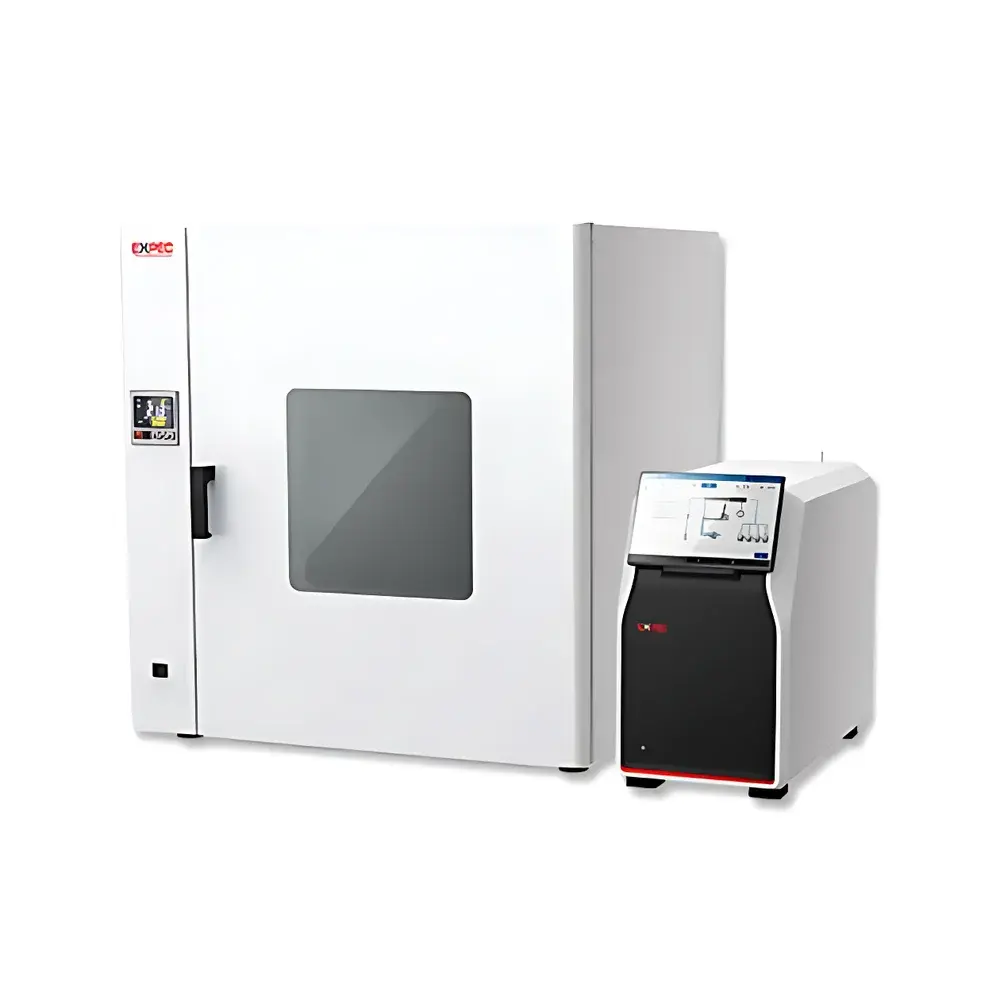
EXPEC 273 SUMMA Canister Cleaning and Evacuation System
| Brand | EXPEC (Puyu Technology) |
|---|---|
| Origin | Zhejiang, China |
| Model | EXPEC 273 |
| Pump Configuration | Oil-free dual-pump system (integrated diaphragm pump + molecular turbomolecular pump) |
| Compliance | EPA Method TO-14A, TO-15A, and HJ 759-2015 |
| Control Interface | External tablet via Wi-Fi (no dedicated PC required) |
| Cleaning Modes | Dry purge, humidified rinse, heated humidified rinse |
| Vacuum Performance | ≤5 mTorr base pressure |
| Throughput | Configurable for 4-position desktop station or 8-position oven-integrated station |
| Certifications | Designed for GLP-compliant laboratories |
Overview
The EXPEC 273 SUMMA Canister Cleaning and Evacuation System is an engineered solution for the rigorous decontamination, rinsing, and high-vacuum evacuation of electropolished stainless-steel SUMMA canisters and glass sampling vials used in ambient air, indoor air, and occupational hygiene monitoring. Based on standardized dynamic purging and vacuum-assisted desorption principles, the system ensures quantitative removal of residual volatile organic compounds (VOCs), semi-volatile organic compounds (SVOCs), and trace-level inorganic gases—critical for minimizing carryover and maintaining analytical integrity across sequential sampling campaigns. Its architecture adheres to the procedural requirements defined in U.S. EPA Methods TO-14A (Determination of Volatile Organic Compounds [VOCs] in Ambient Air Using Summa Polished Canisters and Gas Chromatography/Mass Spectrometry [GC/MS]) and TO-15A (Determination of Volatile Organic Compounds (VOCs) in Air Collected in Electropolished Stainless Steel Containers and Analyzed by Gas Chromatography/Mass Spectrometry), as well as China’s HJ 759–2015 Standard Method for Determination of Volatile Organic Compounds in Ambient Air—SUMMA Canister Sampling/GC-MS Method.
Key Features
- Oil-free dual-pump vacuum architecture: Integrated diaphragm pump (for rough pumping and initial evacuation) and molecular turbomolecular pump (for high-vacuum generation down to ≤5 mTorr), eliminating hydrocarbon contamination risks associated with oil-lubricated systems.
- Humidified cleaning capability: Programmable introduction of controlled humidity (via integrated steam generator or humidified N₂ stream) during rinse cycles enhances removal efficiency for polar VOCs and water-soluble analytes, directly addressing limitations observed in dry-purge-only protocols.
- Heated chamber option: Optional temperature-controlled environment (up to 60 °C) improves desorption kinetics for higher-boiling-point compounds and accelerates moisture removal post-rinse.
- Automated leak verification: Built-in pressure-rise test algorithm performs real-time vacuum integrity assessment after evacuation, logging pass/fail status with timestamped records per canister cycle.
- Wi-Fi-enabled tablet interface: Android-based external tablet communicates wirelessly with the main controller; no local PC installation, driver configuration, or network cabling required—reducing IT dependency and simplifying deployment in mobile labs or field-deployable setups.
- Modular station design: Supports two configurations—4-port benchtop station for routine QC lab use, or 8-port integration with a temperature-controlled drying oven for high-throughput environmental monitoring programs.
Sample Compatibility & Compliance
The EXPEC 273 is validated for use with standard 6-L and 1-L electropolished SUMMA canisters (SilcoCan®, Entech-style), as well as 4–22 mL borosilicate glass vials with PTFE/silicone septa. All cleaning protocols are traceable to regulatory method requirements: full alignment with EPA TO-14A/TO-15A section 8.3 (Canister Cleaning Procedure) and HJ 759–2015 Clause 7.4 (Cleaning and Passivation of Sampling Containers). The system generates electronic log files—including cycle start/end time, vacuum decay rate, final pressure, humidity setpoint, and temperature profile—that comply with data integrity expectations under GLP and ISO/IEC 17025 frameworks. Audit trails are exportable in CSV format and support 21 CFR Part 11–compatible user authentication when deployed with enterprise identity management.
Software & Data Management
The embedded control firmware runs on a real-time Linux kernel and interfaces with a purpose-built Android application. Each cleaning sequence is stored with metadata (operator ID, canister ID, method template name, environmental sensor readings). The software enforces method-locking: only pre-approved cleaning templates—configured with validated pressure ramps, dwell times, humidity levels, and thermal profiles—can be executed. All parameter changes require supervisor-level authentication. Raw vacuum decay curves and humidity response logs are retained onboard for ≥90 days and synchronizable to network storage via configurable SFTP push. No cloud hosting or third-party telemetry is enabled by default—data sovereignty remains fully under laboratory control.
Applications
- Environmental air monitoring networks requiring strict canister re-use protocols between sampling events.
- Emergency response deployments where rapid turnaround of certified-clean canisters is essential for time-critical VOC screening.
- Occupational exposure assessment in industrial hygiene labs processing large volumes of personal breathing zone samples.
- Public health surveillance studies tracking urban atmospheric benzene, formaldehyde, or ozone precursors over multi-season campaigns.
- Method development laboratories validating new extraction efficiencies or evaluating alternative rinsing agents (e.g., isotopically labeled internal standards for recovery correction).
FAQ
Does the EXPEC 273 meet EPA TO-15A validation criteria for blank performance?
Yes—the system achieves <0.5 ppbv total VOC blank levels across three consecutive cleaning cycles when operated per the recommended humidified 60 °C protocol, satisfying TO-15A Section 8.3.2 acceptance thresholds.
Can the system be integrated into a LIMS workflow?
Yes—CSV-formatted cycle reports include unique canister barcode fields and ISO 8601 timestamps, enabling direct ingestion into common LIMS platforms via flat-file import or REST API adapters (custom integration support available).
Is operator training required prior to first use?
A 4-hour onsite or virtual commissioning session is included with purchase, covering safety interlocks, method template configuration, log file retrieval, and preventive maintenance intervals for pump modules and humidity sensors.



