
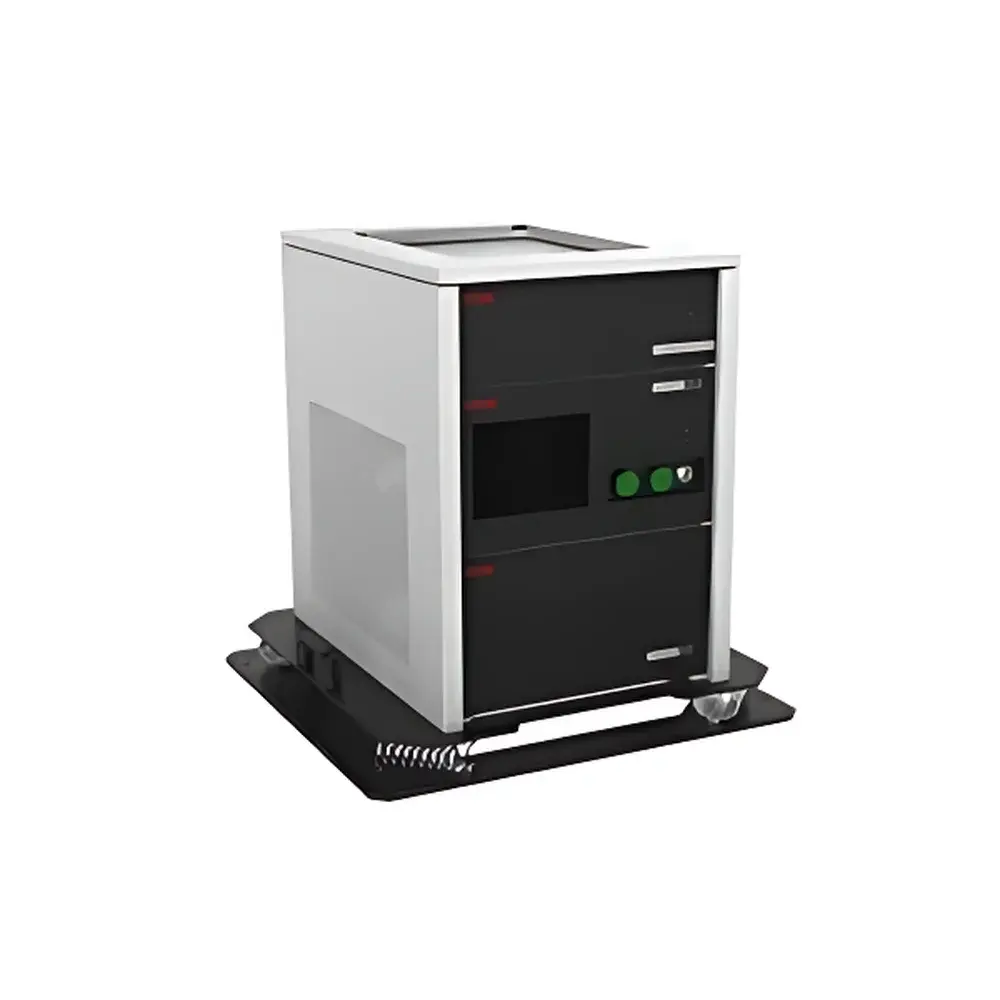
EXPEC 3500 Plus Dual-Channel Mobile VOCs Mass Spectrometry Monitoring System
| Brand | EXPEC (Puyu Technology) |
|---|---|
| Origin | Zhejiang, China |
| Model | EXPEC 3500 Plus |
| Instrument Type | Portable |
| Detection Principle | Gas Chromatography–Mass Spectrometry (GC-MS) and Direct Electron Ionization Mass Spectrometry (EI-MS) |
| Configuration | Dual-Channel Integrated VOCs Analyzer |
| Compliance | Designed for field-deployable environmental monitoring per ISO 16000-6, ASTM D6196, and EPA Method TO-15/TO-17 frameworks |
| Sample Introduction | Real-time direct inlet + automated thermal desorption GC-MS module |
Overview
The EXPEC 3500 Plus Dual-Channel Mobile VOCs Mass Spectrometry Monitoring System is an integrated, vehicle-mounted analytical platform engineered for high-temporal-resolution volatile organic compound (VOC) surveillance in ambient air. It uniquely combines two orthogonal detection modalities within a single chassis: real-time direct electron ionization mass spectrometry (EI-MS) for sub-second response and continuous total VOC (TVOC) and speciated VOC profiling, and a fully automated gas chromatography–mass spectrometry (GC-MS) module for confirmatory identification and quantification of complex mixtures. This dual-channel architecture enables simultaneous acquisition of time-resolved qualitative/quantitative data—addressing the fundamental operational tension between speed and analytical rigor inherent in mobile emission mapping. The system operates without pre-concentration traps during direct MS mode, achieving 1 Hz spectral acquisition with unit-mass resolution (m/Δm ≥ 1,000 at m/z 69), while the GC-MS channel employs cryo-focusing and programmable temperature vaporization to resolve co-eluting isomers and low-volatility compounds (C₂–C₁₆). Its design conforms to the functional requirements of regulatory-grade mobile monitoring as defined in ISO 16000-6 (indoor air) and adapted for ambient applications under EPA Compendium Method TO-15 and ISO 21674.
Key Features
- Dual-sensor architecture: Independent real-time EI-MS channel (1 s cycle time) and GC-MS confirmation channel (5–12 min run time per sample) operating concurrently
- Automated thermal desorption system with dual-bed Tenax TA/Carbograph 1TD sorbents, compliant with ISO 16017-1 sampling protocols
- NIST 2022 Mass Spectral Library integration for on-board spectral matching (match factor ≥ 800 required for positive identification)
- On-vehicle calibration gas delivery system supporting multi-point dynamic calibration using certified PAMS (Photochemical Assessment Monitoring Stations) standards
- Ruggedized chassis with IP54-rated enclosure, shock-absorbed optical bench, and climate-controlled MS source compartment (operating range: −10 °C to +40 °C)
- Integrated GPS-IMU navigation module synchronized to spectral acquisition timestamps at ≤10 cm positional accuracy (RTK-GNSS enabled)
Sample Compatibility & Compliance
The EXPEC 3500 Plus accepts ambient air samples via heated stainless-steel inlet (120 °C) with particle filtration (PM₂.₅ cut-off). It detects >1,000 VOCs across chemical classes including alkanes, aromatics, halogenated hydrocarbons (chlorinated/brominated), oxygenates (esters, ketones, ethers), and sulfur-containing compounds. Detection capability spans C₂–C₁₆ species with method detection limits (MDLs) < 50 pptv for BTEX and < 200 pptv for chlorinated ethenes under GC-MS mode. All analytical workflows support audit-ready data integrity: full electronic lab notebook (ELN) logging, user access control (role-based permissions), and 21 CFR Part 11-compliant audit trails for instrument method changes, calibration events, and report generation. Data output complies with ISO/IEC 17025:2017 documentation requirements for field-deployed testing laboratories.
Software & Data Management
The proprietary EXPEC AirSight™ software suite provides synchronized visualization of real-time MS spectra, GC chromatograms, georeferenced concentration heatmaps, and temporal trend overlays. Raw data are stored in vendor-neutral mzML format; processed results export to CSV, NetCDF, or EPA-compatible AQS-XML schema. The system supports remote diagnostics via TLS-encrypted MQTT communication and integrates with national air quality platforms (e.g., CNEMC’s “Blue Sky” network) through standardized RESTful APIs. All quantitative results include uncertainty propagation based on calibration curve residuals, detector noise floor, and retention time stability metrics—reported per ISO/IEC Guide 98-3 (GUM).
Applications
- Urban and industrial park-wide VOC mapping via systematic grid-based mobile surveys, generating high-resolution spatial emission inventories
- Regulatory enforcement support: rapid screening of fence-line emissions from petrochemical, coating, and printing facilities with immediate compound-specific attribution
- Odor complaint investigation: correlation of elevated terpene, sulfide, or amine signals with facility operational logs and meteorological back-trajectories
- Emergency response: deployment within 15 minutes of incident notification to characterize unknown plume composition and assess acute exposure risks
- Source apportionment modeling: provision of speciated input data for PMF (Positive Matrix Factorization) and CMB (Chemical Mass Balance) receptor models
FAQ
What regulatory standards does the EXPEC 3500 Plus meet for field VOC monitoring?
It aligns with ISO 16000-6 for sampling strategy, ASTM D6196 for sorbent tube methodology, and EPA Method TO-15/TO-17 for GC-MS analysis—validated through interlaboratory comparison studies conducted under CNEMC oversight.
Can the system operate autonomously during extended drive missions?
Yes. With onboard UPS (≥90 min runtime) and automatic GC column conditioning cycles, it sustains unattended operation for up to 8 hours per charge; all sequences are scriptable via AirSight™ Scheduler.
How is data traceability ensured during chain-of-custody scenarios?
Each spectrum and chromatogram carries embedded cryptographic hashes, digital signatures, and immutable metadata (GPS coordinates, barometric pressure, relative humidity, operator ID), satisfying GLP/GMP field data integrity requirements.
Is method validation documentation available for regulatory submission?
Full validation packages—including precision/recovery studies, matrix interference assessments, and limit of detection (LOD) verification reports—are provided upon system commissioning and updated annually per ISO/IEC 17025 clause 7.7.
Does the system support custom library expansion beyond NIST?
Yes. Users may import proprietary spectral libraries in NIST .msp format or generate reference spectra from in-house standards using the built-in tune-and-calibrate workflow.
Related Products







