
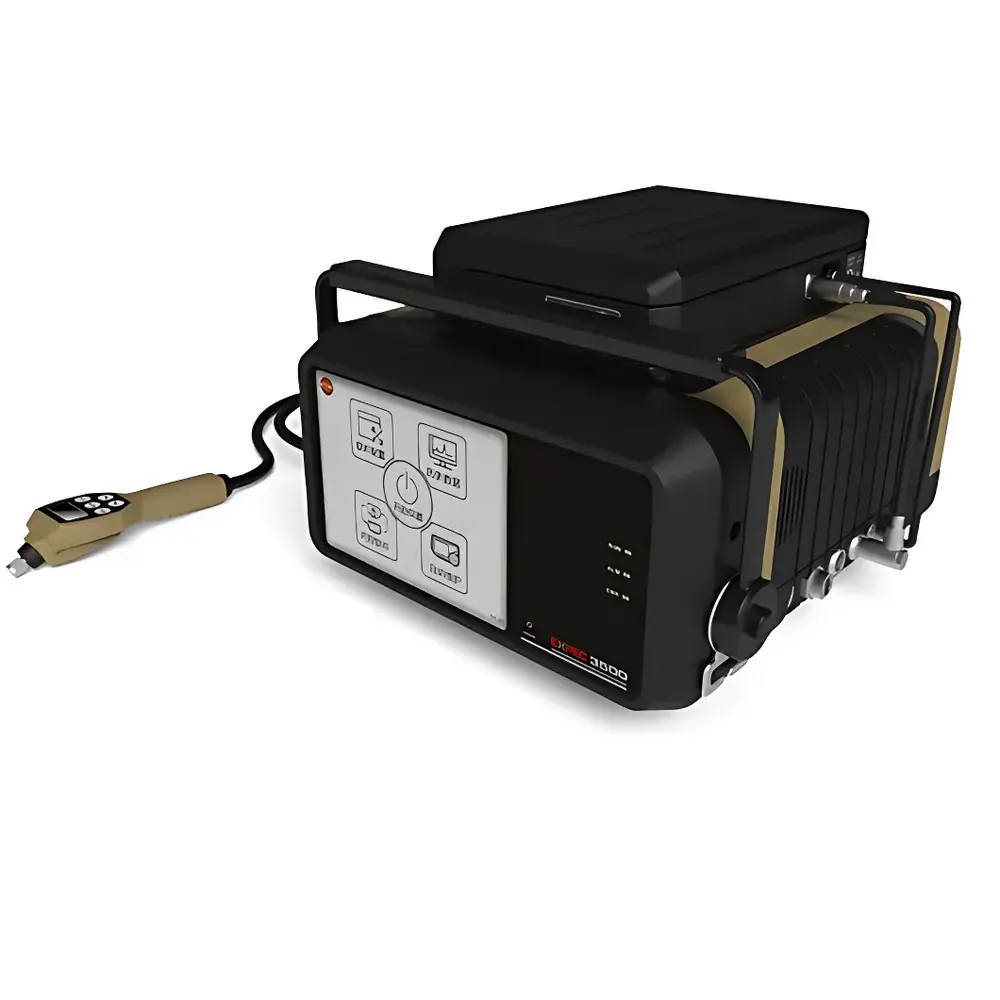
EXPEC 3500 Portable Gas Chromatography-Mass Spectrometry System
| Brand | EXPEC (Puyu Technology) |
|---|---|
| Origin | Zhejiang, China |
| Model | EXPEC 3500 |
| Instrument Type | Portable GC-MS |
| Application Scope | Field-based VOCs and SVOCs analysis in air, water, and soil |
| Compliance Basis | MIL-STD-810G vibration & shock testing for vacuum system |
| Operational Interface | Guided workflow with real-time Chinese-language data display |
| Maintenance Mode | Automated full-system self-maintenance with scheduled unattended diagnostics |
Overview
The EXPEC 3500 Portable Gas Chromatography-Mass Spectrometry (GC-MS) System is an integrated field-deployable analytical platform engineered for rapid, on-site identification and quantification of volatile organic compounds (VOCs) and semi-volatile organic compounds (SVOCs) in environmental matrices. Built upon conventional electron ionization (EI) mass spectrometry coupled with capillary gas chromatography, the system employs pulsed internal ion source technology combined with thermal desorption sampling to achieve sub-ppb detection limits for a broad spectrum of target analytes—including benzene, toluene, ethylbenzene, xylenes (BTEX), polycyclic aromatic hydrocarbons (PAHs), organochlorine pesticides, and phthalate esters—under ambient field conditions. Its design prioritizes operational robustness in non-laboratory settings: the vacuum system has been validated per MIL-STD-810G procedures for mechanical shock and broadband vibration, ensuring stable mass spectral acquisition during transit or operation on uneven terrain. Unlike benchtop GC-MS systems requiring climate-controlled environments and continuous power infrastructure, the EXPEC 3500 operates autonomously from battery or vehicle DC supply, enabling deployment in emergency response scenarios where laboratory turnaround time is prohibitive.
Key Features
- Pulsed internal ion source architecture optimized for field stability and low-power consumption, minimizing ion signal drift during extended mobile operation.
- Integrated thermal desorption module with pre-concentration capability, supporting direct air sampling or solid-phase microextraction (SPME) fiber analysis without off-site sample preparation.
- Pre-evacuation and back-flush functionality: pre-purge ensures representative sample introduction by saturating the transfer line; back-flush removes high-boiling matrix interferences, enhancing reproducibility and extending column lifetime.
- Ruggedized mechanical design compliant with military-grade environmental stress screening (ESS), including operational performance verification after 30 min of 5–500 Hz random vibration exposure.
- Automated maintenance sequence initiated via single-button command: executes vacuum pump oil conditioning, ion source cleaning, detector calibration, and filament activation in predefined order without user intervention.
- Unattended periodic self-diagnostics: configurable maintenance intervals trigger system-level leak checks, pressure stabilization verification, and mass axis validation using internal reference ions.
Sample Compatibility & Compliance
The EXPEC 3500 accepts gaseous samples via direct draw or canister integration, aqueous extracts following purge-and-trap concentration, and solid-phase extracts (e.g., soil headspace, sorbent tubes). It supports EPA Method TO-17 for air sampling and aligns with ISO 16000-6 for indoor air VOC analysis workflows. While not certified under FDA 21 CFR Part 11, its audit trail functionality records all method parameters, operator ID, instrument status flags, and raw spectral metadata—enabling GLP-compliant data review. All software-generated reports include embedded timestamps, digital signatures, and version-stamped method files to support regulatory traceability in environmental monitoring programs governed by national standards such as HJ 639–2012 (China) and ASTM D5710–20.
Software & Data Management
The embedded operating system delivers a guided, step-by-step interface—from startup initialization through chromatographic method selection, real-time peak tracking, library matching (NIST MS Search 2.4 compatible), and quantitative report generation. All spectral data are stored in open-format .mzML files, ensuring interoperability with third-party processing tools. Quantitative results are cross-referenced against built-in regulatory thresholds (e.g., WHO air quality guidelines, US EPA IRIS values) and displayed alongside confidence scores derived from retention index deviation and spectral match factor (AMDIS-compatible deconvolution). Data export supports CSV, PDF, and XML formats; network-enabled units permit secure FTP upload to centralized LIMS platforms.
Applications
- Emergency response: Rapid identification of chemical warfare agent simulants, industrial solvent releases, or illicit drug manufacturing precursors at incident sites.
- Environmental field surveys: Real-time mapping of VOC plumes in landfill perimeter monitoring, refinery fence-line air quality assessment, or groundwater plume delineation.
- Occupational hygiene: Personal breathing zone sampling for workplace exposure evaluation per OSHA Method 05 and NIOSH Method 1501.
- Public safety screening: Detection of accelerants in fire debris or explosives residues in post-blast investigations.
- Academic and method development labs: Platform for optimizing field-adapted GC-MS methods, studying matrix effects in complex environmental samples, or validating portable sensor networks.
FAQ
What sample introduction methods does the EXPEC 3500 support?
It supports direct air aspiration, thermal desorption of sorbent tubes (e.g., Tenax TA, Carbopack B), and headspace analysis of aqueous or solid samples using integrated heating modules.
Is the system compatible with standard GC-MS libraries?
Yes—it imports NIST MS Search-compatible spectral libraries (.msp) and supports user-defined custom libraries with retention index indexing.
How is data integrity ensured during field operation?
All acquisitions log instrument configuration, environmental sensor readings (temperature, pressure, humidity), and operator inputs into a tamper-evident metadata stream embedded within each raw file.
Can the EXPEC 3500 be integrated into existing LIMS or GIS platforms?
Yes—via configurable RESTful API endpoints and scheduled FTP/SFTP transfers; metadata schema follows ASTM E1461-21 for analytical instrument data exchange.
What maintenance is required between deployments?
No routine manual servicing is needed; the automated maintenance cycle handles vacuum integrity checks, ion source conditioning, and mass calibration—typically executed every 72 operational hours or prior to critical missions.






