
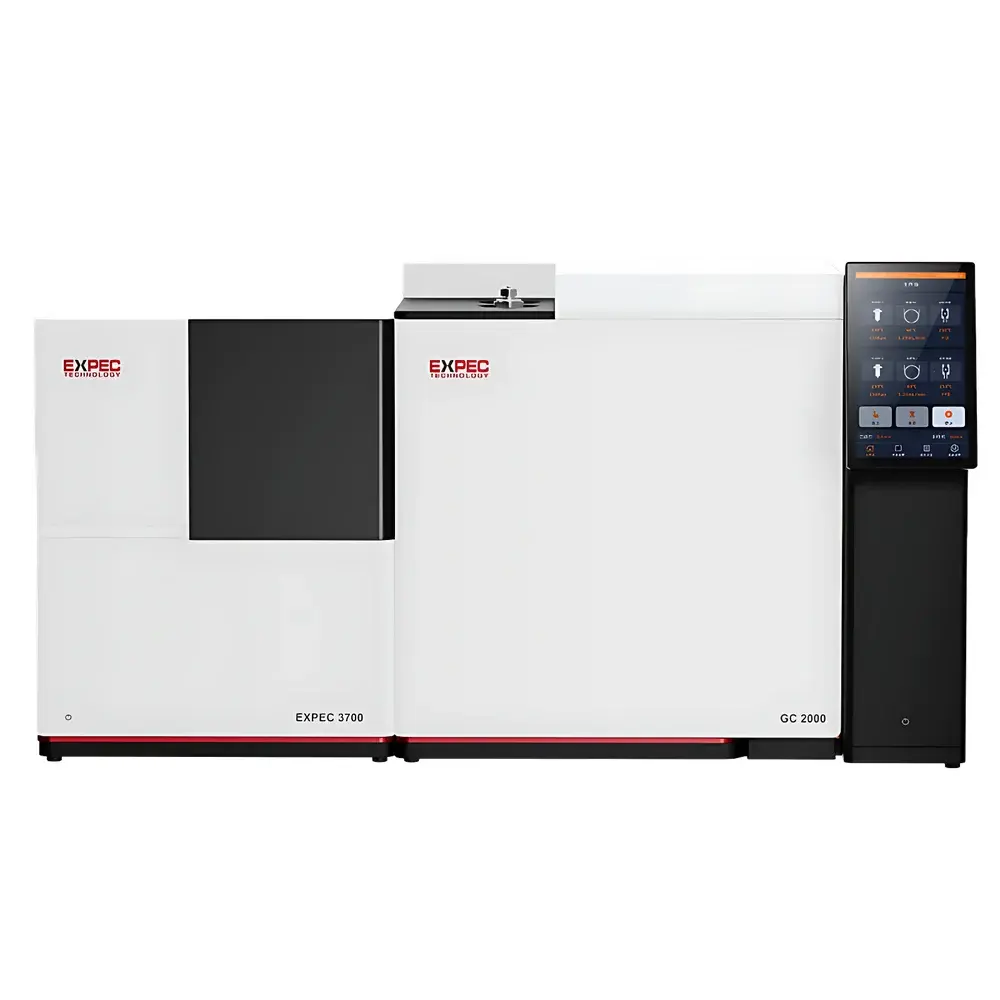
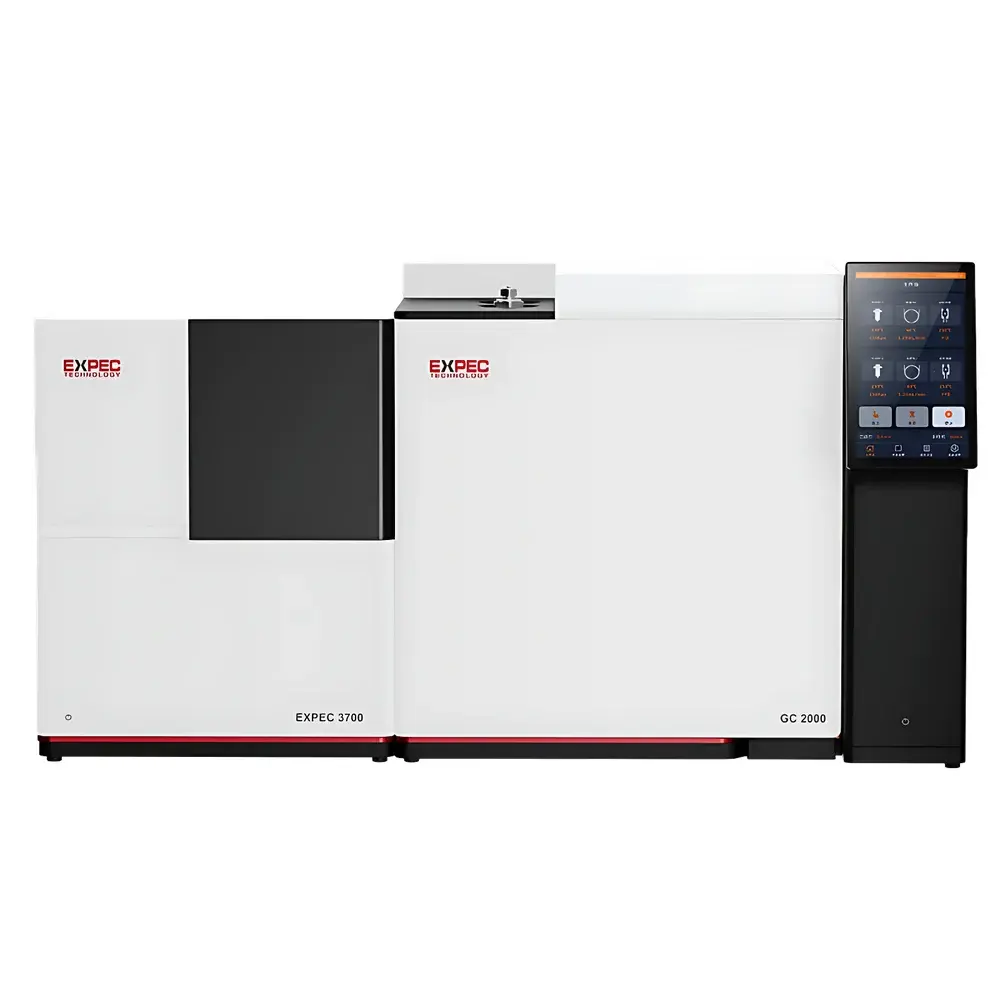
EXPEC 3700 Gas Chromatography–Quadrupole Mass Spectrometer (GC-MS)
| Brand | EXPEC / Superspectra |
|---|---|
| Origin | Zhejiang, China |
| Manufacturer Type | Authorized Distributor |
| Instrument Type | Single Quadrupole Mass Spectrometer |
| GC Configuration | Conventional Capillary GC |
| Vacuum System | High-Speed Turbo Molecular Pump + Optional Integrated Scroll Roughing Pump |
| Ion Source | High-Temperature Inert Dual-Filament Electron Ionization Source |
| Quadrupole | All-Molybdenum Pre- and Main Quadrupoles |
| Detector | Off-Axis Channeltron Electron Multiplier |
| Inlet | Heated Inert Split/Splitless Injector with Electronic Pressure Control (EPC) |
| Software | VOCs Intelligent Diagnostics Platform with Real-Time Alarm Logic |
| Display | 8-inch Android-Based Touchscreen Interface |
| Compliance | Designed for ISO/IEC 17025-compliant laboratories |
Overview
The EXPEC 3700 Gas Chromatography–Quadrupole Mass Spectrometer (GC-MS) is an engineered solution for routine and targeted volatile and semi-volatile organic compound analysis in regulated and research environments. Based on established electron ionization (EI) quadrupole mass spectrometry coupled with capillary gas chromatography, the system delivers high reproducibility, long-term signal stability, and robust performance under continuous operational demands. Its core architecture integrates a thermally stable, inert ion source with dual tungsten-rhenium filaments, a fully metallic molybdenum pre-quadrupole and main quadrupole assembly, and an off-axis channeltron detector—collectively minimizing background noise, reducing neutral ion interference, and sustaining sensitivity across extended acquisition cycles. The vacuum system employs a high-speed turbo molecular pump backed by an optional integrated scroll roughing pump, maintaining base pressures below 1×10⁻⁶ Torr during operation—critical for low-detection-limit quantitation and extended column lifetime.
Key Features
- Inert, high-temperature electron ionization (EI) source with dual replaceable filaments ensures >10,000 analyses without source cleaning or recalibration under standard operating conditions.
- All-molybdenum pre-quadrupole eliminates fringe field distortion and enables periodic surface refurbishment via mechanical polishing—extending quadrupole service life beyond 5 years in high-throughput labs.
- Off-axis channeltron electron multiplier detector suppresses direct line-of-sight neutral particle detection, improving signal-to-noise ratio by up to 3× compared to axial configurations for trace-level analytes (e.g., PAHs, PCBs, chlorinated pesticides).
- Capillary GC inlet equipped with electronic pressure/flow control (EPC) and full-zone heating (up to 450 °C), including heated transfer lines and Deans Switch-enabled heart-cutting capability for simultaneous dual-column separation of complex VOC mixtures.
- Integrated 8-inch Android-based touchscreen interface provides local method setup, real-time chromatogram viewing, and diagnostic status monitoring—without dependency on external PCs or proprietary OS licenses.
- Optional pump service module includes a vibration-isolated scroll roughing pump, self-locking casters, and drawer-style oil collection—designed for mobile labs, field-deployable air monitoring stations, and facilities with limited infrastructure.
Sample Compatibility & Compliance
The EXPEC 3700 accommodates standard 0.25–0.53 mm ID fused silica capillary columns (up to 60 m length) and supports common EI library matching (NIST, Wiley). It meets essential hardware and software requirements for compliance with EPA Methods 8260D, 8270E, and 8082A; ISO 16000-6 for indoor air VOC profiling; and ASTM D5504 for sulfur compounds in natural gas. Data integrity features—including user role-based access control, electronic signatures, and time-stamped audit trails—align with FDA 21 CFR Part 11 expectations for regulated quality control workflows. The instrument’s mechanical design conforms to IEC 61010-1 safety standards for laboratory analytical equipment.
Software & Data Management
The VOCs Intelligent Diagnostics Platform provides automated system suitability checks, real-time vacuum health monitoring, filament emission trending, and proactive alerting for out-of-spec parameters (e.g., source temperature deviation >±5 °C, quadrupole RF/DC ratio drift >2%). Raw data files are stored in open-format .CDF (NetCDF) containers compatible with third-party processing tools (e.g., OpenChrom, MS-DIAL). Batch processing supports AIA-compliant peak integration, isotope ratio correction, and internal standard normalization. All method files and audit logs are encrypted at rest and support network backup via SMB/CIFS protocols.
Applications
The EXPEC 3700 is validated for quantitative and qualitative analysis of volatile organic compounds (VOCs), semi-volatile organic compounds (SVOCs), and halogenated contaminants in environmental matrices—including ambient air (canister and sorbent tube extracts), soil headspace, wastewater effluents, food packaging migrants, and refinery process streams. Its thermal stability and inert flow path make it especially suitable for reactive species (e.g., aldehydes, terpenes, organophosphorus compounds) and thermally labile pesticides. Routine use cases include urban air toxics monitoring networks, industrial fence-line emissions verification, photochemical oxidant precursor profiling, and method development for emerging contaminants (e.g., PFAS precursors, nitrosamines).
FAQ
Does the EXPEC 3700 support SIM mode for improved detection limits?
Yes—the instrument operates in full-scan, selected ion monitoring (SIM), and targeted scan modes, with configurable dwell times down to 10 ms per ion.
Is the quadrupole temperature-controlled?
No—its all-molybdenum construction provides intrinsic thermal inertia and dimensional stability, eliminating the need for active temperature regulation while maintaining mass accuracy within ±0.1 Da over 24-hour runs.
Can the system be integrated into a LIMS environment?
Yes—via standard ODBC drivers and configurable CSV/XML export templates, enabling bidirectional data exchange with major LIMS platforms (e.g., LabWare, Thermo SampleManager, STARLIMS).
What maintenance intervals are recommended for the ion source?
Under typical environmental analysis workloads (50 samples/day), source cleaning is advised every 3–6 months; filament replacement is typically required every 12–18 months based on cumulative emission hours.
Is remote diagnostics supported?
Yes—the embedded Android OS includes secure SSH and VNC server options for authorized technical support personnel, subject to customer-configured firewall policies and TLS 1.2+ encryption.






