
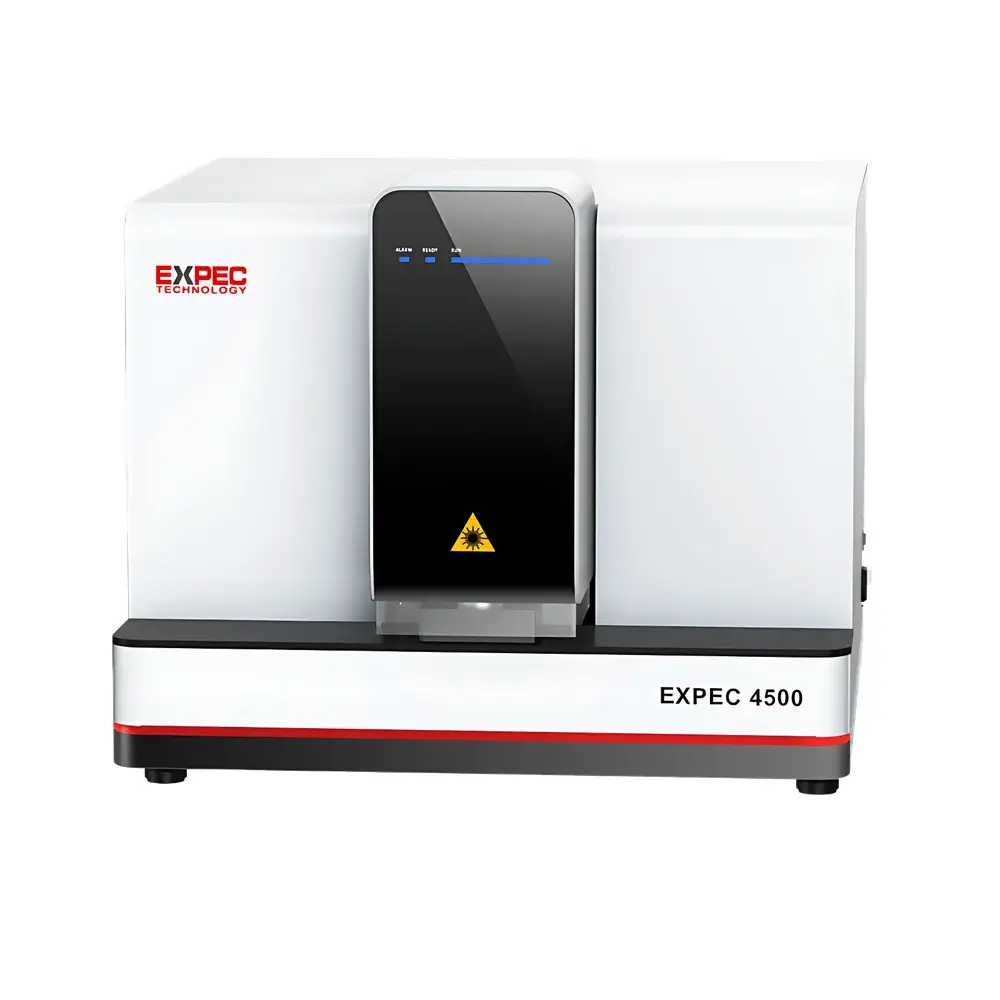
EXPEC 4500 Benchtop Laser-Induced Breakdown Spectroscopy (LIBS) System
| Brand | EXPEC / Superspectra |
|---|---|
| Origin | Zhejiang, China |
| Instrument Type | Benchtop |
| Model | EXPEC 4500 |
| Compliance | CE-marked for laboratory use |
| Sample Form Compatibility | Solid bulk, pressed pellets, powders (no digestion required) |
| Analysis Speed | Qualitative identification in <1 s |
| Software Platform | EXPEC LIBS Studio v3.2 (Windows 10/11, 64-bit) |
| Data Security | Audit trail enabled, compliant with GLP and ISO/IEC 17025 documentation requirements |
| Regulatory Alignment | Supports 21 CFR Part 11-compliant user access control and electronic signature configuration (optional module) |
Overview
The EXPEC 4500 Benchtop Laser-Induced Breakdown Spectroscopy (LIBS) System is an engineered analytical platform designed for rapid, minimally invasive elemental analysis of solid materials. It operates on the fundamental principle of laser-induced plasma spectroscopy: a high-energy pulsed Nd:YAG laser (1064 nm, ~5–10 ns pulse width, adjustable energy up to 100 mJ) is focused onto the sample surface to generate a transient microplasma (~10,000 K). Emitted atomic and ionic line spectra from the cooling plasma are collected via high-throughput Czerny–Turner spectrometer optics (200–850 nm spectral range) and resolved using a back-illuminated, deep-depletion CCD detector with thermoelectric cooling (−15 °C). The system delivers direct solid-state analysis without acid digestion, grinding, or electrode coupling—making it intrinsically suitable for high-throughput industrial QA/QC, R&D screening, and regulatory-compliant material verification.
Key Features
- Optimized optical architecture featuring dual-grating monochromator design for enhanced spectral resolution (≤0.08 nm FWHM at 400 nm) and improved signal-to-noise ratio across UV-VIS-NIR regions.
- Integrated autofocus and auto-alignment subsystem ensuring consistent laser-sample coupling across heterogeneous surfaces (e.g., rough castings, coated electrodes, irregular battery cathode particles).
- Modular laser ablation chamber compatible with inert gas purging (Ar or N₂) to stabilize plasma emission and suppress oxide formation—critical for accurate quantification of light elements (Li, Be, B, C, N, O, F).
- Real-time plasma monitoring with gated ICCD detection (delay time: 0.1–10 µs; gate width: 1–100 µs) enabling time-resolved spectral acquisition to mitigate continuum background interference.
- Ruggedized benchtop chassis (600 × 450 × 420 mm, 42 kg) with vibration-damped optical baseplate and EMI-shielded electronics enclosure, certified for continuous operation in ISO Class 7 cleanrooms and factory-floor environments.
Sample Compatibility & Compliance
The EXPEC 4500 accepts untreated solid samples including metallic alloys (Fe-, Al-, Cu-, Ni-, Ti-based), sintered ceramics, lithium-ion battery cathode/anode powders (NMC, LFP, graphite), halide salts, geological slags, and polymer composites. No conductive coating or vacuum requirement is necessary. Sample presentation supports standard 25 mm diameter pins, custom holders for irregular geometries, and optional motorized XYZ stage (±0.5 µm repeatability) for mapping applications. The system conforms to IEC 61000-6-3 (EMC emissions), IEC 61000-6-2 (immunity), and meets essential safety requirements under EN 60825-1:2014 (Class 4 laser product). Full traceability documentation—including factory calibration certificates (NIST-traceable Fe, Cu, Al, Si standards), IQ/OQ protocols, and instrument qualification reports—is provided for GMP/GLP-regulated laboratories.
Software & Data Management
EXPEC LIBS Studio v3.2 provides a validated, role-based interface supporting method development, spectral library management, multivariate calibration (PLS, PCA, SVM), and automated report generation. All raw spectra, processed data, and metadata (laser energy, delay/gate settings, ambient conditions) are stored in encrypted SQLite databases with immutable audit trails. User authentication, session logging, and electronic signature workflows align with FDA 21 CFR Part 11 requirements when configured with optional PKI certificate integration. Data export formats include ASTM E1357-compliant .csv, .spc, and .jdx for third-party chemometric software interoperability.
Applications
The EXPEC 4500 serves as a primary or complementary tool in metallurgical process control (scrap sorting, melt composition verification), lithium battery material certification (Li/Ni/Co/Mn stoichiometry, transition metal impurity screening), catalyst formulation QA (Pt/Pd/Rh loading on ceramic substrates), petrochemical catalyst residue analysis (V, Ni, Na content in FCC catalysts), and academic research in plasma diagnostics and elemental fractionation studies. Its speed and minimal sample prep make it especially valuable for incoming raw material inspection, finished goods release testing, and failure analysis where traditional ICP-OES/MS sample preparation timelines are prohibitive.
FAQ
Does the EXPEC 4500 require vacuum or argon purge for routine operation?
Standard operation uses ambient air; however, argon purge is recommended for quantitative analysis of low-Z elements (Li, Be, B, C, N, O) and reproducible plasma stabilization.
Can the system be integrated into an automated production line?
Yes—via Ethernet/IP or Modbus TCP interfaces, the EXPEC 4500 supports external trigger signals, PLC handshake protocols, and real-time pass/fail output to SCADA systems.
What calibration standards are supplied with the instrument?
A set of 12 certified reference materials (CRMs) covering Fe-, Al-, Cu-, and Ni-base alloys, plus LiCoO₂ and NaCl standards, is included for initial method validation and periodic performance verification.
Is spectral library sharing supported between multiple EXPEC 4500 units?
Yes—LIBS Studio supports centralized library deployment through network-mounted repositories and version-controlled updates synchronized across multi-instrument deployments.
How is measurement uncertainty estimated for quantitative results?
Uncertainty propagation follows ISO/IEC Guide 98-3 (GUM), incorporating contributions from laser energy drift, detector noise, spectral baseline correction, and CRM certificate uncertainties—reported automatically in final assay reports.
Related Products





