
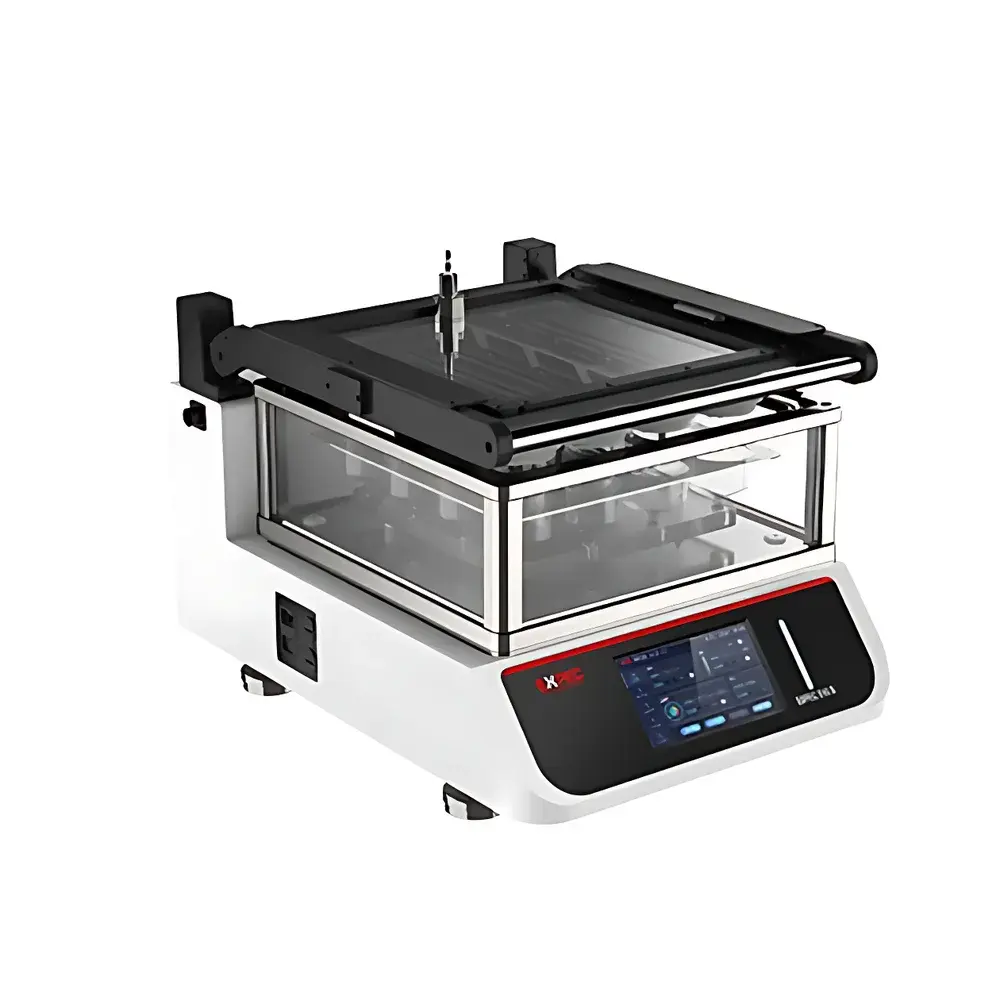
EXPEC 510S Vacuum Parallel Concentrator
| Brand | EXPEC |
|---|---|
| Origin | Zhejiang, China |
| Model | EXPEC 510S |
| Sample Capacity Options | 9 / 16 / 36 positions |
| Heating Method | Water Bath |
| Compliance | Designed for GLP/GMP-aligned sample prep workflows |
Overview
The EXPEC 510S Vacuum Parallel Concentrator is an engineered solution for high-throughput, reproducible solvent removal in analytical laboratories. It operates on the principle of vacuum-assisted evaporation—lowering the ambient pressure above liquid samples to reduce boiling points, while simultaneously applying controlled water-bath heating and gentle orbital shaking to accelerate mass transfer. Evaporated vapors are directed through a coiled condenser where they undergo phase transition and are collected in dedicated solvent recovery flasks—eliminating uncontrolled atmospheric release and supporting closed-loop solvent handling. Unlike nitrogen blow-down systems, the EXPEC 510S requires no external gas source, reducing infrastructure dependency and operational complexity. Its integrated architecture—including a one-piece hinged lid with single-action locking mechanism—ensures rapid setup, consistent sealing integrity, and minimal user intervention across multi-sample workflows.
Key Features
- Vacuum-Driven Parallel Processing: Simultaneous concentration of up to 36 samples under uniform pressure and temperature conditions, ensuring inter-sample comparability and minimizing run-to-run variability.
- Uniform Thermal Management: Precision-regulated water bath heating delivers ±0.5 °C temperature stability across all positions; combined with optimized airflow distribution via proprietary channel design, it ensures homogeneous evaporation kinetics.
- Full-View Observation Chamber: Four-sided borosilicate glass enclosure enables real-time visual monitoring of sample volume reduction, foam formation, and condensate accumulation without interrupting operation.
- Integrated Solvent Recovery: Cold-trap condenser with high-surface-area coil geometry achieves >95% condensation efficiency for common organic solvents (e.g., acetonitrile, ethyl acetate, dichloromethane), mitigating exposure hazards and supporting environmental compliance.
- Modular Sample Capacity: Interchangeable sample racks support 9-, 16-, or 36-position configurations—adapting to diverse throughput requirements from targeted residue analysis to high-volume environmental screening.
- Optional IR-Leveling Detection: Infrared optical sensors enable endpoint detection at 1.0 mL per individual tube, delivering automated termination for precise final volume control without cross-contamination risk.
Sample Compatibility & Compliance
The EXPEC 510S accommodates standard laboratory consumables including 12–18 mm OD test tubes, culture tubes, and extraction vials. Its vacuum range (5–100 mbar), adjustable heating (30–80 °C), and programmable shaking frequency (0–300 rpm) provide flexibility for volatile, thermolabile, or high-boiling-point analytes. The system supports method development aligned with ASTM D7067 (residue analysis), ISO 17025-accredited validation protocols, and USP chromatographic sample preparation guidelines. All solvent collection pathways are chemically resistant (PTFE-coated valves, borosilicate glass condenser), and the sealed operation meets OSHA PEL and EU REACH solvent exposure mitigation expectations. Documentation packages include IQ/OQ templates compatible with FDA 21 CFR Part 11 audit trails when paired with validated LIMS integration.
Software & Data Management
While the EXPEC 510S operates via intuitive front-panel controls, optional USB/RS-232 connectivity enables remote parameter logging and event timestamping. Protocol storage supports up to 20 user-defined methods—including ramp profiles for pressure, temperature, and agitation—with password-protected access levels for operator, supervisor, and administrator roles. Audit logs record start/stop times, vacuum setpoints, actual bath temperatures, and IR-leveling triggers—satisfying GLP documentation requirements for traceability and reprocessibility. Data export is compatible with CSV format for downstream statistical analysis in JMP or Minitab.
Applications
- Food Safety Testing: Concentration of QuEChERS extracts for veterinary drug residues (e.g., sulfonamides, tetracyclines), pesticide multiresidue analysis (e.g., organophosphates, pyrethroids), and food additive quantification (e.g., synthetic dyes, preservatives).
- Environmental Monitoring: Large-volume aqueous sample processing (up to 250 mL/tube) for PAHs, PCBs, phthalates, and emerging contaminants (e.g., PFAS precursors) prior to GC-MS or LC-MS/MS analysis.
- Pharmaceutical Quality Control: Residue-on-analysis (ROA) preparation per Chinese Pharmacopoeia and European Pharmacopoeia monographs, particularly for pesticide screening in herbal raw materials and excipients.
- Clinical & Forensic Toxicology: Pre-concentration of urine or plasma extracts for targeted small-molecule biomarker assays requiring low ng/mL detection limits.
FAQ
Does the EXPEC 510S require compressed air or nitrogen gas?
No—it uses only vacuum and water-bath heating; no external gas supply is needed.
Can different sample volumes be processed simultaneously in one run?
Yes, provided tubes are of compatible diameter and height; however, optimal parallelism is achieved with uniform starting volumes.
Is the condenser compatible with highly volatile solvents like diethyl ether or pentane?
Recommended operating temperature for the condenser coolant should be ≤ −10 °C for full recovery; users must verify compatibility with their specific solvent’s vapor pressure curve.
How is calibration verified for temperature and vacuum accuracy?
Temperature calibration follows ASTM E74; vacuum sensor verification can be performed using a NIST-traceable digital manometer.
What maintenance is required for long-term reliability?
Monthly inspection of O-ring integrity, quarterly cleaning of condenser coils with isopropanol, and annual replacement of vacuum pump oil (if internal pump is used).



