
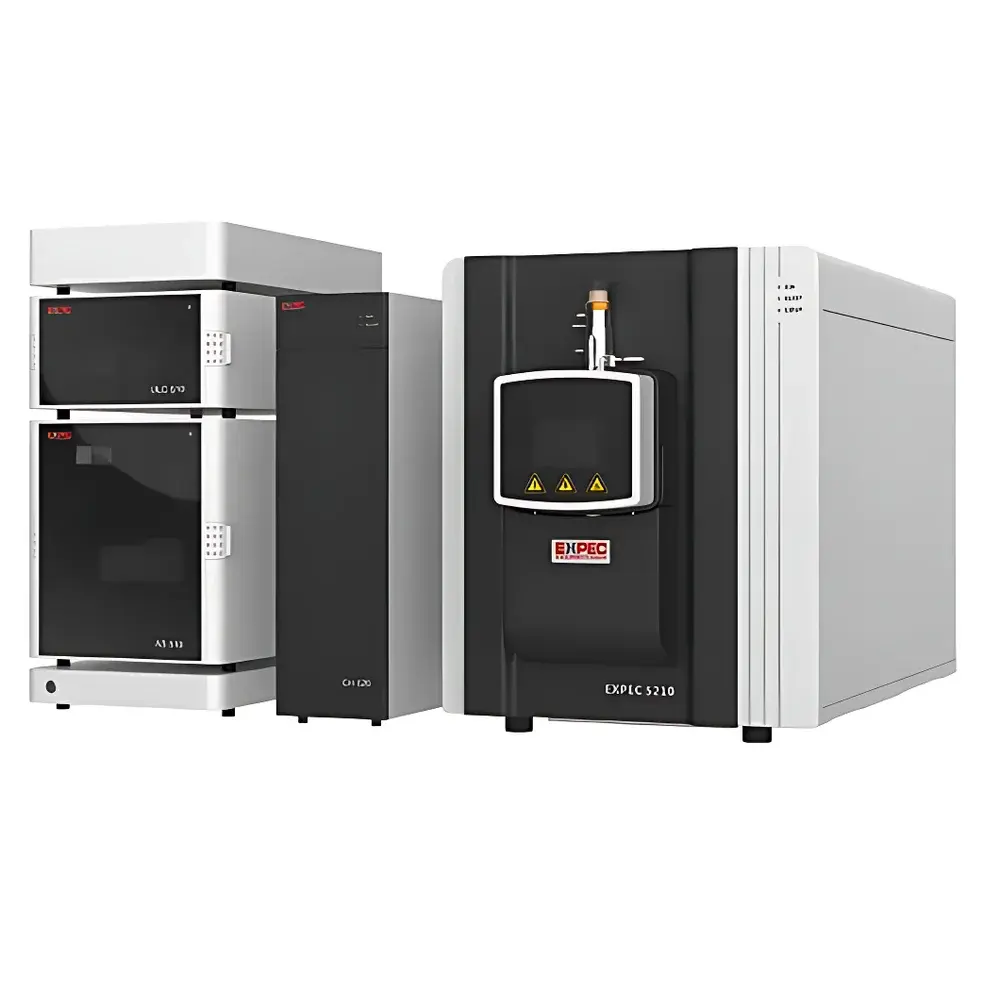
EXPEC 5210 Triple Quadrupole Liquid Chromatography Tandem Mass Spectrometer (LC-MS/MS)
| Brand | EXPEC / Superspectra |
|---|---|
| Origin | Zhejiang, China |
| Manufacturer Type | Authorized Distributor |
| Product Category | Domestic |
| Model | EXPEC 5210 |
| Instrument Type | Triple Quadrupole (QqQ) |
| Application Scope | General-Purpose |
| Mass Range | Not Specified |
| Sensitivity | Not Specified |
| Resolution | Not Specified |
| Mass Accuracy | Not Specified |
| Operating Pressure Range | Not Specified |
Overview
The EXPEC 5210 Triple Quadrupole Liquid Chromatography Tandem Mass Spectrometer (LC-MS/MS) is a domestically developed, high-performance mass spectrometry platform engineered for targeted quantitative analysis in regulated and research laboratory environments. Designed under the National Major Scientific Instrument Development Program of China, the system implements tandem mass spectrometry based on three quadrupole mass filters arranged in Q1–q2–Q3 configuration, enabling selective reaction monitoring (SRM) and multiple reaction monitoring (MRM) workflows with high specificity and robust signal-to-noise performance. Its core architecture integrates electrospray ionization (ESI) with optional atmospheric pressure chemical ionization (APCI), coupled to ultra-high-performance liquid chromatography (UHPLC), delivering reliable detection and quantification of small molecules—including pesticides, pharmaceuticals, endogenous metabolites, environmental contaminants, and clinical biomarkers—across complex matrices.
Key Features
- Step Scan Ion Transmission Technology: A proprietary ion optics design that enhances ion transmission efficiency across the entire mass range by dynamically adjusting RF/DC voltages during scanning, minimizing ion loss and improving duty cycle utilization.
- Orthogonal Dual-Gas ESI Source: Features 90° orthogonal geometry to suppress neutral particle entry; incorporates symmetric dual desolvation gas channels optimized via computational fluid dynamics (CFD) simulation for uniform droplet desolvation and improved ion yield.
- Accelerated Collision Cell (q2): Axially aligned collision cell with optimized RF confinement and kinetic energy ramping enables rapid ion passage while maintaining high fragmentation efficiency and low cross-talk between MRM transitions.
- Pulse-Counting Detector: 90°-bent channel electron multiplier with digital pulse-counting electronics delivers enhanced dynamic range, reduced electronic noise, and stable long-term signal response without analog saturation effects.
- Multi-Stage Vacuum System: Configured with turbomolecular pumps backed by dry scroll pumps, employing step-transition pressure gradients between source, q2, and analyzer regions to minimize ion scattering and preserve transmission integrity.
- Dual RF Power Supply with Closed-Loop Adaptation: Independent RF generators for Q1 and Q3 employ real-time feedback control to maintain field stability under varying environmental and operational conditions, ensuring consistent mass resolution and calibration fidelity.
Sample Compatibility & Compliance
The EXPEC 5210 supports broad sample compatibility through its modular ion source design, accommodating standard 2.1 mm and 4.6 mm ID LC columns, microflow and nanoflow configurations, and direct infusion interfaces. It complies with fundamental instrumentation requirements outlined in ISO/IEC 17025 for testing laboratories and aligns with data integrity expectations referenced in FDA 21 CFR Part 11 when deployed with audit-trail-enabled software configurations. While not pre-certified for GMP or GLP environments out-of-the-box, its hardware architecture—including hardware interlocks for gas flow, voltage, and vacuum states—supports integration into validated workflows. The system meets CE marking requirements for electromagnetic compatibility (EMC) and low-voltage directive compliance per applicable EU harmonized standards.
Software & Data Management
Mass Expert™ is a full-featured, Windows-based LC-MS/MS control and data analysis platform supporting method development, instrument tuning, acquisition control, peak integration, calibration curve fitting, and customizable reporting. It includes automated mass calibration and tuning routines, intelligent MRM transition optimization, and built-in libraries containing over 3,000 compound-specific SRM methods covering food safety, environmental, clinical toxicology, and traditional Chinese medicine applications. All analytical parameters—including dwell time, collision energy, declustering potential, and source temperature—are fully scriptable and exportable for SOP documentation. Audit trails, user access levels, and electronic signature support can be enabled to meet ALCOA+ principles for regulated data handling. Raw data files adhere to open-standard mzML format for third-party interoperability.
Applications
The EXPEC 5210 is routinely deployed in accredited testing laboratories for residue analysis in food and agricultural products (e.g., pesticide screening per GB 23200 series), quantification of pharmaceutical impurities and degradation products (aligned with ICH Q2(R2)), environmental monitoring of persistent organic pollutants (POPs) and emerging contaminants (e.g., PFAS, microplastic additives), and clinical research applications such as therapeutic drug monitoring (TDM), newborn screening, and steroid profiling. Its sensitivity and reproducibility make it suitable for method validation studies requiring precision ≤15% RSD and accuracy within ±15% of nominal concentration across five orders of magnitude linear dynamic range.
FAQ
Is the EXPEC 5210 compliant with FDA 21 CFR Part 11?
The hardware architecture supports Part 11 compliance when configured with appropriate software settings, including electronic signatures, audit trail logging, and role-based access control—though formal validation must be performed by the end-user laboratory per their quality management system.
Can the system operate with both ESI and APCI sources simultaneously?
No—the ion source module is swappable; ESI and APCI are mutually exclusive configurations requiring manual changeover and recalibration.
What LC systems are compatible with the EXPEC 5210?
It interfaces seamlessly with all major UHPLC/HPLC platforms via standard analog/digital I/O and vendor-neutral communication protocols (e.g., Agilent ChemStation, Waters Empower, Thermo Xcalibur drivers).
Does the Mass Expert software support custom report templates?
Yes—users can define layout, metadata fields, calculation logic, and regulatory headers using the embedded template editor, enabling alignment with ISO/IEC 17025 or internal QA reporting requirements.
Is remote monitoring or control supported?
Instrument status, acquisition progress, and basic diagnostics can be accessed remotely via secure HTTP-based dashboard; full remote operation requires local network authentication and IT policy approval.






