
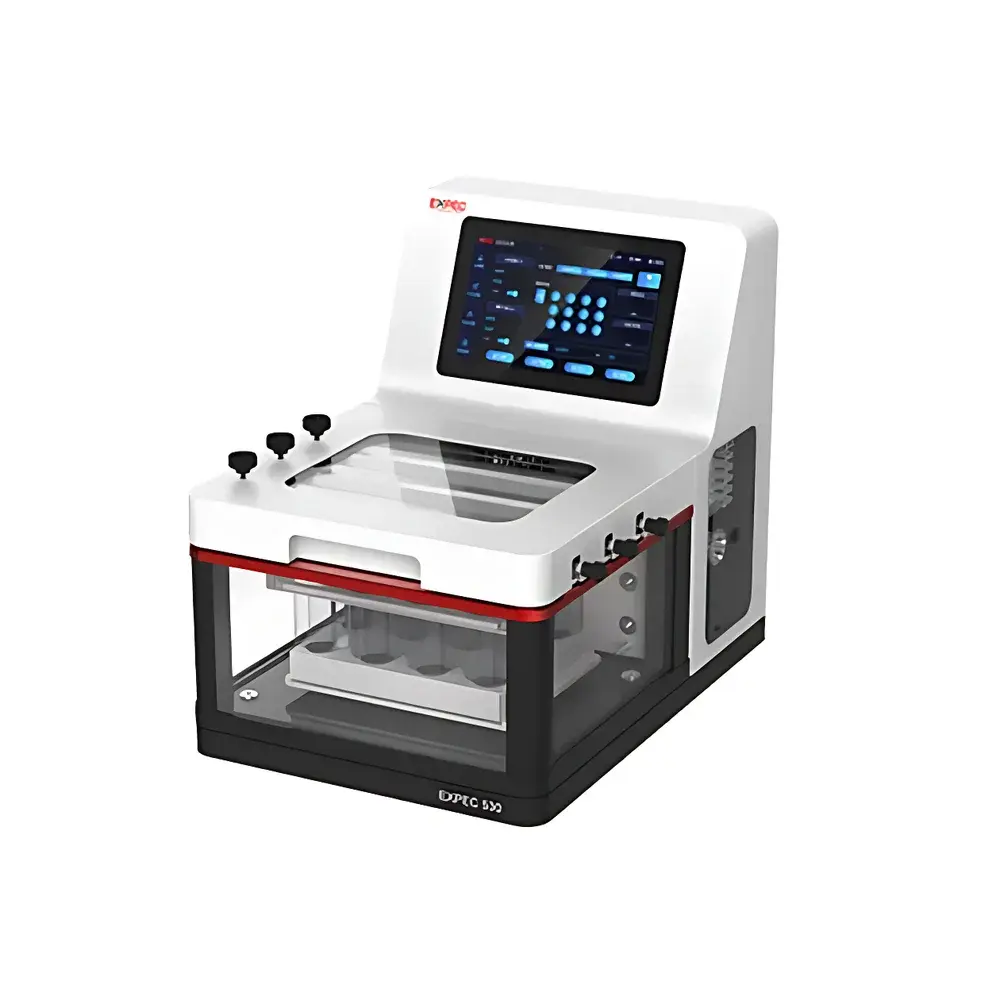
EXPEC 530 Automated Fixed-Volume Parallel Concentration System
| Brand | EXPEC (Puyu Technology) |
|---|---|
| Origin | Zhejiang, China |
| Model | EXPEC 530 |
| Capacity | 12-position parallel processing |
| Endpoint Detection | Auto-sensing nitrogen blowdown termination |
| Final Volume Options | 0.5 mL or 1.0 mL (user-selectable) |
| Visual Monitoring | Triple-sided tempered glass viewport with integrated LED illumination |
| Sample Tube Compatibility | 80 mL and 300 mL tubes |
| Optional Feature | Wall-rinse module for solvent-assisted recovery enhancement |
| Safety Design | Fully enclosed water bath chamber with internal exhaust fan and dedicated vent ducting |
Overview
The EXPEC 530 Automated Fixed-Volume Parallel Concentration System is an engineered solution for reproducible, high-throughput sample concentration in regulated and research laboratory environments. Based on controlled nitrogen gas flow combined with precise temperature-regulated water bath heating, the system implements a validated endpoint detection algorithm to halt evaporation at user-defined final volumes—0.5 mL or 1.0 mL—without operator intervention. Unlike manual or timer-based concentrators, the EXPEC 530 employs real-time optical monitoring of meniscus position and solvent surface dynamics to determine endpoint with high repeatability. Its architecture integrates thermal stability, gas flow uniformity, and mechanical alignment across all 12 positions to ensure inter-sample coefficient of variation (CV) remains within ≤3% under standard operating conditions. Designed for compatibility with routine QC workflows and GLP-compliant laboratories, the system supports trace-level analyte preservation during volatile solvent removal—critical for residual analysis where over-concentration leads to analyte degradation or adsorption losses.
Key Features
- 12-channel parallel concentration with independent gas flow control per position for consistent evaporation kinetics
- Intelligent endpoint recognition via optical sensing—detects meniscus stabilization at target volume without reliance on preset time or pressure thresholds
- User-selectable final volume modes: 0.5 mL and 1.0 mL, each calibrated against gravimetric reference standards
- Triple-sided transparent borosilicate glass enclosure with adjustable LED lighting enables unobstructed visual verification of sample status throughout the run
- Enclosed water bath design with integrated axial exhaust fan and external vent port minimizes ambient solvent vapor exposure and meets OSHA-recommended ventilation guidelines
- Optional wall-rinse module delivers programmable solvent pulses to inner tube walls during final concentration phase, improving analyte recovery by up to 12% for viscous or surface-adherent matrices
Sample Compatibility & Compliance
The EXPEC 530 accommodates standard 80 mL and 300 mL round-bottom and conical sample tubes used in EPA Method 525.3, ISO 17025-accredited residue labs, and pharmacopeial testing (USP , EP 2.2.46). Its mechanical stage accepts both tapered and straight-walled configurations without adapter kits. All wetted surfaces contact only medical-grade stainless steel (316L) and PTFE-coated components, ensuring chemical resistance to acetonitrile, ethyl acetate, dichloromethane, and methanol. The system operates within Class II biosafety cabinet-compatible footprint and conforms to IEC 61010-1 safety requirements for laboratory electrical equipment. While not FDA 21 CFR Part 11–certified out-of-the-box, audit trails, user access logs, and method parameter locking can be implemented via optional LIMS integration protocols compliant with ISO/IEC 17025:2017 clause 7.7.
Software & Data Management
Operation is managed through a dedicated embedded touchscreen interface running a deterministic real-time OS. Each method stores temperature setpoint (range: 30–80 °C, ±0.3 °C), nitrogen pressure (0.1–0.5 MPa), ramp profiles, endpoint volume selection, and rinse cycle timing (if enabled). All parameters are timestamped and exportable as CSV or PDF reports with digital signature fields. Audit trail functionality records operator ID, start/stop times, parameter changes, and endpoint confirmation events—retained for ≥36 months per internal storage policy. Remote monitoring is supported via Ethernet (TCP/IP) with Modbus TCP protocol for integration into centralized lab automation platforms.
Applications
The EXPEC 530 is routinely deployed in multi-residue analysis workflows requiring quantitative recovery of thermally labile compounds. In food safety laboratories, it supports veterinary drug screening (e.g., fluoroquinolones, sulfonamides) and pesticide multiresidue methods (QuEChERS AOAC 2007.01, EN 15662:2018). Environmental labs apply it to EPA SW-846 Methods 3550C (soil extraction) and 502.2 (volatile organics in water), where precise final volume control directly impacts GC-MS calibration linearity. Forensic toxicology units utilize its reproducibility for blood ethanol derivatization prep; pharmaceutical QC labs employ it for dissolution sample cleanup prior to HPLC-UV quantitation. Its low carryover design (<0.05%) and absence of moving parts in the vapor path reduce cross-contamination risk in high-sensitivity applications.
FAQ
Does the EXPEC 530 support method validation per ISO/IEC 17025?
Yes—the system allows full documentation of operational parameters, environmental conditions, and endpoint confirmation events required for method validation packages.
Can the wall-rinse module be retrofitted to existing units?
Yes, provided firmware version v2.4.0 or higher is installed; retrofit requires factory calibration verification.
What maintenance intervals are recommended for nitrogen flow sensors?
Flow sensors should be verified quarterly using certified mass flow calibrators; full recalibration is advised annually or after 2,000 operational hours.
Is the water bath temperature uniformity validated across all 12 positions?
Yes—per internal QA protocol, uniformity is tested with 12 calibrated PT100 probes; maximum deviation is ≤±0.4 °C at 60 °C steady state.
How does the optical endpoint detection handle colored or turbid samples?
The system uses dual-wavelength reflectance analysis (650 nm + 850 nm) to distinguish meniscus from suspended particulates, maintaining accuracy for samples with absorbance up to 1.8 AU at 650 nm.



