
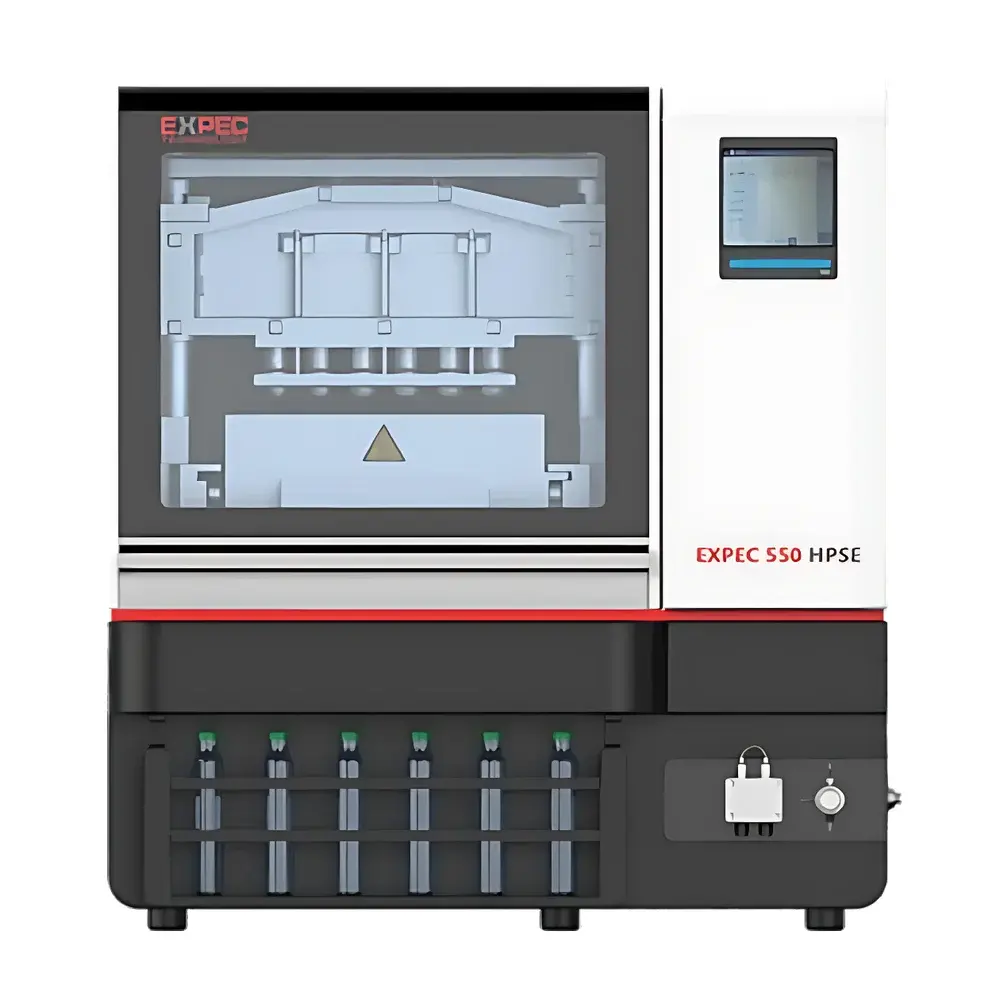
EXPEC 550 Pressurized Fluid Extractor
| Brand | EXPEC (Hangzhou Superspectra Technology Co., Ltd.) |
|---|---|
| Model | EXPEC 550 |
| Extraction Vessel Capacity | 10–60 mL |
| Operating Pressure Range | Up to 20 MPa |
| Temperature Range | Ambient to 200 °C |
| Cycle Time per Sample | 15–30 min |
| Solvent Consumption | Reduced by ≥70% vs. Soxhlet |
| Safety Compliance | Integrated Leak Detection, Over-Pressure & Over-Temperature Interlocks, Method Validation Alert System |
| Heating Jacket Surface Temp | <50 °C |
Overview
The EXPEC 550 Pressurized Fluid Extractor is an automated, programmable solid-phase extraction system engineered for rapid, reproducible isolation of organic analytes from complex solid and semi-solid matrices using pressurized hot solvent extraction (PHSE)—a technique standardized under ASTM D7656 and EPA Method 3545A. Unlike conventional Soxhlet or ultrasonic extraction, the EXPEC 550 applies controlled pressure (up to 20 MPa) and precise temperature (ambient to 200 °C) to maintain solvents—such as acetone, dichloromethane, or ethyl acetate—in a subcritical liquid state, significantly enhancing solvation power, mass transfer kinetics, and penetration into sample microstructures. This thermodynamic optimization enables complete analyte release within 15–30 minutes per cycle while reducing solvent consumption by ≥70% compared to traditional methods. Its modular architecture supports unattended operation across multi-sample batches, making it suitable for high-throughput laboratories operating under ISO/IEC 17025, GLP, or FDA-regulated environments.
Key Features
- Patented tolerance-compensated extraction cell positioning system ensures leak-free sealing across vessel sizes (10–60 mL), eliminating manual torque calibration and minimizing operator-induced variability.
- Low-surface-temperature heating jacket design maintains external casing temperature below 50 °C during operation—reducing thermal hazard risk and enabling safe proximity placement in shared fume hood workspaces.
- Integrated real-time pressure and temperature monitoring with automatic method validation alerts prevents execution of out-of-spec protocols (e.g., exceeding solvent critical point or vessel pressure rating), supporting audit-ready compliance workflows.
- Chemically resistant cell construction (316L stainless steel with optional inert-coated variants) ensures compatibility with aggressive solvents and minimizes metal leaching in trace-level analyses.
- Modular solvent delivery module supports gradient elution and sequential solvent switching without hardware reconfiguration—critical for multi-analyte extractions requiring polarity-based fractionation.
Sample Compatibility & Compliance
The EXPEC 550 accommodates heterogeneous samples including dried soils, sediment cores, food composites (e.g., milled cereals, ground spices), polymer fragments (microplastics), biological tissues, and industrial sludges. It meets functional requirements outlined in US EPA SW-846 Methods 3545A (Pressurized Fluid Extraction) and 3546 (Microwave-Assisted Extraction), and aligns with ISO 16703:2021 for petroleum hydrocarbon recovery from soils. All operational parameters—including pressure ramp rate, static/dynamic extraction time, flush volume, and purge duration—are fully programmable and digitally logged with timestamped metadata, satisfying 21 CFR Part 11 data integrity requirements when paired with compliant LIMS integration.
Software & Data Management
Controlled via EXPEC-ExtractSuite™ v3.x software, the system provides role-based user access, electronic signature support, and full audit trail functionality—including parameter change history, run logs, and alarm event records. Extraction methods are stored as encrypted XML templates with version control, enabling cross-laboratory method portability and SOP enforcement. Raw sensor data (pressure, temperature, flow rate) is exported in CSV or ASTM E1394-compliant format for downstream processing in chromatographic data systems (CDS) or statistical analysis platforms. Optional OPC UA interface allows seamless integration into Industry 4.0 laboratory automation frameworks.
Applications
- Food Safety: Quantitative recovery of organophosphate, organochlorine, and neonicotinoid pesticides from cereal grains, legumes, and processed foods per EU Regulation (EC) No 396/2005 residue monitoring protocols.
- Environmental Analysis: Extraction of PAHs, PCBs, phthalates, and emerging contaminants (e.g., PFAS precursors) from soil, landfill leachate solids, airborne particulate filters (PM10/PM2.5), and dredged sediments.
- Polymer & Microplastic Research: Isolation of additive migrants (e.g., BPA, flame retardants) and sorbed environmental contaminants from polyethylene, PET, and nylon fragments—validated per ASTM D8337-22 for microplastic-associated chemical profiling.
- Pharmaceutical & Biotech: Recovery of lipophilic actives and degradation products from excipient-blended tablets and lyophilized biologics formulations prior to HPLC-MS/MS analysis.
FAQ
What solvent types are compatible with the EXPEC 550?
Commonly used solvents include hexane, acetone, methanol, dichloromethane, ethyl acetate, and mixtures thereof—provided their critical temperature and pressure fall within the instrument’s operational envelope (≤200 °C, ≤20 MPa). Supercritical CO₂ is not supported.
Does the system support method validation documentation per ISO/IEC 17025?
Yes—full parameter logging, electronic signatures, and audit trails comply with ISO/IEC 17025:2017 Clause 7.7 (Results Reporting) and Annex A.2 (Data Integrity), when configured with validated software settings.
Can extraction cells be cleaned in-place (CIP) or require disassembly?
Cells are designed for manual cleaning using solvent rinses and ultrasonic baths; no integrated CIP function is provided due to material compatibility constraints with heated caustic or acidic solutions.
Is remote monitoring or troubleshooting supported?
Remote desktop access is enabled via secure TLS-encrypted VNC connection for technical support; however, live control functions remain restricted to local operator stations for safety and regulatory reasons.
Related Products



