
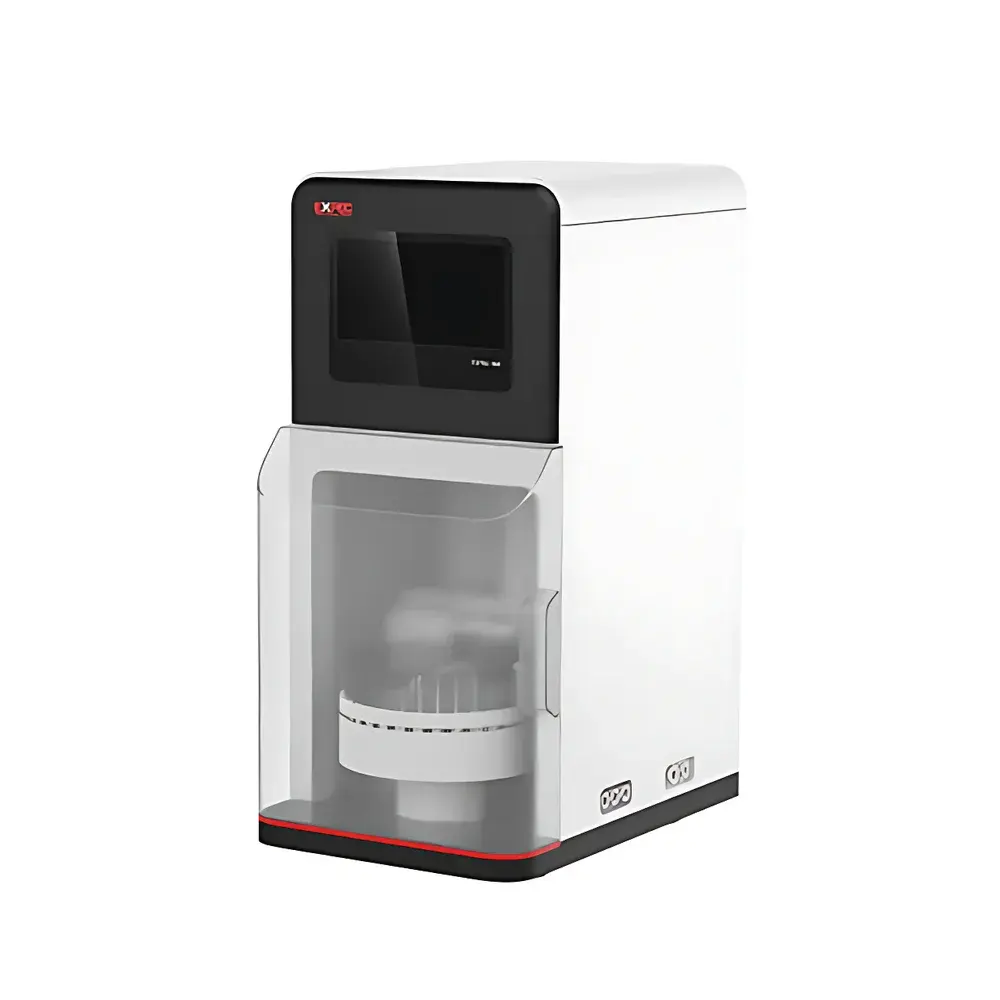
EXPEC 560 Automated Homogenizer
| Brand | EXPEC (Hangzhou Superspectra Technology Co., Ltd.) |
|---|---|
| Origin | Zhejiang, China |
| Model | EXPEC 560 |
| Throughput | Up to 36 samples per batch |
| Drive Type | Brushless DC motor with variable-speed control |
| Homogenization Motion | Vertical reciprocating + rotational motion |
| Cleaning Modes | Aqueous rinse, organic solvent rinse, ultrasonic-assisted cleaning |
| Enclosure | Full-integrated transparent safety door with interlock |
| Safety Compliance | CE-marked per EN 61000-6-2/6-4 and EN 61000-3-2/3-3 |
| Software Interface | Touchscreen HMI with method storage, real-time status monitoring, and fault logging |
Overview
The EXPEC 560 Automated Homogenizer is an engineered solution for high-throughput, reproducible sample homogenization and mechanical lysis in regulated laboratory environments. Designed around a dual-motion homogenization principle—combining controlled rotational shear with synchronized vertical reciprocation—the system achieves uniform particle size reduction and efficient cell disruption across heterogeneous matrices including soft tissues, plant materials, food composites, and environmental solid samples. Unlike fixed-speed or static-blade homogenizers, the EXPEC 560 dynamically adjusts blade trajectory during operation to minimize thermal buildup and maximize energy transfer efficiency, supporting consistent extraction yields required for quantitative analysis workflows such as LC-MS, GC-MS, and ELISA-based assays.
Key Features
- Unattended Batch Processing: Supports simultaneous preparation of up to 36 samples using standardized 15–50 mL conical tubes or centrifuge vials; automatic tray recognition via optical encoder ensures positional accuracy and process repeatability.
- Intelligent Motion Control: The homogenizing probe executes programmable vertical travel (±15 mm stroke) at variable frequencies (50–300 rpm), enabling adaptive shearing force application tailored to sample viscosity and density.
- Multi-Stage Probe Decontamination: Integrated cleaning station performs sequential aqueous rinse, organic solvent flush (e.g., acetone or methanol), and ultrasonic cavitation (40 kHz, 10 min max), followed by 360° pressurized spray nozzles ensuring complete residue removal from probe surfaces.
- Containment-Centric Architecture: Fully enclosed stainless-steel housing with polycarbonate safety door featuring electromagnetic interlock and real-time pressure differential monitoring prevents aerosol escape and complies with OSHA 29 CFR 1910.1200 requirements for hazardous material handling.
- Fail-Safe Operational Logic: Built-in torque sensors detect abnormal load conditions; immediate motor shutdown and audible/visual alerts are triggered upon deviation exceeding ±5% from nominal setpoint, preserving both sample integrity and equipment longevity.
Sample Compatibility & Compliance
The EXPEC 560 accommodates biological tissues (liver, muscle, leaf), powdered herbs, cereal grains, soil cores, and composite food matrices without pre-sizing. It supports ISO 17025-accredited laboratories through traceable calibration logs, electronic audit trails, and user-access-level permissions (admin/operator/guest). All firmware operations adhere to FDA 21 CFR Part 11 principles—electronic signatures, time-stamped event records, and immutable method archives are natively supported. Device certification includes conformity to IEC 61000 electromagnetic compatibility standards and EN 61010-1 for laboratory electrical safety.
Software & Data Management
The embedded touchscreen interface (7-inch capacitive display, IP65-rated) hosts a dedicated homogenization OS allowing creation, versioning, and recall of up to 100 stored protocols. Each method defines rotational speed, reciprocation frequency, dwell time, cleaning sequence, and post-cycle drying duration. All operational data—including timestamped start/stop events, motor current draw, temperature drift (via internal NTC sensor), and error codes—are exported in CSV or XML format compatible with LIMS integration (e.g., LabWare, STARLIMS). Remote diagnostics via Ethernet port enable preventive maintenance scheduling based on cumulative probe usage metrics.
Applications
- Food Safety Testing: Homogenization of meat, dairy, and fruit samples prior to mycotoxin (aflatoxin B1, ochratoxin A) quantification per AOAC 2005.02 and EU Commission Regulation (EC) No 401/2006.
- Agricultural Residue Analysis: Preparation of rice, wheat, and vegetable homogenates for multi-residue pesticide screening under SANTE/11813/2017 guidelines.
- Traditional Chinese Medicine (TCM) Quality Control: Standardized tissue disruption of Ginseng radix, Scutellaria baicalensis, and other herbaceous materials aligned with Chinese Pharmacopoeia (ChP) 2020 Volume IV section 0401.
- Environmental Monitoring: Processing of sediment and sludge samples for PAH, PCB, and heavy metal leaching studies compliant with EPA Method 3550C and ISO 11466.
- Biopharmaceutical R&D: Scalable lysis of cultured mammalian cells (HEK293, CHO-K1) and microbial pellets (E. coli BL21) for downstream protein purification and activity assays.
FAQ
What types of homogenization probes are compatible with the EXPEC 560?
Standard stainless-steel probes (diameters: 5 mm, 7 mm, 10 mm) with threaded quick-release fittings are supported; custom geometries require mechanical validation against torque limits.
Can the EXPEC 560 be integrated into a robotic sample preparation line?
Yes—RS-232 and Modbus TCP interfaces allow bidirectional communication with third-party liquid handlers and tube sorters for end-to-end automation.
Is method validation documentation provided for regulatory submissions?
A comprehensive IQ/OQ protocol package—including performance verification templates, calibration certificates, and risk assessment reports—is available upon request for GLP/GMP audits.
How often does the ultrasonic cleaning bath require maintenance?
The transducer array is rated for 10,000 operating hours; routine degassing and descaling every 200 cycles ensure optimal cavitation efficiency.
Does the system support remote software updates?
Firmware upgrades are delivered via secure HTTPS endpoint with SHA-256 signature verification and rollback capability to previous stable versions.



