
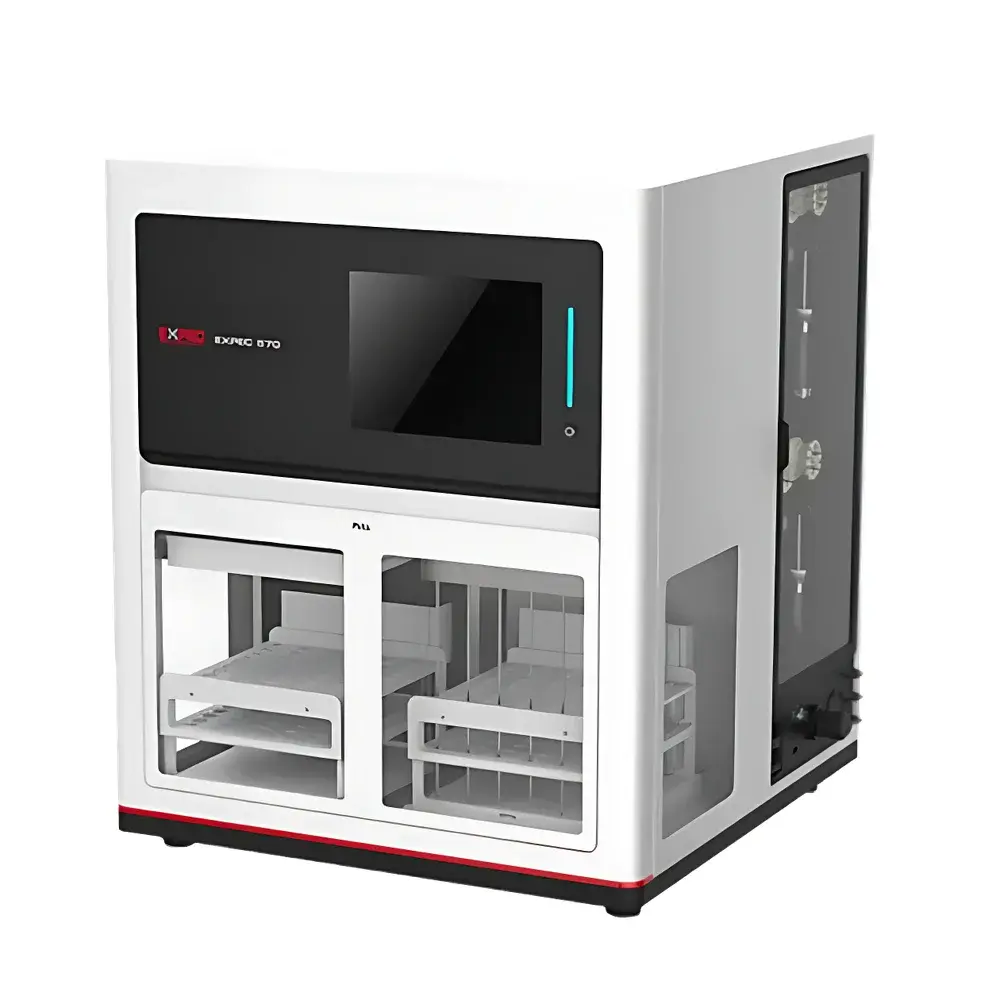
EXPEC 570 Automated Solid-Phase Extraction System
| Brand | EXPEC (Hangzhou Superspectra Technology Co., Ltd.) |
|---|---|
| Model | EXPEC 570 |
| Configuration Options | 2-, 6-, 8-channel & PFA-dedicated variants |
| Origin | Zhejiang, China |
| System Architecture | Integrated touchscreen-controlled platform with internal waste segregation |
| Sample Throughput | Batch-mode processing for up to 8 samples simultaneously (model-dependent) |
| Flow Control | Precision syringe-pump-driven elution with column-seal plug design |
| Compatibility | Standard 1 mL–6 mL SPE cartridges (C18, HLB, Florisil, SAX, SCX, PFA-lined, etc.) |
| Optional Modules | Large-volume aqueous sample enrichment (>500 mL), custom cartridge adapters, GLP-compliant audit trail upgrade |
Overview
The EXPEC 570 Automated Solid-Phase Extraction System is an integrated, benchtop sample preparation workstation engineered for high-reproducibility isolation and concentration of trace organic analytes from complex matrices. Based on classical solid-phase extraction (SPE) principles—comprising sequential steps of sorbent conditioning, sample loading, washing, drying, and elution—the system executes all stages under programmable, closed-loop control without manual intervention. Designed specifically for laboratories performing routine environmental, food safety, pharmaceutical, and clinical toxicology analyses, the EXPEC 570 eliminates operator variability in flow rate, dwell time, and solvent volume delivery—critical parameters governing recovery efficiency and method robustness. Its modular architecture supports scalable throughput across configurations (2-, 6-, or 8-channel), while the PFA-dedicated variant (EXPEC 570F) addresses stringent requirements for perfluoroalkyl substance (PFAS) analysis by minimizing background contamination through fluoropolymer-wetted pathways.
Key Features
- Precision syringe-pump-driven fluid handling ensures consistent flow rates (0.1–10 mL/min adjustable per channel), independent of cartridge backpressure or column aging—enabling superior inter-sample reproducibility.
- Column-insertion seal mechanism maintains positive pressure integrity during activation and elution, preventing air bubble formation and channel cross-contamination.
- Integrated dual-waste management system segregates organic solvents (e.g., methanol, acetonitrile) from aqueous wash fractions into dedicated, sealed reservoirs—reducing vapor exposure and complying with OSHA and EU CLP labeling requirements.
- 12-inch industrial-grade capacitive touchscreen interface with intuitive workflow navigation, real-time status monitoring (including pump position, valve state, and elapsed step time), and password-protected method storage.
- Modular expansion support includes large-volume sample introduction kits (up to 2 L aqueous samples via gravity-assisted or peristaltic-assisted loading), customizable cartridge racks for non-standard geometries (e.g., 96-well plates, custom-packed columns), and optional 21 CFR Part 11–compliant electronic signature and audit trail modules.
Sample Compatibility & Compliance
The EXPEC 570 accommodates standard commercial SPE cartridges (1–6 mL format) across reversed-phase (C8, C18, HLB), ion-exchange (SAX, SCX), and adsorption (Florisil, silica, alumina) chemistries. It supports EPA Methods 508.1, 525.3, 8270, and 1613 for semi-volatile organics and PFAS; ISO 17993:2022 for water analysis; and AOAC Official Methods for pesticide residue extraction in food matrices. All wetted components—including tubing, seals, and fluid paths in the EXPEC 570F variant—are constructed from PFA or PTFE to ensure chemical inertness and minimize leachables. The system meets IEC 61000-6-3 (EMC) and IEC 61010-1 (safety) standards for laboratory equipment and is compatible with GLP/GMP environments when configured with optional data integrity enhancements.
Software & Data Management
Control software provides method development tools including multi-step gradient programming, variable flow ramping, timed fraction collection, and conditional logic (e.g., “pause until solvent level reaches threshold”). Raw method files are stored locally with timestamped version history and exportable in CSV or XML formats for LIMS integration. Optional firmware upgrades enable automated calibration verification logs, user access level management (admin/operator/auditor), and electronic record retention aligned with FDA 21 CFR Part 11 Annex 11 expectations. No cloud dependency—data remains on-device unless explicitly exported via USB or Ethernet.
Applications
- Environmental testing: Enrichment of PFAS, phthalates, PAHs, PCBs, and organochlorine pesticides from drinking water, wastewater, soil leachates, and sediment extracts.
- Food & agricultural safety: Cleanup of QuEChERS extracts prior to LC-MS/MS analysis of veterinary drug residues (e.g., sulfonamides, tetracyclines), mycotoxins (aflatoxins, ochratoxin A), and food additives (e.g., synthetic dyes, preservatives).
- Pharmaceutical R&D: Desalting and buffer exchange of biologics; removal of phospholipids from plasma samples prior to small-molecule PK quantitation.
- Clinical & forensic toxicology: Isolation of amphetamines, benzodiazepines, and opioids from urine and blood homogenates using mixed-mode cation-exchange protocols.
- Petrochemical analysis: Fractionation of hydrocarbon classes (saturates, aromatics, resins, asphaltenes) from crude oil and refinery streams.
FAQ
Does the EXPEC 570 support method validation according to ISO/IEC 17025?
Yes—when operated with documented SOPs and paired with certified reference materials, the system supports repeatability, intermediate precision, and spike recovery studies required for accredited testing laboratories.
Can it be integrated with autosamplers from major LC-MS vendors?
Direct hardware integration is not provided; however, standardized fraction tube output (12 × 75 mm or 15 × 45 mm formats) enables seamless transfer to most commercial LC autosamplers via robotic arms or manual placement.
What maintenance intervals are recommended for syringe pumps and valves?
Syringe seals should be inspected every 500 cycles and replaced every 2,000 cycles; rotary valves require cleaning with methanol every 100 runs and full lubrication annually per manufacturer guidelines.
Is remote monitoring supported?
Local network connectivity allows browser-based status viewing via HTTP; full remote control requires on-premise VPN configuration and is not enabled by default for security compliance.
How is carryover minimized between samples?
The system performs post-elution column flushing with strong solvent (e.g., 100% methanol) followed by air-drying, and includes a dedicated needle wash station with dual-solvent capability (aqueous + organic) prior to each aspiration cycle.



