
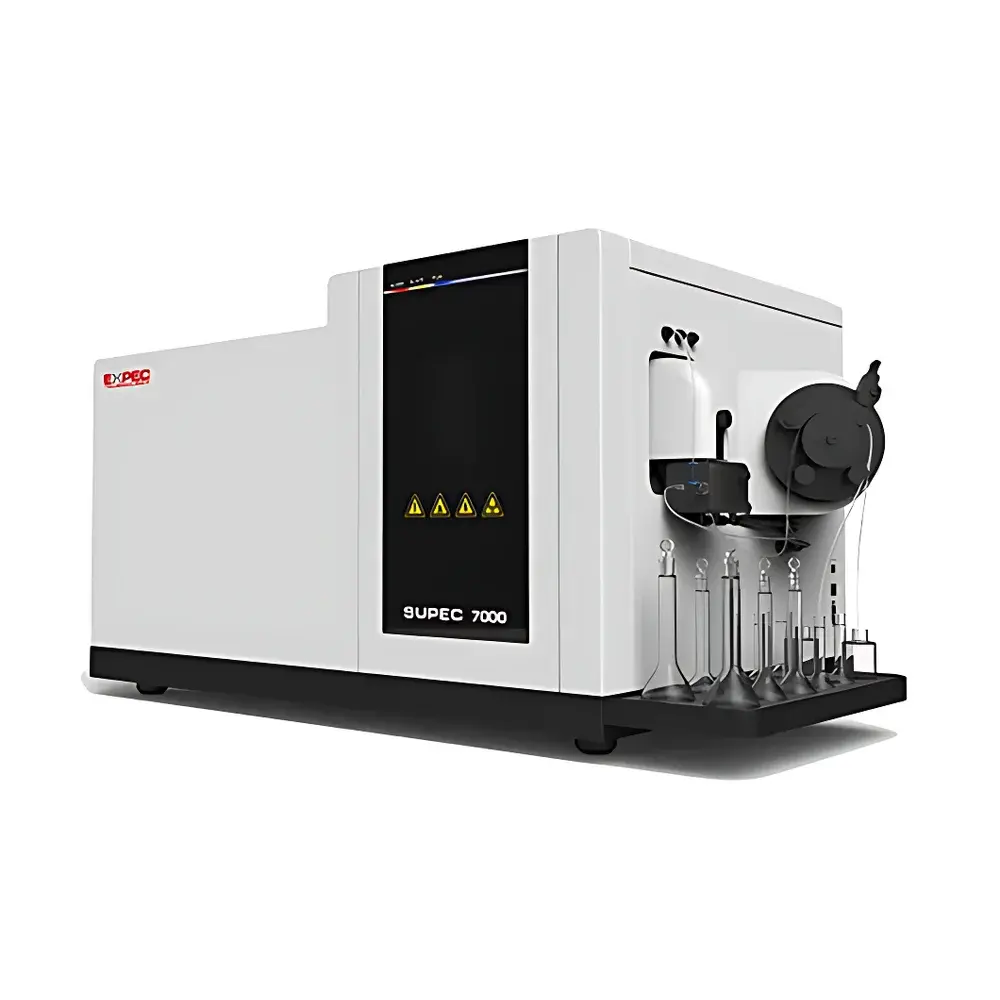
EXPEC 7200 Inductively Coupled Plasma Mass Spectrometer (ICP-MS)
| Brand | EXPEC / Superspectra |
|---|---|
| Origin | Zhejiang, China |
| Manufacturer Type | Authorized Distributor |
| Regional Classification | Domestic (China-made) |
| Model | EXPEC 7200 |
| Instrument Type | Quadrupole ICP-MS |
| Application Environment | Laboratory-Based Analysis |
| Compliance | Designed for GLP/GMP-aligned workflows and compatible with ISO/IEC 17025 laboratory accreditation requirements |
| Software Platform | Element V (fully localized Chinese GUI with English-language technical documentation support) |
| Hyphenation Options | LC-ICP-MS, LA-ICP-MS, GC-ICP-MS, Direct Atmospheric Sampling, Organic Solvent Introduction, Oxygen-Enhanced Combustion Mode |
Overview
The EXPEC 7200 is a high-sensitivity quadrupole inductively coupled plasma mass spectrometer engineered for trace elemental analysis at sub-pictogram-per-liter levels. It operates on the fundamental principle of ionizing analytes in a high-temperature argon plasma (~6,000–8,000 K), followed by mass separation via a radiofrequency-driven quadrupole mass filter and detection using a secondary electron multiplier (SEM). The instrument is developed under China’s National Major Scientific Instrument Development Program, emphasizing robustness, operational accessibility, and multi-modal sample introduction compatibility. Its architecture integrates thermal plasma physics optimization—particularly at the plasma-vacuum interface—with aerodynamic simulation-guided ion optics to maximize ion transmission efficiency. This design yields measurable sensitivity improvements of 3–5× over conventional quadrupole ICP-MS platforms, enabling routine quantification of ultra-trace elements in high-purity materials (e.g., semiconductor-grade chemicals, ultrapure water, photovoltaic precursors) and complex matrices without mandatory pre-dilution.
Key Features
- Aerodynamically optimized ion interface: Computational fluid dynamics (CFD)-informed extraction optics enhance ion beam collimation and transmission efficiency across the atmospheric-to-high-vacuum transition zone.
- Dual off-axis ion path configuration: Minimizes neutral noise and polyatomic interferences (e.g., 40Ar16O+, 40Ar16O1H+) while preserving signal intensity for target isotopes.
- Patented collision/reaction cell (CRC): Equipped with adjustable gas flow control (He, H2, NH3, O2) and dynamic reaction mode switching to suppress isobaric and polyatomic interferences without compromising throughput.
- Self-excited all-solid-state RF generator: Delivers stable 1.5 kW plasma power with 99.9% argon purity and enables oxygen-enhanced combustion for organic matrix decomposition.
- Integrated vibration-damping chassis and solid-state component layout: Validated through MIL-STD-810G-compliant road-spectrum testing over 10,000 km, confirming mechanical integrity for mobile or field-deployable lab configurations.
- Modular sample introduction compatibility: Native support for laser ablation (LA), liquid chromatography (LC), gas chromatography (GC), direct atmospheric sampling (DAS), organic solvent nebulization (with microconcentric nebulizer and chilled spray chamber), and online argon dilution for high-salinity samples (up to 10% w/v NaCl).
Sample Compatibility & Compliance
The EXPEC 7200 accommodates aqueous solutions, digested solids, organic solvents (e.g., methanol, nitric acid–methanol blends), laser-ablated particulates, and volatile organometallics. Its ion source and interface are chemically resistant to halogenated acids (HF, HCl, HBr) and oxidizing media (HNO3, H2O2). For regulatory compliance, the system supports audit-trail-enabled operation per FDA 21 CFR Part 11 when deployed with validated Element V software configurations. It meets essential performance criteria outlined in ASTM D5673 (trace metals in water), ISO 17294-2 (water quality — ICP-MS methods), and USP / (elemental impurities in pharmaceuticals). Routine calibration and verification follow ISO/IEC 17025 clause 7.7 requirements for measurement uncertainty estimation.
Software & Data Management
Element V is a fully localized Chinese-language mass spectrometry platform with embedded English technical documentation and international method templates. It features automated mass calibration, peak centering, and sensitivity optimization routines; guided method setup wizards for LA, LC-ICP-MS, and high-salt analysis; real-time instrument status visualization (plasma stability, vacuum level, detector voltage, gas flows); and integrated QC reporting (CRM recovery, blanks, duplicates, drift correction). Data files conform to mzML 1.1 standard for third-party processing (e.g., Skyline, MassHunter, ICP-MS DataCal). Audit trails record user actions, parameter changes, and calibration events with timestamped, non-erasable entries—enabling full traceability for GLP, GMP, and ISO 17025 audits.
Applications
- Ultra-trace elemental impurity screening in semiconductor process chemicals (SEMI C12/C32 compliance)
- Isotopic ratio analysis of geological and environmental reference materials (e.g., NIST SRM 610, BCR-2)
- Multi-element speciation coupling with HPLC-ICP-MS for As, Se, Cr, and Hg species in food and biological tissues
- Direct solid sampling via laser ablation for metallurgical inclusion mapping and forensic glass analysis
- High-salinity brine analysis in oilfield water and seawater desalination monitoring
- Pharmaceutical elemental impurity profiling per ICH Q3D and USP /
FAQ
What sample introduction techniques are natively supported?
The EXPEC 7200 provides hardware and software integration for pneumatic nebulization, laser ablation, liquid chromatography, gas chromatography, direct atmospheric sampling, and organic solvent introduction—including dedicated flow controllers, temperature-stabilized spray chambers, and oxygen-enriched plasma modes.
Does the system comply with FDA 21 CFR Part 11 requirements?
Yes—when operated with validated Element V software configurations, the instrument generates secure, time-stamped, non-modifiable audit trails, electronic signatures, and role-based access control suitable for regulated environments.
Can the EXPEC 7200 analyze high-salt matrices without dilution?
It supports direct injection of aqueous samples containing up to 10% (w/v) total dissolved solids using argon online dilution, dual off-axis optics, and CRC-based interference removal.
Is remote monitoring and diagnostics available?
Element V includes web-accessible status dashboards and SNMP-compatible alerting for vacuum, plasma, and detector subsystems—enabling centralized lab management across multi-instrument deployments.
What maintenance protocols are recommended for long-term stability?
Daily autotune, weekly cone cleaning, quarterly ion lens alignment verification, and annual RF generator calibration—documented in the manufacturer’s GLP-aligned Preventive Maintenance Manual (PMM-EXPEC7200 Rev. 3.1).
Related Products





