
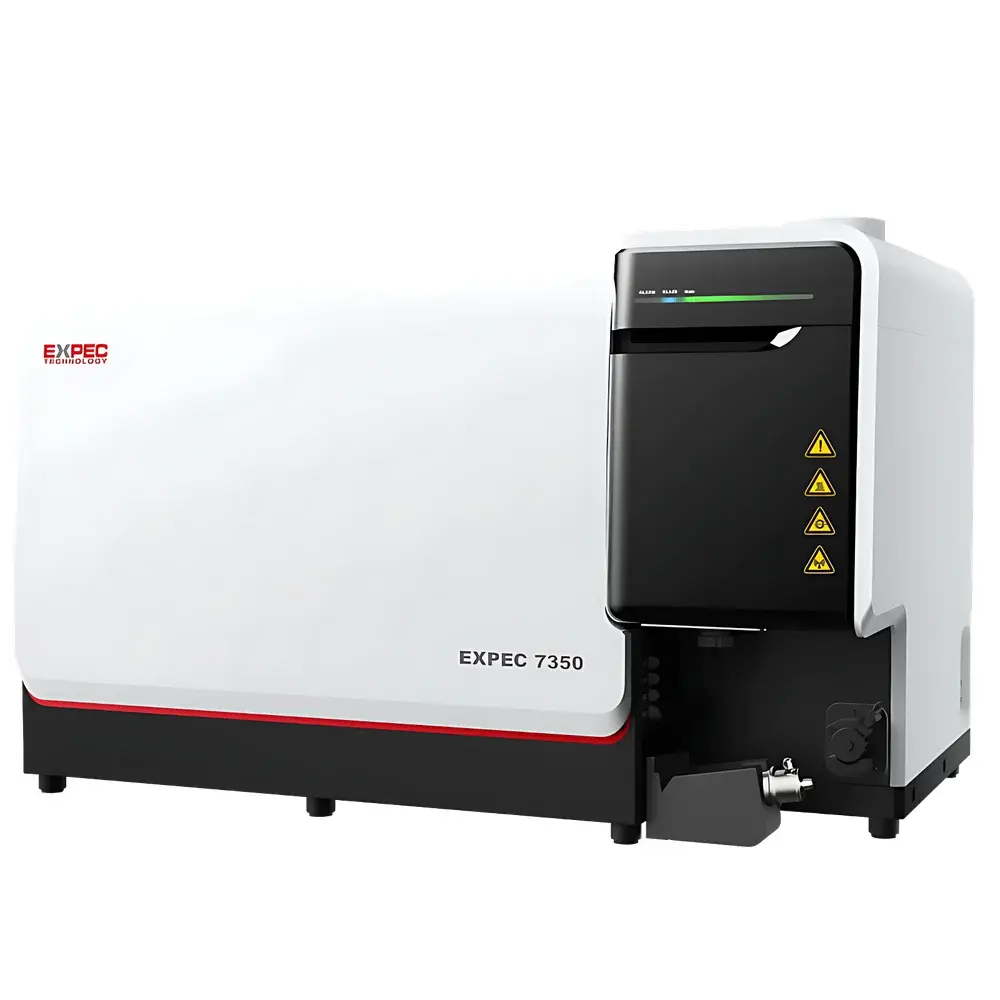
EXPEC 7350 Triple Quadrupole ICP-MS
| Brand | EXPEC (Superspectra Technology) |
|---|---|
| Origin | Zhejiang, China |
| Model | EXPEC 7350 |
| Instrument Type | Quadrupole-based ICP-MS |
| Configuration | Triple Quadrupole (Q1–CRC–Q2) |
| Intended Use | Laboratory-based elemental and isotopic analysis |
| Regulatory Context | Designed for compliance with ISO/IEC 17025, ASTM D5673, USP <232>/<233>, and EPA Methods 200.8 & 6020B |
Overview
The EXPEC 7350 Triple Quadrupole Inductively Coupled Plasma Mass Spectrometer (ICP-MS) is an engineered solution for ultra-trace elemental and isotopic analysis in high-complexity matrices. Unlike conventional single-quadrupole ICP-MS systems, the EXPEC 7350 integrates a true triple-quadrupole architecture—comprising a mass-resolving first quadrupole (Q1), a pressurized collision/reaction cell (CRC), and a second mass-analyzing quadrupole (Q2)—to enable selective ion transmission and on-mass or mass-shift interference removal. This configuration operates on the principle of *mass-resolved reaction monitoring* (MRM), where Q1 isolates precursor ions prior to controlled gas-phase reactions in the CRC, and Q2 transmits only product ions of interest. The system is optimized for applications demanding sub-pictogram-per-liter detection limits, robust polyatomic interference mitigation (e.g., 40Ar16O+ on 56Fe+, 40Ar35Cl+ on 75As+, or 31PH2+ on 33S+), and stable signal response across variable matrix loads—including seawater, digested biological tissues, semiconductor process chemicals, and high-salinity environmental extracts.
Key Features
- Vertical ion optics with dual-stage ion beam deflection: Removes >99.9% of neutral species and photons pre-Q1, minimizing background noise and enhancing signal-to-noise ratio (SNR) by up to 10× versus conventional horizontal designs.
- Patented vertical torch geometry and right-angle ion extraction: Improves plasma stability and reduces matrix-induced signal suppression, enabling direct analysis of samples containing up to 0.2% total dissolved solids (TDS) without dilution or offline desalting.
- Waterfall-style pressurized CRC with independently controlled reactive gases (He, H2, NH3, O2, CH4): Supports both kinetic energy discrimination (KED) and chemical resolution modes for targeted interference elimination.
- Self-excited all-solid-state RF generator (27.12 MHz): Delivers stable 1.5 kW plasma power with <±0.1% long-term output variation, ensuring reproducible ionization efficiency across multi-hour analytical sequences.
- On-line argon dilution module: Dynamically adjusts nebulizer gas flow and carrier gas composition to maintain optimal plasma conditions during high-salt or organic solvent introduction.
Sample Compatibility & Compliance
The EXPEC 7350 supports liquid, solid, and gaseous sample introduction via standardized interfaces compliant with ISO 11885, ASTM D1976, and ICH Q2(R2). It accommodates direct aqueous injection, laser ablation (LA-ICP-MS), electrothermal vaporization (ETV), hydride generation (HG), and gas chromatography (GC) coupling. All hardware and firmware are architected to support GLP/GMP audit trails, including full electronic signature capability, user-access logging, method version control, and 21 CFR Part 11–compliant data integrity features. Routine calibration verification follows NIST-traceable multi-element standards (e.g., CRM 3100a, ERM-AE633), and system performance is validated per EPA Method 6020B criteria (e.g., <2% RSD for internal standard recovery, <0.5 cps background at m/z 220).
Software & Data Management
Controlled by Superspectra’s proprietary MassHunter-compatible EXPEC MS Suite v4.x, the platform provides real-time MRM method setup, automated tuning (sensitivity, oxide, double-charge ratios), and integrated QC dashboards. Raw data files adhere to ANDI/NetCDF format for third-party processing (e.g., Agilent MassHunter Quant, Thermo TraceFinder, or open-source tools like OpenMS). Audit-ready reporting includes full metadata embedding (instrument parameters, calibration history, operator ID, timestamped sequence logs), and encrypted database storage with role-based access permissions. Software validation packages—including IQ/OQ/PQ documentation—are available upon request for regulated laboratories.
Applications
- Environmental Monitoring: Quantification of U, Pu, Am isotopes in nuclear effluents; Cr, As, Cd speciation in groundwater per EPA 1638; rare earth elements (REEs) in atmospheric particulate matter (PM2.5/PM10) collected via online aerosol concentrators.
- Food & Beverage Safety: Pb, Cd, As speciation in rice and infant formula per EU Commission Regulation (EU) No 1881/2006; authenticity testing of honey and wine using Sr/Nd isotopic fingerprinting.
- Clinical & Biomedical Research: Multi-element profiling (Zn, Cu, Se, Co) in serum and urine per CLIA guidelines; Pt-group element uptake studies in tumor tissue following chemotherapy.
- Materials Science: Sub-ppt impurity screening (Na, K, Ca, Fe) in 12-nm Si wafers; trace dopant mapping (B, P, As) in GaN epitaxial layers; leachable metals from pharmaceutical packaging polymers.
- Geochemistry & Mining: High-precision Lu–Hf and Sm–Nd isotope ratio measurements in zircon separates using desolvating nebulization and Faraday cup detection options.
FAQ
What regulatory standards does the EXPEC 7350 support for routine compliance testing?
It meets method requirements for EPA 200.8, 6020B, ISO 17294-2, and USP <232>/<233>, with built-in templates for QC acceptance criteria and reporting formats.
Can the system perform isotope ratio measurements with certified uncertainty?
Yes—when equipped with optional multi-collector detector arrays and calibrated using NIST SRM 981/982, it achieves internal precision of ≤0.05% RSD for 208Pb/206Pb ratios over 100 cycles.
Is remote diagnostics and software update capability available?
All units include secure TLS 1.3–enabled remote support ports, allowing authorized engineers to perform firmware updates, spectral diagnostics, and parameter optimization without onsite visits.
How is data integrity ensured during long-term unattended operation?
Full audit trail capture, cyclic redundancy checksum (CRC32) validation on every raw scan, and write-once-read-many (WORM) disk partitioning prevent post-acquisition tampering.
What consumables require scheduled replacement, and what is their typical service life?
Torch assemblies: 6–12 months depending on TDS load; Ni sampler/skimmer cones: 3–6 months; CRC reaction gases: cylinder lifespan varies by usage rate (typically 3–8 weeks at 5 sccm He flow).





