
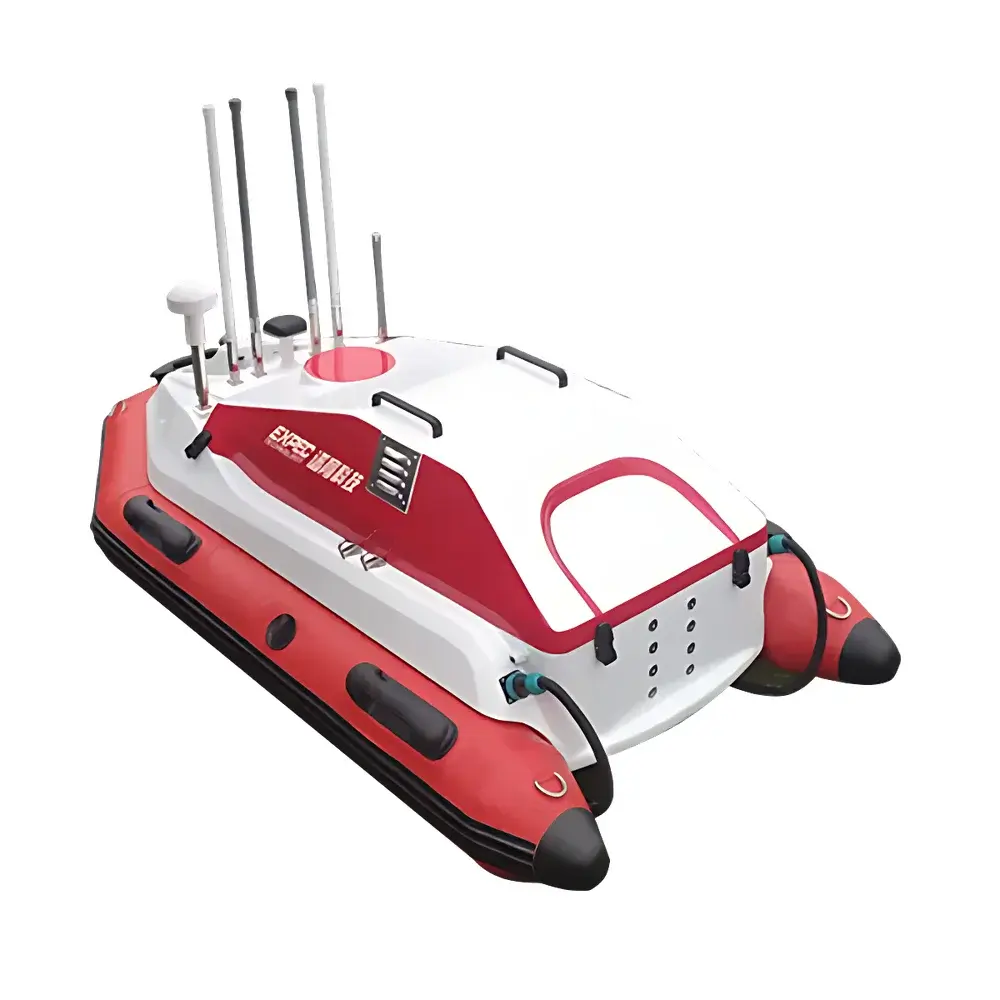
EXPEC MOST 8000 Aquatic Environmental Mobile Survey Monitoring System
| Brand | EXPEC |
|---|---|
| Origin | Zhejiang, China |
| Manufacturer Type | Authorized Distributor |
| Country of Origin | China |
| Model | MOST 8000 |
| Pricing | Available Upon Request |
Overview
The EXPEC MOST 8000 Aquatic Environmental Mobile Survey Monitoring System is an integrated, platform-agnostic water quality surveillance solution engineered for autonomous or manned deployment on unmanned surface vehicles (USVs), crewed vessels, and mobile land-based platforms. It operates on a multi-sensor fusion architecture, combining in situ optical spectroscopy (UV-Vis, fluorescence, and full-spectrum absorbance), electrochemical sensing (pH, DO, conductivity, ORP, ion-selective electrodes), chromatographic separation (for targeted organic pollutants), and selective mass spectrometry modules—where configured—to deliver real-time, multi-parameter water quality data. The system adheres to the fundamental measurement principles defined in China’s HJ environmental monitoring standards (e.g., HJ 535–2009 for ammonia nitrogen, HJ 828–2017 for CODCr, HJ 484–2009 for cyanide), ensuring regulatory traceability and methodological consistency with national environmental enforcement protocols.
Key Features
- Multi-platform compatibility: Designed for seamless integration with USVs (≥1.2 m length), small crewed patrol boats, and vehicle-mounted mobile labs—supporting dynamic positioning, GPS-synchronized sampling, and geo-referenced data tagging.
- Dual-mode analytical validation: Simultaneous quantitative analysis via standardized wet-chemistry methods and rapid qualitative screening using full-spectrum UV-Vis absorbance (190–850 nm), enabling cross-verification to reduce false positives/negatives in complex matrices.
- Modular instrument architecture: Each analytical module (e.g., spectrophotometric COD analyzer, amperometric nitrate sensor, ion chromatography unit) is self-contained, with integrated reagent cooling (4–10 °C), pressure-regulated fluidic control, and auto-calibration routines compliant with ISO/IEC 17025 preconditions.
- High-density sensor integration: A single compact USV payload bay accommodates up to six independent detection modules with shared power management (24 V DC input), centralized waste containment (sealed 5 L capacity per module), and unified hydraulic control (peristaltic pumps + precision solenoid valves).
- Embedded edge computing: Onboard ARM-based controller executes real-time QA/QC checks—including drift correction, blank subtraction, and outlier rejection—before transmitting time-stamped, metadata-enriched datasets to the cloud.
Sample Compatibility & Compliance
The MOST 8000 system is validated for use with natural freshwater (rivers, lakes, reservoirs), urban stormwater and wastewater-impacted surface water, brackish estuarine systems (up to 15 psu salinity), and nearshore marine environments (≤5 m depth). All wetted components comply with NSF/ANSI Standard 61 for drinking water system components and are constructed from chemically inert materials (e.g., PTFE, quartz, 316L stainless steel). Data acquisition workflows support audit-ready logging aligned with GLP principles, including electronic signatures, immutable timestamps, and change history tracking—facilitating alignment with future FDA 21 CFR Part 11 readiness when deployed in regulated monitoring programs.
Software & Data Management
The system interfaces with EXPEC’s AquaCloud™ Platform—a secure, role-based SaaS environment supporting ISO/IEC 27001-certified data encryption (AES-256 at rest and in transit). Raw sensor outputs undergo automated unit conversion (e.g., µS/cm → dS/m), matrix correction (e.g., temperature compensation for conductivity), and spatial interpolation via inverse distance weighting (IDW) to generate contour maps of parameters such as turbidity, chlorophyll-a, total phosphorus, and heavy metal concentrations. API access enables integration with municipal water resource dashboards, provincial ecological monitoring networks, and third-party GIS platforms (ArcGIS Online, QGIS Server). Audit trails record all configuration changes, calibration events, and manual overrides—meeting minimum requirements for environmental data governance under China’s “River Chief System” implementation guidelines.
Applications
- River basin-wide water quality mapping: Continuous transect-based profiling across longitudinal gradients to identify spatial hotspots and longitudinal trends in nutrient loading.
- Pollution source attribution: High-resolution spatial scanning around suspected discharge points to quantify effluent flux (kg/day) using synchronized flow velocity measurements and concentration gradients.
- Emergency response monitoring: Rapid deployment during chemical spills or algal bloom events, delivering time-series toxin profiles (e.g., microcystin-LR via LC-MS/MS module) with ≤15-minute turnaround from sample intake to report generation.
- Regulatory compliance verification: Automated routine surveillance supporting “River Chief” accountability reporting, inter-provincial water transfer monitoring, and ecological red-line boundary enforcement.
- Long-term trend analysis: Cloud-stored historical datasets enable statistical modeling of seasonal variability, climate-driven regime shifts, and anthropogenic impact assessment over multi-year cycles.
FAQ
What water depth ranges is the MOST 8000 system rated for?
The standard USV-integrated configuration operates reliably in depths from 0.5 m to 8 m; optional bathymetric sonar integration extends navigational safety down to 20 m.
Can the system operate in tidal or high-turbidity estuarine environments?
Yes—optical sensors include automatic turbidity compensation algorithms, and electrochemical probes feature anti-fouling membranes validated for continuous operation in suspended solids concentrations up to 150 mg/L.
Is remote firmware update supported?
Yes, over-the-air (OTA) updates are delivered via encrypted MQTT channels, with rollback capability and SHA-256 signature verification.
Does the system meet international calibration traceability requirements?
All factory calibrations reference NIST-traceable standards (e.g., SRM 1640a for absorbance, BAM-100 for pH), and on-site verification protocols align with ISO 7027 and ISO 5667-3.
How is data integrity ensured during satellite or low-bandwidth transmission?
Local edge storage retains ≥72 hours of raw data; differential compression and packet-level CRC32 checksums prevent corruption during intermittent connectivity.




