
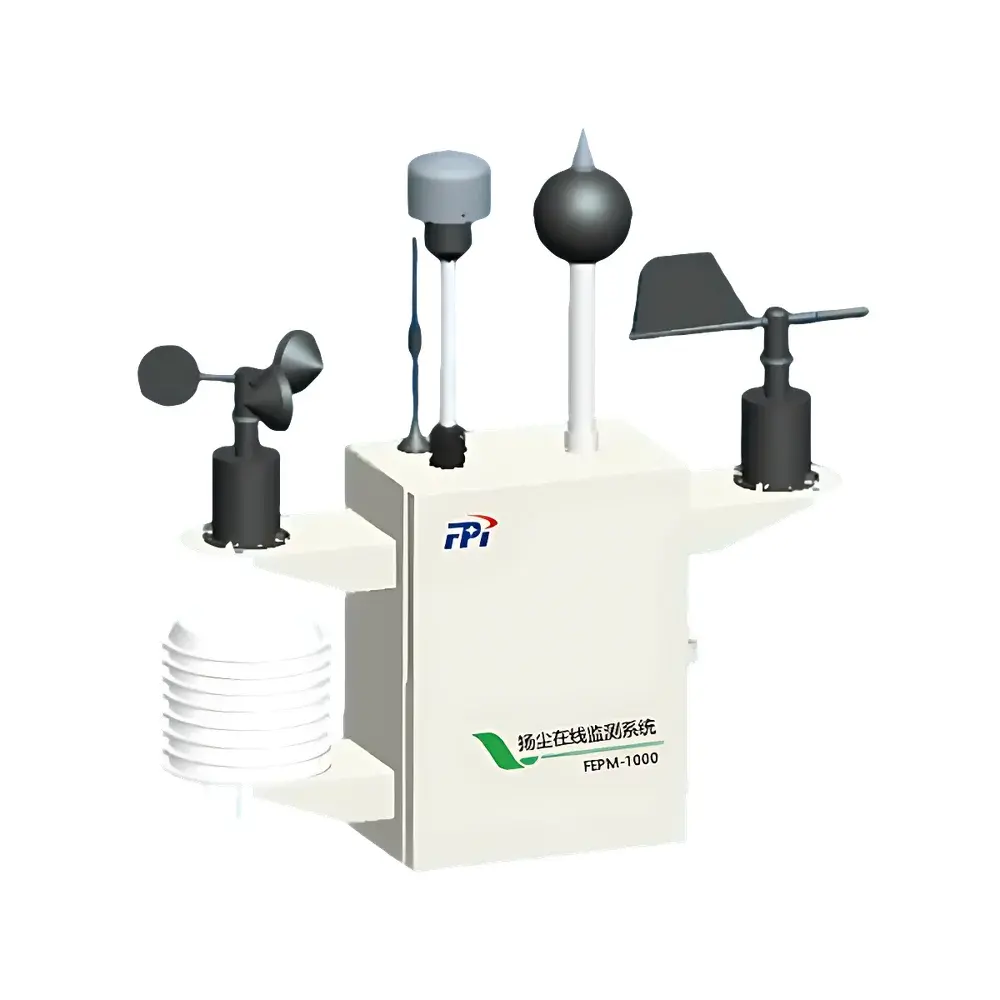
EXPEC FEPM-1000 Real-Time Ambient Dust Monitoring System
| Brand | EXPEC (Hangzhou Puyu Technology Co., Ltd.) |
|---|---|
| Origin | Zhejiang, China |
| Model | FEPM-1000 |
| Measurement Principle | Optical Scattering (Nephelometry) |
| Particle Size Channels | PM₁.₀, PM₂.₅, PM₁₀, TSP |
| Environmental Operating Range | −20 °C to 50 °C |
| Heating Function | Dynamic Temperature-Controlled Inlet Heater |
| Calibration | Automated Zero-Point Calibration & Optical Chamber Air-Purge Self-Cleaning |
| Communication Interfaces | Ethernet (LAN), RS485, Wireless (4G/LTE) |
| Protocol Support | Modbus RTU/TCP, MQTT, HTTP API |
| Expandable Modules | Integrated Noise Sensor, Optional LED Display Unit |
| Data Management | Cloud-Connected Central Platform with Device Health Monitoring & Event-Driven Alerting |
| Compliance Framework | Designed for alignment with China’s HJ 653–2013, HJ 93–2013, and GB 3095–2012 |
Overview
The EXPEC FEPM-1000 Real-Time Ambient Dust Monitoring System is an industrial-grade, compact environmental sensor platform engineered for continuous, unattended measurement of airborne particulate matter in high-concentration outdoor environments. It employs calibrated optical scattering (nephelometry) — a well-established, field-proven principle defined in ISO 21501-4 and referenced in US EPA EQPM-0702-170 — to quantify mass concentrations of respirable and inhalable fractions: PM₁.₀, PM₂.₅, PM₁₀, and total suspended particulates (TSP). Unlike laboratory-based gravimetric methods, the FEPM-1000 delivers second-by-second concentration data with high temporal resolution, enabling detection of transient emission events, diurnal patterns, and spatial gradients across distributed monitoring networks. Its robust mechanical design and embedded environmental compensation algorithms ensure metrological stability under variable humidity, temperature, and wind-loading conditions typical of roadside, construction site, and bulk-material handling zones.
Key Features
- Dynamic inlet heating system maintains consistent sample temperature and suppresses hygroscopic growth artifacts — critical for accurate PM measurement in high-humidity or freezing ambient conditions.
- Automated zero-point calibration routine combined with periodic optical chamber air-purge cycles minimizes drift and preserves long-term photometric sensitivity without manual intervention.
- Multi-interface communication architecture supports simultaneous LAN (TCP/IP), RS485 (Modbus RTU), and cellular 4G/LTE connectivity — enabling deployment in locations with limited infrastructure while ensuring redundancy and uptime.
- Protocol-agnostic firmware stack accommodates integration into legacy SCADA systems (via Modbus), modern IoT platforms (via MQTT), and custom dashboards (via RESTful HTTP API).
- Modular expansion capability allows seamless addition of co-located sensors — including Class 2 sound level meters (IEC 61672-1 compliant) and sunlight-readable LED display units for on-site public visibility.
Sample Compatibility & Compliance
The FEPM-1000 is validated for ambient air sampling in non-explosive, non-corrosive atmospheres with particulate loadings up to 1000 µg/m³ — suitable for hotspots such as unpaved haul roads, coal stockpiles, mineral processing yards, and active excavation sites. Its flow control system maintains stable volumetric aspiration (±2% accuracy) across pressure differentials encountered at elevations up to 3000 m ASL. While not certified to EU EN 12341 or US EPA EQPM specifications as a reference method, the system is designed and verified for indicative monitoring in accordance with China’s Ministry of Ecology and Environment standards: HJ 653–2013 (specifications for PM monitoring instruments), HJ 93–2013 (technical requirements for PM samplers), and ambient air quality standard GB 3095–2012. Internal data logging includes full timestamping, instrument status flags, and environmental metadata — supporting traceability during regulatory audits or source attribution studies.
Software & Data Management
The FEPM-1000 operates within EXPEC’s cloud-native Environmental Intelligence Platform (EIP), a secure, role-based SaaS environment accessible via web browser or mobile application. The platform ingests time-series data with millisecond-level precision, applies configurable correction algorithms (e.g., humidity compensation, baseline offset adjustment), and generates ISO-compliant reporting templates. Device health telemetry — including laser power decay, fan RPM, heater duty cycle, and communication latency — is continuously monitored; anomalies trigger automated email/SMS alerts and optional SNMP traps. All user actions, configuration changes, and alarm acknowledgments are recorded in an immutable audit log, satisfying documentation requirements aligned with GLP and GMP operational frameworks. Raw data export is supported in CSV, NetCDF, and JSON formats, with optional encryption-at-rest and TLS 1.2+ in-transit security.
Applications
- Urban traffic corridor monitoring: Quantifying brake wear, tire abrasion, and resuspended road dust along arterial roads and intersections.
- Industrial material handling facilities: Tracking fugitive emissions from conveyor transfer points, open stockpiles, and loading/unloading operations in mining, cement, and thermal power sectors.
- Construction site boundary monitoring: Enforcing local PM mitigation ordinances through real-time compliance dashboards shared with municipal environmental bureaus.
- Rural and peri-urban background assessment: Establishing baseline aerosol loading in ecologically sensitive zones, national parks, and heritage districts where fine particle exposure must be minimized.
- Mobile deployment on vehicles or UAVs: Supporting dynamic mapping of dust plumes during emergency response or pre-construction baseline surveys.
FAQ
Does the FEPM-1000 meet U.S. EPA or EU reference method equivalency requirements?
No — it is classified as an indicative monitor per Chinese regulatory guidance and is not certified as a Federal Equivalent Method (FEM) or EN 12341 reference instrument. It is intended for trend analysis, hotspot identification, and operational decision support.
Can the system operate autonomously during extended power outages?
Yes — when paired with an external UPS or solar-charged battery bank (recommended capacity: ≥12 V / 20 Ah), the FEPM-1000 maintains core sensing and wireless transmission functions for up to 72 hours.
Is remote firmware update supported?
Yes — over-the-air (OTA) updates are delivered securely via the EIP platform, with version rollback capability and integrity checksum verification.
What maintenance interval is recommended for field-deployed units?
A biannual inspection is advised: visual verification of inlet filter integrity, optical window cleanliness, and mounting hardware torque; no consumables require replacement under normal operating conditions.
How is data synchronization handled if cellular connectivity is temporarily lost?
Onboard flash memory stores up to 30 days of high-resolution data (1-minute intervals); once connectivity resumes, buffered records are transmitted in chronological order with original timestamps preserved.







