
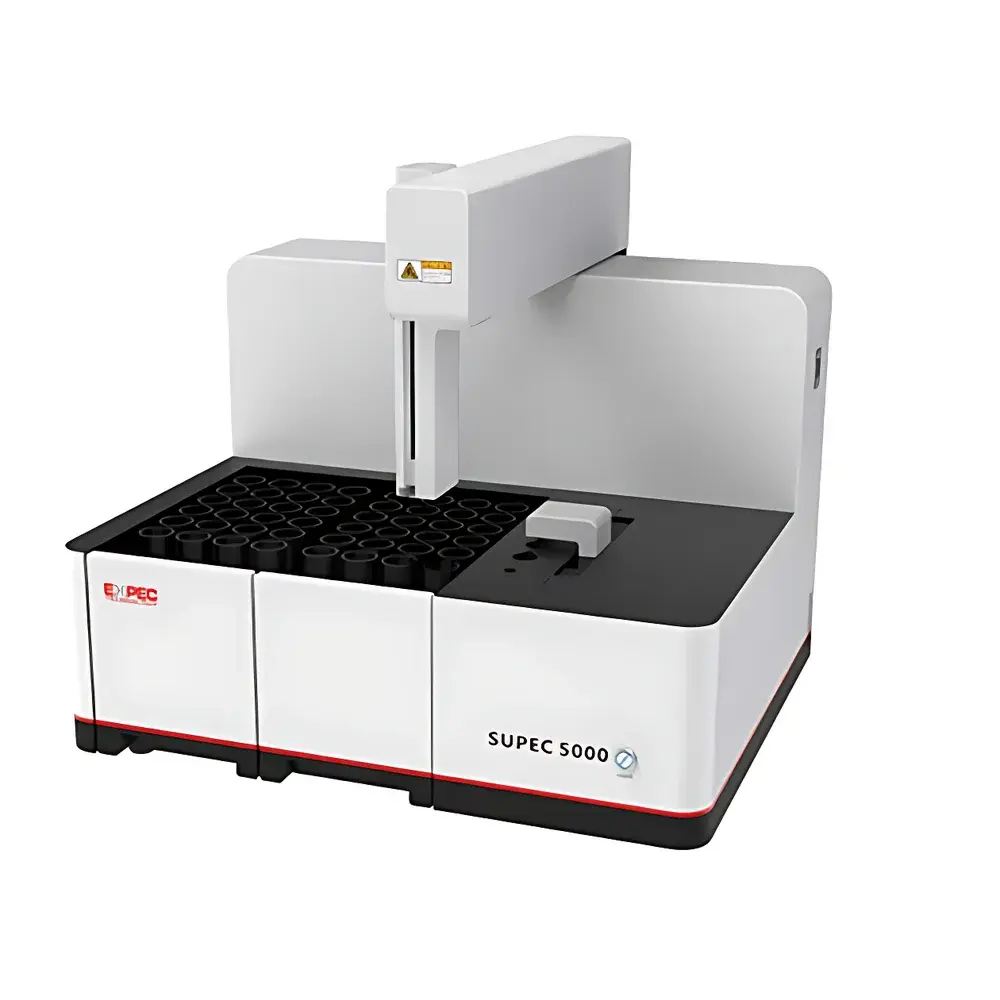
EXPEC SUPEC 5000 NH₃-N Automated Ammonia-Nitrogen Analyzer
| Brand | EXPEC |
|---|---|
| Origin | Zhejiang, China |
| Model | SUPEC 5000 NH₃-N |
| Measurement Principle | Nesslerization-based UV-Vis Spectrophotometry |
| Compliance | HJ 535–2009, National Surface Water Monitoring SOPs |
| Sample Throughput | High-throughput batch analysis |
| Pretreatment | Integrated coagulation-sedimentation module |
| Detection Range | Optimized for environmental water matrices (typical range: 0.02–2.0 mg/L NH₃-N) |
| Optical System | Dual-beam UV-Vis photometric detection at 420 nm |
| Sample Capacity | Motorized multi-position carousel with pull-out sample trays |
| Fluid Handling | Corrosion-resistant sealed robotic arm with precision liquid handling |
| Data Integrity | Audit-trail-enabled software compliant with GLP/GMP data governance principles |
Overview
The EXPEC SUPEC 5000 NH₃-N Automated Ammonia-Nitrogen Analyzer is a dedicated benchtop spectrophotometric system engineered for high-reproducibility, regulatory-compliant quantification of ammonia nitrogen (NH₃-N) in environmental water samples. It implements the standardized Nesslerization reaction—where ammonia reacts with alkaline Nessler’s reagent to form a yellow-brown colloidal complex—followed by quantitative measurement via dual-beam UV-Vis photometry at 420 nm. Unlike manual wet-chemistry workflows, this instrument fully automates sample aspiration, reagent addition, mixing, coagulation-sedimentation pretreatment, color development, optical measurement, and result calculation. Designed specifically for routine monitoring laboratories, it eliminates operator-induced variability while maintaining strict adherence to HJ 535–2009 (“Water Quality – Determination of Ammonia Nitrogen – Nessler Reagent Spectrophotometric Method”) and the procedural requirements outlined in the National Surface Water Environmental Quality Monitoring Network Operational Guidelines.
Key Features
- Integrated coagulation-sedimentation pretreatment module that effectively removes interferences from color, turbidity, and suspended solids—critical for raw surface water, groundwater, and wastewater-impacted drinking water sources.
- Motorized, multi-position sample carousel with pull-out tray design, enabling rapid loading/unloading of standardized sample tubes without disrupting ongoing runs; supports up to 60+ samples per batch depending on configuration.
- Fully enclosed, chemically resistant robotic arm with PTFE-coated pipetting channels and corrosion-proof actuation components—ensuring long-term reliability in aggressive reagent environments (e.g., NaOH, KNaC₄H₄O₆·4H₂O, HgI₂/KI solutions).
- Dual-beam UV-Vis optical architecture with thermally stabilized tungsten-halogen source and precision interference filter at 420 nm, delivering stable baseline response and minimizing drift over extended operation cycles.
- Onboard calibration verification using certified reference standards prior to each analytical sequence—supporting traceability and method validation per ISO/IEC 17025 requirements.
Sample Compatibility & Compliance
The SUPEC 5000 NH₃-N accepts standard 12–16 mm diameter glass or polypropylene sample tubes (10–50 mL volume). It accommodates raw, filtered, or centrifuged aqueous matrices including river water, lake water, groundwater, treated drinking water, and low-salinity effluents. All operational protocols—including reagent delivery volumes, incubation times, and photometric integration parameters—are preconfigured to meet HJ 535–2009 performance criteria (e.g., detection limit ≤ 0.02 mg/L NH₃-N, repeatability RSD ≤ 3%, recovery 90–110%). The system supports full documentation of instrument settings, reagent lot numbers, calibration history, and raw absorbance data—enabling audit readiness for GLP, ISO 17025, and provincial environmental monitoring accreditation programs.
Software & Data Management
Controlled via EXPEC Analytical Suite v3.x, the analyzer features role-based user access, electronic signature capability, and built-in 21 CFR Part 11–aligned audit trail functionality. All measurements are timestamped, digitally signed, and stored with metadata (operator ID, method version, QC results, instrument status logs). Raw spectral data, calibration curves, and QC charts are exportable in CSV and PDF formats. Software includes automated outlier detection, trend analysis across multi-day monitoring campaigns, and configurable report templates aligned with China’s Ministry of Ecology and Environment (MEE) reporting formats.
Applications
- Routine surveillance of NH₃-N in national and provincial surface water quality monitoring networks.
- Groundwater vulnerability assessment in agricultural and industrial catchment zones.
- Compliance testing for drinking water treatment plants under GB 5749–2022 (Sanitary Standard for Drinking Water).
- Process control and discharge monitoring in municipal wastewater treatment facilities.
- Research applications requiring statistically robust, high-frequency NH₃-N time-series data in limnological and hydrological studies.
FAQ
Does the SUPEC 5000 NH₃-N require manual digestion or distillation steps?
No—this instrument operates exclusively on the Nessler reagent method and does not incorporate high-temperature digestion or steam distillation. It is intended for samples where ammonia is present predominantly in the free or ionized form.
Can it analyze seawater or high-salinity brines?
Not recommended without matrix-specific validation. Elevated chloride and ionic strength may interfere with the Nessler reaction kinetics and precipitate formation; users should perform spike-recovery tests per ISO 5667-16 prior to deployment.
Is method validation documentation provided?
Yes—the system ships with a comprehensive Validation Package including IQ/OQ documentation, HJ 535–2009 conformance test reports, and a Certificate of Conformance issued by EXPEC’s CNAS-accredited metrology lab.
What maintenance intervals are recommended?
Daily: optical window cleaning and waste reservoir emptying. Quarterly: robotic arm lubrication and photometer lamp intensity verification. Annually: full fluidic path calibration and gravimetric verification of reagent dispensing accuracy.





