
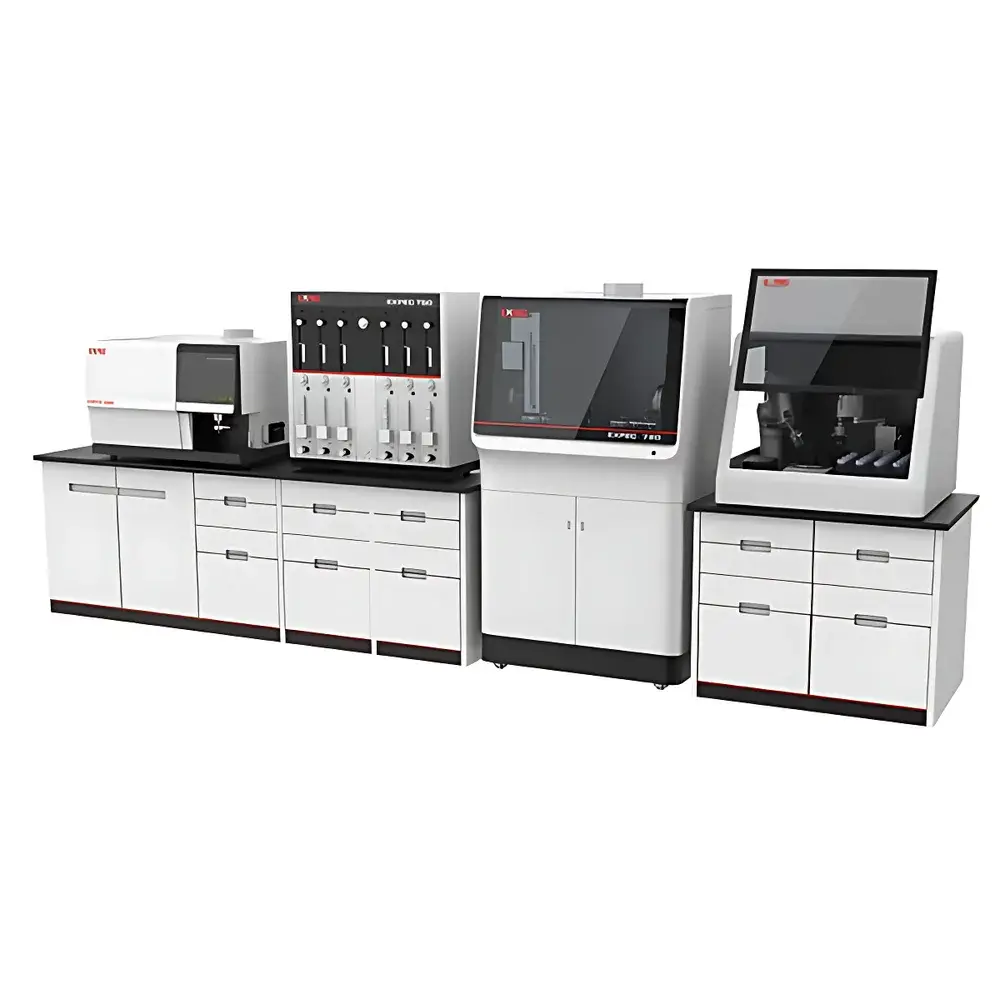
EXPEC SUPEC 6020/7020 Fully Automated Heavy Metal Analysis System
| Brand | EXPEC |
|---|---|
| Origin | Zhejiang, China |
| Manufacturer Type | Authorized Distributor |
| Product Origin | Domestic (China) |
| Model | SUPEC 6020 / SUPEC 7020 |
| Instrument Type | Full-Spectrum Direct-Reading ICP-OES (6020) / Quadrupole ICP-MS (7020) |
| Detection Limit | Not Specified |
| Precision (RSD) | Not Specified |
| Stability | Not Specified |
| Wavelength Range | Not Specified |
| Optical Resolution | Not Specified |
Overview
The EXPEC SUPEC 6020/7020 Fully Automated Heavy Metal Analysis System is an integrated analytical platform engineered for high-throughput, unattended elemental quantification in environmental, food safety, clinical, and regulatory laboratories. The SUPEC 6020 employs Inductively Coupled Plasma Optical Emission Spectrometry (ICP-OES) with full-spectrum direct-read CCD/CMOS detection architecture, enabling simultaneous multi-element analysis across the UV–Vis spectral range (typically 165–900 nm). The SUPEC 7020 utilizes quadrupole-based Inductively Coupled Plasma Mass Spectrometry (ICP-MS), delivering sub-trace detection capabilities for isotopic and elemental analysis. Both systems are fully coupled to an automated sample preparation module—supporting either graphite block digestion or high-pressure microwave-assisted digestion—eliminating manual transfer steps and minimizing contamination risk. The system operates under a unified control architecture that coordinates plasma ignition, optical/mass spectrometer optimization, calibration, quality control, and data validation in sequence, conforming to GLP-compliant workflow design principles.
Key Features
- Fully automated plasma ignition and instrumental parameter optimization: The system initiates plasma generation, tunes RF power, nebulizer gas flow, and viewing height autonomously prior to analysis.
- Intelligent reagent handling: Corrosion-resistant fluidic pathways accommodate nitric acid, hydrochloric acid, hydrofluoric acid, and perchloric acid; precise syringe-pump-driven reagent addition ensures stoichiometric accuracy during digestion and standardization.
- Automated lid sealing and venting: Hermetic digestion vessel sealing prevents volatile loss; acid fume extraction via integrated exhaust management ensures operator safety and method reproducibility.
- Volumetric precision via ultrasonic liquid-level sensing and high-accuracy syringe pumps: Final dilution volumes from 5 mL to 50 mL are achieved with ≤ ±0.025 mL accuracy; bubble-induced homogenization guarantees solution uniformity prior to introduction.
- Autonomous sample introduction and inline filtration: Post-dilution, samples are aspirated through a PTFE-lined peristaltic pump and filtered via 0.45 µm membrane before nebulization—reducing clogging and enhancing long-term stability.
- Self-diagnostic QC execution: At user-defined intervals, the system automatically injects blanks, certified reference materials (CRMs), and detection limit standards; results trigger configurable actions including re-analysis, flagging, or workflow suspension.
Sample Compatibility & Compliance
The SUPEC 6020/7020 accommodates aqueous extracts, digested soil/sediment leachates, biological tissue homogenates, and food homogenates following EPA Methods 200.7, 200.8, and 6020B, as well as ISO 17294-2 and China’s HJ 680-2013 and HJ 803-2016 standards. All automated digestion protocols comply with ASTM D5688 for microwave-assisted acid digestion. The software architecture supports 21 CFR Part 11-compliant electronic signatures, audit trails, and role-based access control—enabling deployment in regulated environments requiring GMP/GLP documentation integrity. Instrument logs record timestamps for every critical event: reagent dispense, plasma ignition, calibration update, and QC failure.
Software & Data Management
The EXPEC SmartLab™ Control Suite provides a unified GUI for method development, real-time monitoring of digestion status (temperature, pressure, torque), and interactive calibration curve visualization. Each element displays CPS (counts per second), concentration (µg/L or ng/L), RSD (%), and confidence interval in tabular format. Curves update dynamically during analysis; outliers are highlighted with color-coded alerts and optional auto-rejection logic. Raw spectral or mass data files are stored in vendor-neutral .csv and .mzML (for 7020) formats. Data export supports LIMS integration via ASTM E1394-compliant interfaces and OPC UA protocol for factory-floor connectivity.
Applications
- Environmental monitoring: Quantification of As, Cd, Cr, Pb, Hg, Ni, Cu, Zn, and Se in drinking water, wastewater, and solid waste according to EU Directive 2020/2184 and US EPA Safe Drinking Water Act compliance requirements.
- Food and feed safety: Multi-element screening in rice, infant formula, seafood, and animal feed per GB 5009.268–2016 and Codex Alimentarius STAN 193–1995.
- Clinical toxicology: Trace metal profiling (e.g., Co, Mn, V) in serum and urine matrices aligned with CLIA and CAP proficiency testing guidelines.
- Geochemical prospecting: Rapid analysis of rock powders and ore concentrates using fusion or closed-vessel microwave digestion workflows.
- Pharmaceutical excipient testing: Residual catalyst metals (Pd, Pt, Rh) in active pharmaceutical ingredients per ICH Q2(R2) validation framework.
FAQ
Does the system support both open-vessel and closed-vessel digestion?
Yes—the platform integrates optional graphite block digesters (open-vessel, ambient pressure) and high-pressure microwave modules (up to 300 °C, 120 bar) with real-time temperature/pressure feedback.
Can the SUPEC 6020 and 7020 share the same sample preparation module?
Yes—both instruments interface with the identical automated digestion and dilution unit via standardized I/O protocols and fluidic connectors.
Is method validation documentation provided for regulatory submissions?
Yes—EXPEC supplies IQ/OQ/PQ templates, system suitability test procedures, and traceable calibration records compliant with ISO/IEC 17025 and FDA guidance on analytical instrument qualification.
How is argon consumption optimized during operation?
Plasma gas flow is dynamically modulated based on sample matrix conductivity and nebulizer backpressure; standby mode reduces Ar flow by >60% during idle periods without compromising restart stability.
What cybersecurity measures are implemented in the control software?
SmartLab™ includes TLS 1.2 encryption for remote access, Windows Defender Application Control policies, and automatic firmware signature verification prior to installation.






