
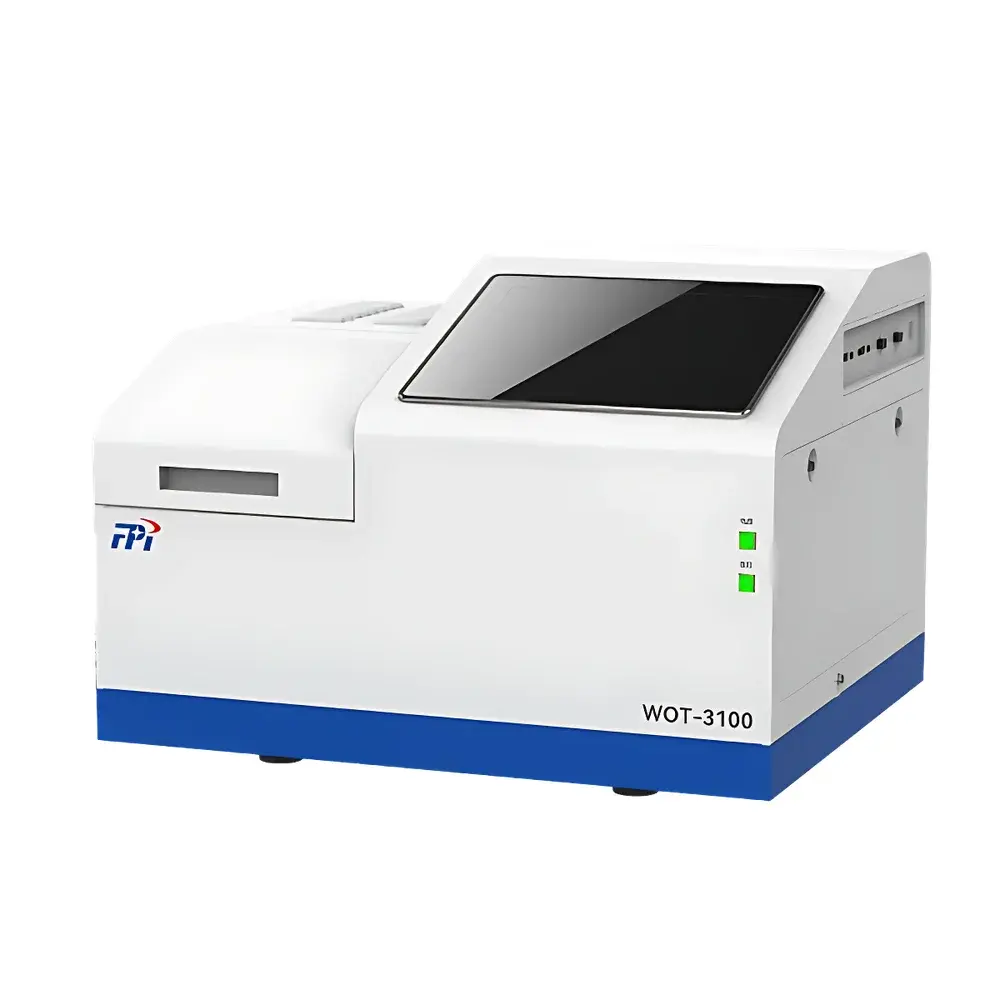
EXPEC WOT-3100 Benchtop Water Quality Early-Warning & Source-Tracking Instrument
| Brand | EXPEC |
|---|---|
| Origin | Zhejiang, China |
| Model | WOT-3100 |
| Application | Organic Contaminant Source Identification via Fluorescence Excitation-Emission Matrix (EEM) Fingerprinting |
| Detection Principle | UV-Vis Fluorescence Spectroscopy (200–450 nm excitation |
| Operational Mode | Reagent-Free, Non-Destructive Optical Analysis |
| Deployment Flexibility | Benchtop, Mobile (Vehicle/Boat-Mounted), Field-Deployable |
| Data Integration Capability | Compatible with Heavy Metal Analyzers and Organic Pollutant Sensors for Multi-Parameter Emergency Response |
Overview
The EXPEC WOT-3100 Benchtop Water Quality Early-Warning & Source-Tracking Instrument is an optical analytical system engineered for rapid identification and spatial attribution of organic contamination in surface water, groundwater, and wastewater effluents. It operates on the principle of three-dimensional fluorescence spectroscopy—specifically Excitation-Emission Matrix (EEM) profiling—wherein natural or anthropogenic organic compounds (e.g., humic substances, protein-like materials, polycyclic aromatic hydrocarbons, and wastewater-derived fluorophores) exhibit characteristic spectral signatures under controlled UV-Vis excitation. By capturing full EEM landscapes (excitation range: 200–450 nm; emission range: 250–550 nm) and applying multivariate statistical pattern recognition—including Parallel Factor Analysis (PARAFAC) and correlation-based spectral matching—the instrument enables quantitative fingerprint comparison against reference libraries of known pollution sources (e.g., domestic sewage, industrial discharge, agricultural runoff, landfill leachate). Unlike conventional wet-chemistry methods, the WOT-3100 delivers source-inference results within minutes without reagent consumption, sample digestion, or derivatization—making it suitable for routine surveillance, incident response, and regulatory screening.
Key Features
- Reagent-free, non-invasive fluorescence detection: Eliminates chemical waste generation and operator exposure risk while ensuring long-term operational sustainability.
- Integrated EEM acquisition and automated spectral deconvolution: Captures high-resolution fluorescence landscapes with calibrated photomultiplier tube (PMT) detection and temperature-stabilized optics.
- Proprietary source-matching algorithm suite: Combines Euclidean distance mapping, cosine similarity scoring, and hierarchical clustering to rank candidate source profiles from a curated database of >200 validated emission fingerprints.
- Modular hardware architecture: Supports benchtop laboratory use, vehicle-integrated deployment (19″ rack-mountable chassis), and marine vessel integration via IP65-rated enclosure options.
- Real-time data synchronization: Equipped with Ethernet and optional 4G LTE connectivity for remote firmware updates, cloud-based library expansion, and centralized dashboard integration.
Sample Compatibility & Compliance
The WOT-3100 accepts liquid samples in standard quartz cuvettes (10 mm pathlength) or flow-through cells (for continuous monitoring mode). It accommodates turbidities up to 100 NTU (with built-in Rayleigh scatter correction) and handles pH ranges from 4.0 to 9.5 without matrix interference. All spectral acquisition protocols align with ISO 17294-2:2016 (Water quality — Elemental analysis by inductively coupled plasma mass spectrometry — Part 2: Guidance on analytical methodology) for method validation rigor, and raw spectral metadata comply with ASTM D8259-20 standards for fluorescence-based water characterization. The system supports audit-trail logging per GLP and EPA Region 10 guidance for environmental forensic applications, including time-stamped operator actions, calibration history, and version-controlled spectral libraries.
Software & Data Management
The instrument is operated via EXPEC AquaTrace™ v3.2 software—a Windows-based platform compliant with FDA 21 CFR Part 11 requirements for electronic records and signatures. Key modules include: (1) EEM Acquisition Console with auto-gain optimization and dark-current subtraction; (2) Library Manager supporting user-defined profile import/export in .jdx and .csv formats; (3) TraceMatch Engine performing batch-wise comparison across up to 50 concurrent samples; and (4) Reporting Module generating PDF reports with embedded spectra, match confidence scores (0–100%), and geotagged sampling metadata (when paired with GPS-enabled mobile platforms). All raw and processed data are stored in encrypted SQLite databases with role-based access control and automatic backup to network-attached storage (NAS) or AWS S3 buckets.
Applications
- Regulatory surveillance: Routine analysis of municipal intake points, reservoirs, and river transects to establish baseline fluorescence signatures and detect anomalous deviations indicative of illicit discharge.
- Emergency response: Rapid deployment during fish kills, odor complaints, or unexplained turbidity events—enabling field operators to triage upstream segments within 90 minutes of sampling.
- Cross-instrument corroboration: Synchronized operation with EXPEC heavy metal analyzers (e.g., ICPOES-2000) and GC-MS platforms to distinguish co-occurring inorganic/organic pollution vectors and validate forensic conclusions.
- Judicial support: Generation of court-admissible spectral evidence packages—including chain-of-custody logs, calibration certificates, and inter-laboratory reproducibility metrics—for environmental enforcement proceedings.
FAQ
Does the WOT-3100 require daily calibration with certified reference standards?
No—factory-calibrated grating and PMT gain settings remain stable for ≥6 months under normal operating conditions; annual verification using NIST-traceable quinine sulfate solution is recommended.
Can the system differentiate between natural organic matter and synthetic pollutants?
Yes—through PARAFAC modeling, the software isolates component-specific EEM peaks (e.g., Peak C at Ex/Em ≈ 330/420 nm for humics vs. Peak T at Ex/Em ≈ 275/310 nm for tryptophan-like compounds), enabling discrimination between autochthonous and anthropogenic fluorophores.
Is spectral library expansion supported for site-specific contaminants?
Yes—users may curate proprietary libraries via the Library Manager, subject to internal validation protocols aligned with ISO/IEC 17025:2017 clause 7.2.2 for method development.
What cybersecurity measures are implemented in AquaTrace™ software?
Role-based authentication, TLS 1.2 encrypted communications, mandatory password complexity policies, and immutable audit trails meeting IEC 62443-3-3 SL2 requirements for industrial control systems.
Related Products







