
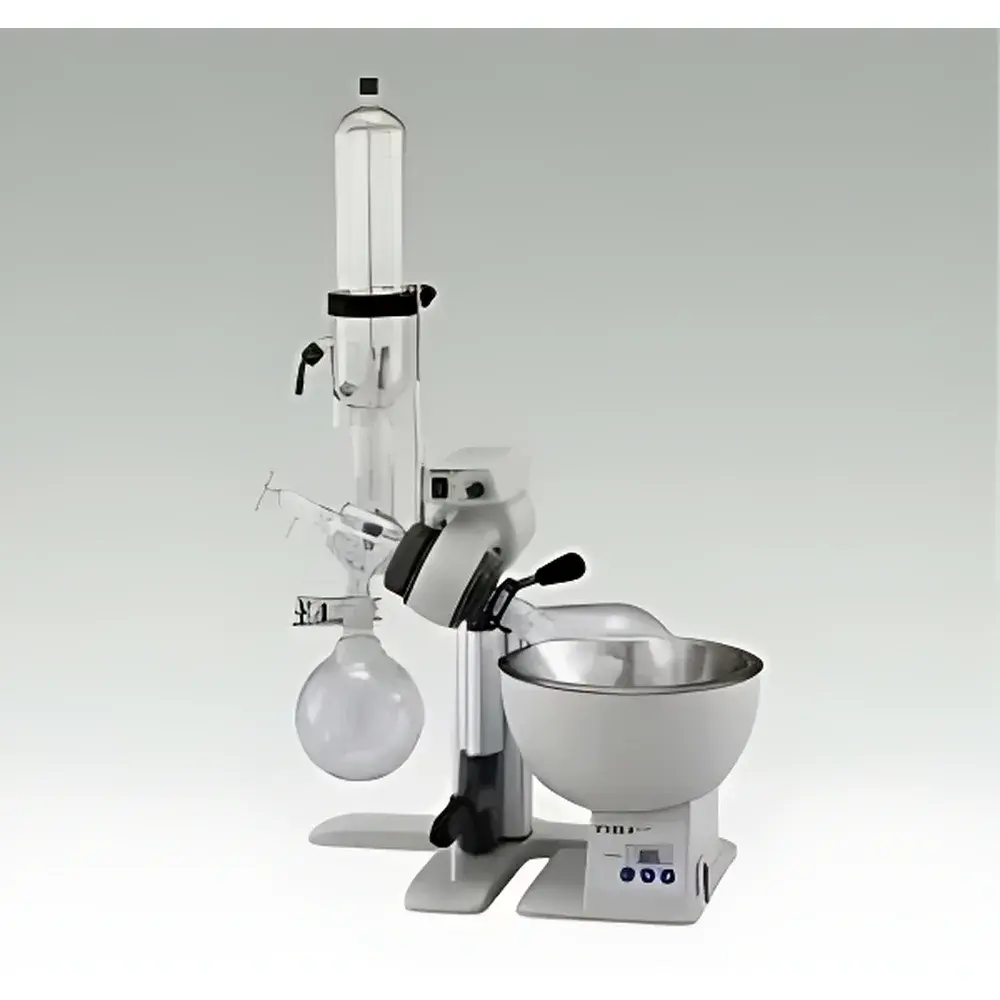
EYELA N-1100V-W/WD Rotary Evaporator
| Brand | EYELA (Tokyo Rikakikai) |
|---|---|
| Origin | Japan |
| Model | N-1100V-W/WD |
| Evaporation Capacity | Max. 25 mL/min |
| Rotational Speed | 20–180 rpm |
| Ultimate Vacuum | < 399.9 Pa |
| Bath Temperature Range | Room Temp +5°C to 90°C |
| Heating Control Accuracy | ±0.5°C (typical for PID-controlled water/oil bath) |
| Cooling Surface Area | 0.146 m² |
| Evaporating Flask Capacity | 3 L |
Overview
The EYELA N-1100V-W/WD is a high-performance, dual-mode rotary evaporator engineered for reliable solvent removal, concentration, and gentle sample recovery in research laboratories, QC environments, and pilot-scale purification workflows. Designed and manufactured in Japan by Tokyo Rikakikai Co., Ltd. (EYELA), this instrument operates on the principle of reduced-pressure distillation: by lowering the system pressure via integrated vacuum control and simultaneously rotating the evaporation flask, the effective surface area of the liquid film is increased while the boiling point of solvents is depressed—enabling efficient, low-temperature evaporation with minimal thermal stress on heat-sensitive compounds. The N-1100V-W/WD features a dual configuration option: the “W” variant includes a water bath heating system, while the “WD” version adds an integrated digital vacuum controller with pressure feedback regulation, allowing precise, programmable vacuum ramping and stabilization—critical for reproducible method transfer and regulatory-compliant operations.
Key Features
- Dual operational modes: Standard water-bath heating (N-1100V-W) or advanced vacuum-regulated operation with digital pressure control (N-1100V-WD), supporting method development and routine SOP execution.
- PID-controlled heating bath with temperature stability of ±0.5°C across the full range (RT+5°C to 90°C), ensuring consistent thermal input and minimizing batch-to-batch variability.
- Stepless rotational speed adjustment from 20 to 180 rpm via digital motor drive, enabling optimization of thin-film formation and evaporation kinetics for diverse solvent viscosities and boiling points.
- Vacuum performance rated to < 399.9 Pa (≈3 Torr), compatible with standard lab-grade diaphragm or oil-sealed vacuum pumps; WD model integrates real-time pressure monitoring and auto-compensation to maintain setpoint within ±5 Pa.
- Large-capacity 3 L evaporation flask with standardized ISO-KF 25 joint interface, supporting scalable processing without compromising seal integrity or rotational balance.
- Cooling condenser with 0.146 m² effective surface area—optimized geometry and high-efficiency coolant flow path maximize condensate recovery rate (>95% typical for common solvents such as ethanol, acetone, ethyl acetate).
- Robust stainless-steel frame, borosilicate glass components (DIN/ISO-compliant), and IP20-rated electrical enclosure ensure long-term mechanical reliability and compatibility with GLP/GMP laboratory infrastructure.
Sample Compatibility & Compliance
The N-1100V-W/WD accommodates a broad spectrum of organic and aqueous solutions, including but not limited to alcohols, esters, hydrocarbons, and moderately polar solvents. Its design conforms to IEC 61010-1:2010 safety standards for laboratory electrical equipment. When operated with documented parameters and maintained per EYELA’s service schedule, the system supports data integrity requirements under FDA 21 CFR Part 11 when integrated with compliant LIMS or ELN platforms (audit trail enabled via external software). It is routinely employed in applications aligned with ASTM D129, ISO 7751, and USP <467> residual solvents methodology—particularly where controlled evaporation rate and minimal analyte degradation are essential.
Software & Data Management
While the base N-1100V-W operates via front-panel digital controls only, the WD variant includes embedded firmware supporting RS-232 or optional USB-to-serial communication for remote parameter logging and basic sequence triggering. No proprietary cloud platform is included; however, the device outputs ASCII-formatted status strings (temperature, rotation, pressure, runtime) compatible with third-party SCADA systems, LabVIEW, or Python-based acquisition scripts. All operational settings—including ramp profiles, hold times, and vacuum setpoints—are stored in non-volatile memory and survive power cycling. For regulated environments, users may implement electronic logbooks with timestamped parameter exports to satisfy ALCOA+ data governance principles.
Applications
- Concentration of natural product extracts (e.g., plant alkaloids, flavonoids) under mild conditions to preserve stereochemical integrity.
- Removal of volatile reaction solvents (THF, DCM, toluene) post-Suzuki coupling or Grignard synthesis.
- Preparative-scale fractionation in medicinal chemistry workflows prior to HPLC injection.
- Lyophilization feedstock preparation—generating concentrated solutions with tightly controlled residual moisture content.
- Educational demonstrations of colligative properties, phase equilibria, and vacuum thermodynamics in undergraduate physical chemistry labs.
- QC release testing for pharmaceutical intermediates where solvent residue limits must be verified per ICH Q3C guidelines.
FAQ
What is the difference between the N-1100V-W and N-1100V-WD models?
The WD model includes a built-in digital vacuum controller with pressure sensing, closed-loop regulation, and programmable vacuum ramps—whereas the W model relies on manual vacuum valve adjustment.
Is the heating bath compatible with silicone oil or only water?
Yes—the bath is designed for both water and heat-transfer oils up to 180°C; maximum recommended oil temperature is 130°C for continuous operation.
Can the unit be integrated into a fume hood with external vacuum line routing?
Absolutely. The vacuum inlet uses a standard 1/4″ Swagelok-compatible port, and all glassware joints follow ISO-KF 25 specifications for secure, leak-tight connections in confined enclosures.
Does EYELA provide calibration certificates traceable to JCSS?
Factory calibration reports are available upon request; JCSS-traceable certification requires third-party accredited service providers and is performed per ISO/IEC 17025 scope.
What maintenance intervals are recommended for long-term reliability?
Inspect vacuum seals and condenser gaskets every 6 months; clean bath chamber quarterly; verify rotational axis runout annually using dial indicator—full service recommended every 24 months or after 5,000 operating hours.



