
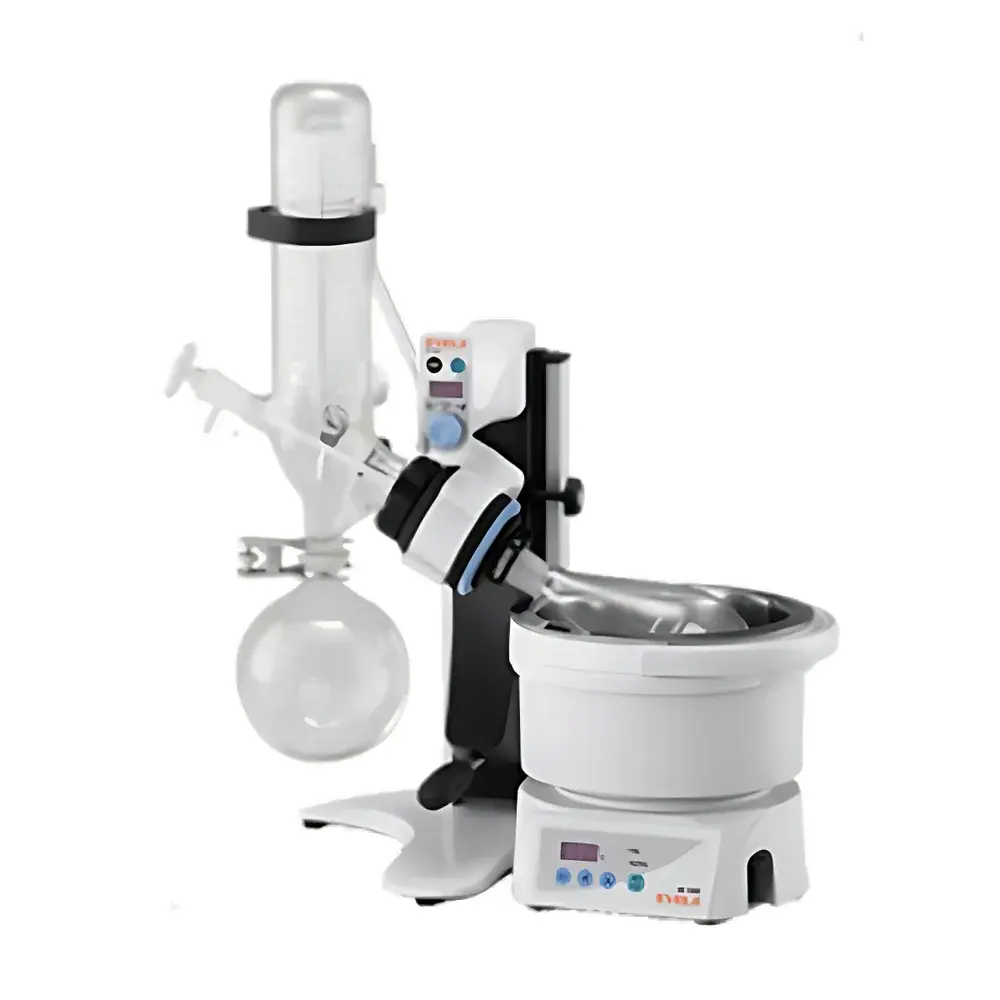
EYELA N-1300D Rotary Evaporator
| Brand | EYELA |
|---|---|
| Origin | Japan |
| Model | N-1300D |
| Rotational Speed | 10–310 rpm |
| Bath Temperature Range | RT+5°C to 90°C (water) / RT+5°C to 180°C (oil) |
| Temperature Accuracy | ±1.5°C (water), ±3°C (oil) |
| Max. Evaporation Rate | 25 mL/min (water) |
| Ultimate Vacuum | ≤399.9 Pa (≤3 mmHg) |
| Condenser Surface Area | 0.146 m² |
| Lift Stroke | 180 mm (manual, stepless) |
| Motor | Brushless DC |
| Cooling Water Inlet/Outlet | Ø10 mm |
| Power Input | AC 220 V, 50 Hz, 6.5 A, 1.43 kVA |
| Dimensions (W×D×H) | 578×352×645 mm (N-1300D-W) / 565×352×645 mm (N-1300D-WB) |
| Weight | 12.7 kg (N-1300D-W) / 13.3 kg (N-1300D-WB) |
| Bath Capacity | 4.3 L (SB-1300, stainless steel SUS304) / 5.4 L (OSB-2200, aluminum with PTFE coating) |
| Sealing | Dual-layer PTFE/Viton vacuum seal |
Overview
The EYELA N-1300D Rotary Evaporator is an engineered solution for efficient, reproducible solvent removal and concentration of heat-sensitive samples in research, quality control, and pilot-scale laboratories. Based on the fundamental principle of reduced-pressure distillation—where lowering the system pressure decreases the boiling point of solvents—the N-1300D integrates precise rotational control, thermally stable bath heating, and high-efficiency condensation to maximize recovery yield while minimizing thermal degradation. Designed and manufactured in Japan, it complies with IEC 61010-1 safety standards for laboratory electrical equipment and supports GLP-compliant workflows through traceable operational parameters and stable mechanical architecture. Its compact footprint (under 0.21 m² floor space) and modular design make it suitable for benchtop integration in ISO Class 5–7 cleanrooms, regulated QC labs, and university teaching facilities.
Key Features
- Brushless DC motor delivering consistent torque across the full 10–310 rpm range, with digital speed display and rotary knob adjustment for fine-tuned control during delicate evaporation steps.
- Two bath configuration options: SB-1300 (4.3 L stainless steel SUS304, water-only) and OSB-2200 (5.4 L anodized aluminum with PTFE coating, water/oil compatible), both featuring concealed 1.3 kW heating elements for uniform thermal distribution and simplified cleaning.
- Vertical double-layer condenser (0.146 m² surface area) constructed from high-transparency borosilicate glass, optimized for rapid vapor condensation under sub-atmospheric conditions down to ≤399.9 Pa (≤3 mmHg).
- Manual counterbalanced lift mechanism with 180 mm stepless vertical travel, enabling precise positioning of the evaporation flask relative to the bath—critical for optimizing heat transfer and preventing bumping.
- Dual-side flask mounting capability (left or right orientation), accommodating operator ergonomics and lab layout constraints without compromising vacuum integrity.
- Programmable forward/reverse rotation (timer-controlled), enhancing homogeneity during drying of suspensions, slurries, or particulate-laden solutions—particularly valuable in pharmaceutical API isolation and natural product extraction.
Sample Compatibility & Compliance
The N-1300D accommodates standard ground-glass jointed flasks (up to 3 L with optional thick-shaft H-type adapter) and accepts a wide range of organic solvents—including acetone, dichloromethane, ethyl acetate, and methanol—as well as aqueous buffers and low-volatility oils when paired with appropriate vacuum control (e.g., NVC-series controllers). All wetted parts are chemically resistant: PTFE/Viton dual-seal vacuum joints prevent outgassing and maintain leak rates <1×10⁻³ Pa·m³/s per ISO 2859-1 acceptance sampling protocols. The system meets CE marking requirements (2014/30/EU EMC Directive, 2014/35/EU LVD Directive) and conforms to JIS B 7970:2017 for rotary evaporator performance testing. When operated with DPE-1300/DPE-1400 solvent recovery units, it enables closed-loop solvent reclamation compliant with EPA 40 CFR Part 262 hazardous waste minimization guidelines.
Software & Data Management
While the N-1300D operates as a standalone analog-digital hybrid instrument (no embedded microprocessor or network interface), its operational parameters—including bath temperature setpoint, rotation speed, and lift position—are fully manual and repeatable across users and shifts. For audit-ready documentation, integration with external data loggers (e.g., Omega OM-DAQPRO-5300) via 4–20 mA or 0–10 V analog outputs (available on optional NVC vacuum controllers) enables time-stamped recording of vacuum level, temperature, and rotation profile. This configuration satisfies FDA 21 CFR Part 11 requirements for electronic records when paired with validated acquisition software and user access controls—commonly implemented in GMP manufacturing environments for batch record generation.
Applications
- Concentration of chromatographic fractions (HPLC, flash column eluates) without analyte decomposition.
- Removal of volatile reaction solvents (THF, toluene, DMF) post-Suzuki coupling or peptide synthesis.
- Lyophilization pre-concentration of protein solutions prior to freeze-drying.
- Essential oil recovery from hydrodistillates in food and fragrance R&D.
- Recycling of >95% of used organic solvents in academic teaching labs—reducing procurement costs and environmental impact per ISO 14001 lab certification criteria.
FAQ
What vacuum level is required for optimal operation?
The N-1300D achieves maximum efficiency at ≤399.9 Pa (≤3 mmHg); however, process-specific optimization may require dynamic vacuum control using the NVC-2000 series controller to prevent foaming or bumping during low-boiling solvent removal.
Can the N-1300D be used with corrosive solvents like concentrated HCl or bromine-containing compounds?
No—standard glassware and PTFE/Viton seals are not rated for strong oxidizers or halogenated acids. Use only with solvents listed in EYELA’s chemical compatibility chart (e.g., ASTM D471-17 referenced materials resistance data).
Is the bath temperature calibration traceable to national standards?
Yes—factory calibration is performed against NIST-traceable RTDs; users may perform in-house verification using a calibrated immersion thermometer per ISO/IEC 17025 procedures.
Does the N-1300D support automated endpoint detection?
Not natively; endpoint determination requires external monitoring (e.g., weight loss via analytical balance, IR moisture analysis, or refractometry). Integration with gravimetric modules is possible via third-party PLC interfaces.
What maintenance intervals are recommended for long-term reliability?
Vacuum seal inspection every 6 months; condenser cleaning after each solvent class change; bath fluid replacement annually (or per contamination assessment); motor brushless design eliminates scheduled commutator servicing.



