
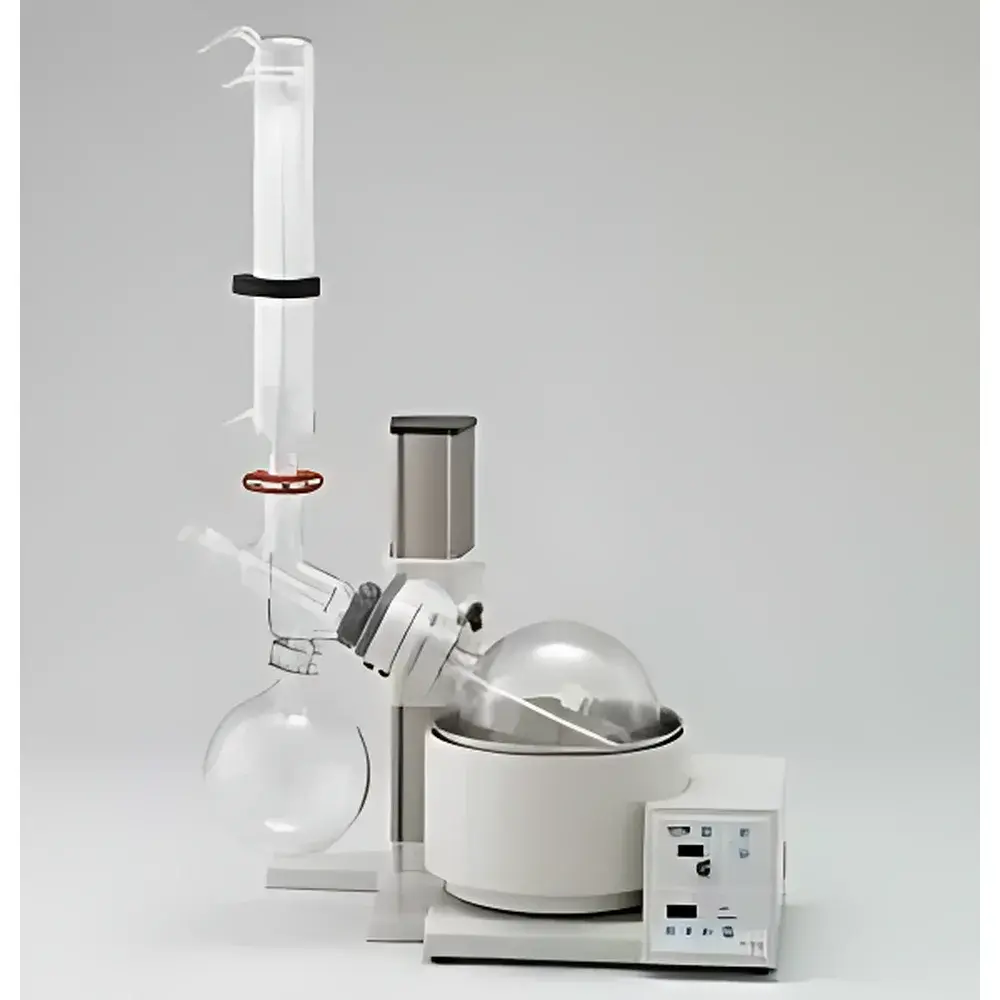
EYELA N-2100 Automated Rotary Evaporator
| Brand | EYELA (Tokyo Rikakikai Co., Ltd.) |
|---|---|
| Origin | Japan |
| Model | N-2100 |
| Bath Temperature Range | Room Temp +5 to 90°C |
| Bath Temp Control Accuracy | ±1°C |
| Rotation Speed | 5–160 rpm |
| Max Evaporation Rate | 43 mL/min (F-type), 23 mL/min (U/R-type) |
| Ultimate Vacuum | 399.9 Pa |
| Condenser Surface Area | 0.25 m² |
| Lift Stroke | 160 mm |
| Bath Dimensions & Capacity | Ø280 × 144 mm, ~8.5 L |
| Flask Capacity | 5 L (round-bottom), 3 L (receiving flask) |
| Joint Standard | S35/20 spherical ground glass |
| Weight | ~29 kg |
Overview
The EYELA N-2100 Automated Rotary Evaporator is an engineered solution for high-reproducibility solvent removal and sample concentration in analytical, pharmaceutical, and synthetic laboratories. Based on the fundamental principle of reduced-pressure distillation—where lowering system pressure decreases the boiling point of solvents—the N-2100 integrates precise thermal, rotational, and vacuum control to optimize evaporation kinetics while minimizing thermal degradation and bumping. Its design conforms to core laboratory workflow requirements for unattended operation, including automated start/stop sequences, real-time parameter feedback, and fail-safe thermal and pressure monitoring. The system is particularly suited for applications demanding strict process consistency, such as pesticide residue extraction, natural product isolation, and preparative-scale reaction workup under GLP-aligned conditions.
Key Features
- Automated vacuum control with integrated vapor temperature sensing—enables dynamic adjustment of system pressure to match solvent boiling point, significantly improving recovery yield and reproducibility.
- P.I.D.-regulated water bath heating with ±1°C accuracy across a range of ambient +5°C to 90°C, ensuring stable thermal input during extended runs.
- Motor-driven vertical lift mechanism (160 mm stroke) with programmable positioning—facilitates safe, repeatable flask engagement and disengagement without manual intervention.
- Dual-sensor correction function: automatically compensates for deviations in bath temperature (±10°C), vapor temperature (±10°C), and system pressure (±100 Pa) to maintain setpoint fidelity.
- Nine preconfigured operating modes—two fully automated (e.g., “Boiling Point Tracking”, “Constant Rate”), seven manual (e.g., “Fixed Vacuum”, “Ramp Temp”)—all user-selectable and memory-storable for method standardization.
- Comprehensive safety architecture: independent overtemperature cutoff, earth-leakage protection, power-failure recovery protocol, and multi-point fault detection (motor, heater, bath temp, pressure sensor, condensate level).
- Vertical triple-coil condenser (0.25 m² effective surface area) optimized for high-efficiency solvent trapping across volatile organic solvents including acetone, ethyl acetate, dichloromethane, and ethanol.
Sample Compatibility & Compliance
The N-2100 accommodates standard S35/20 spherical ground-glass joints, enabling seamless integration with EYELA’s modular glassware suite—including F-, U-, and R-type assemblies—for varied throughput and volatility requirements. Its 5 L evaporation flask and 3 L receiving flask support large-volume processing without compromising vacuum integrity or thermal uniformity. The instrument complies with IEC 61010-1 (Safety Requirements for Electrical Equipment for Measurement, Control, and Laboratory Use) and meets essential electromagnetic compatibility (EMC) standards per EN 61326-1. While not certified for Class I Div 1 hazardous locations, its leakage-current protection and grounded chassis align with general-purpose lab electrical safety protocols under ISO/IEC 17025-accredited environments.
Software & Data Management
The N-2100 operates via an embedded microcontroller interface with no external PC dependency. All operational parameters—including rotation speed, bath temperature, vapor temperature, vacuum setpoint, and lift position—are digitally displayed and logged internally with timestamped event markers (e.g., “Vacuum reached”, “Auto-stop triggered”). Though it does not feature USB or Ethernet connectivity, its control logic supports audit-trail-capable operation: error codes (e.g., E03 = bath overtemp, E12 = pressure sensor drift) are retained in non-volatile memory and displayed with diagnostic prompts. This architecture satisfies basic 21 CFR Part 11 readiness when used within documented SOPs that define operator roles, parameter lockout procedures, and calibration verification intervals.
Applications
- Automated removal of extraction solvents in pesticide multiresidue analysis (e.g., QuEChERS workflows), where consistent endpoint detection prevents analyte loss or co-evaporation artifacts.
- Concentration of thermally sensitive natural product fractions (e.g., terpenoids, glycosides) under precisely controlled vapor-phase conditions.
- High-yield recovery of reaction solvents in pilot-scale organic synthesis, especially with low-boiling or azeotropic mixtures.
- Parallel sample preparation for LC-MS or GC-MS analysis, where inter-run consistency directly impacts quantitative precision.
- Teaching laboratories requiring robust, intuitive instrumentation for demonstrating phase-equilibrium principles and vacuum distillation fundamentals.
FAQ
Does the N-2100 support external vacuum pump control?
Yes—the unit provides ON/OFF dry-contact output for interfacing with compatible diaphragm vacuum pumps, enabling synchronized pump activation/deactivation during automated cycles.
Can vapor temperature be measured independently of bath temperature?
Yes—a dedicated platinum resistance thermometer (Pt100) is inserted directly into the vapor path above the rotating flask, delivering real-time feedback for closed-loop vacuum regulation.
Is the glassware assembly interchangeable across N-2100 configurations?
Yes—all N-2100 variants accept the same S35/20 joint standard; six distinct glass component sets (F, U, R, etc.) are available to tailor condensation efficiency, flask geometry, and scalability.
What maintenance intervals are recommended for long-term reliability?
Daily: inspect condenser coil cleanliness and seal integrity. Quarterly: verify bath temperature calibration against traceable reference standard; validate vacuum sensor zero point. Annually: replace silicone oil in bath (if used) and inspect lift motor gear train for wear.
How does the auto-stop function determine endpoint completion?
Endpoint is triggered either by elapsed time, predefined vacuum level stabilization, or sustained absence of vapor temperature rise—configurable per method, not based on weight change or optical sensing.



