
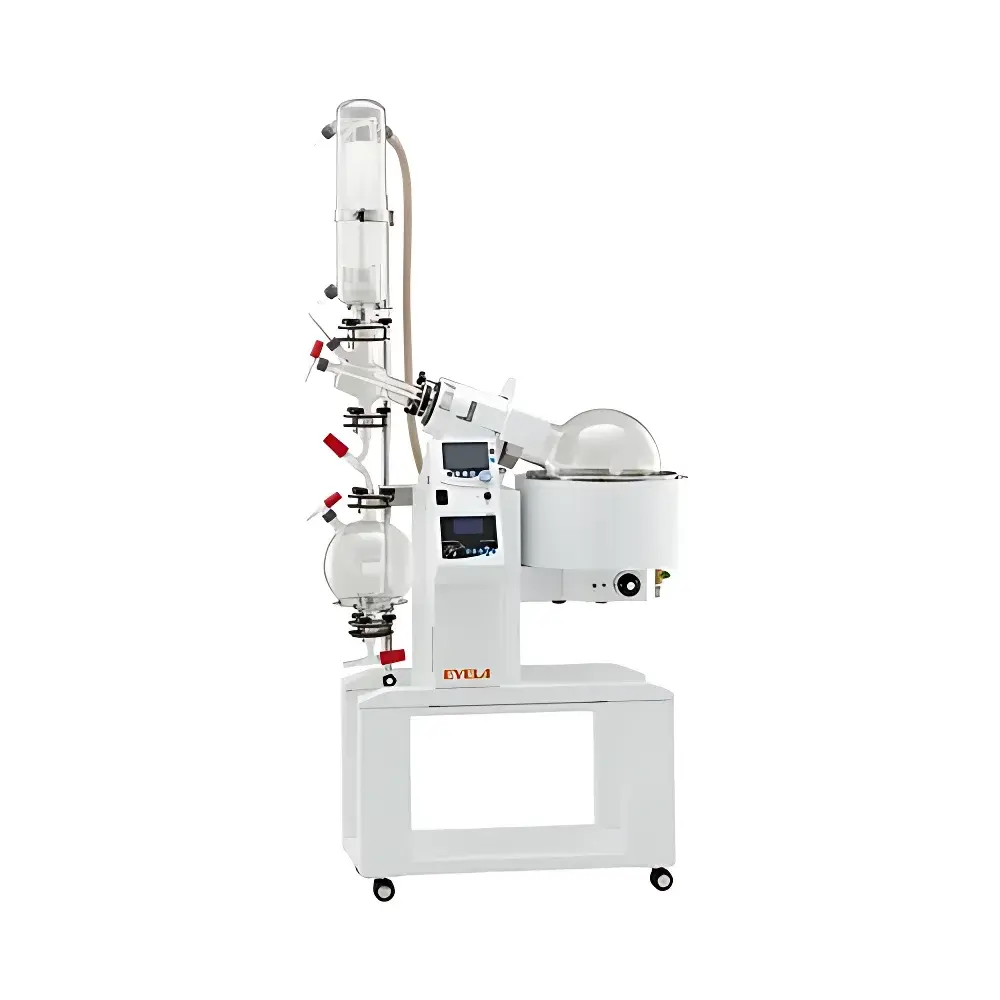
EYELA N-3100 10L Rotary Evaporator
| Brand | EYELA |
|---|---|
| Origin | Japan |
| Model | N-3100 |
| Rotational Speed Range | 10–140 rpm |
| Max. Evaporation Rate | 3.5 L/h (water) |
| Ultimate Vacuum | 2.6 hPa |
| Bath Temperature Range | Ambient +10°C to 180°C (±1°C in water, ±3°C in oil) |
| Heating Power | 3.5 kW |
| Temperature Control | PID |
| Vacuum Control Modes | Setpoint, Auto, Program, Pressure-Step |
| Bath Dimensions & Capacity | Φ360 × 200 mm, ~20 L |
| Bath Material | SUS304 stainless steel |
| Condenser | Vertical triple-coil, 0.5 m² cooling surface |
| Flask Capacity | 10 L spherical (neck Ø100 mm) |
| Collection Flask | 5 L spherical with drain valve |
| Sealing | PTFE mechanical seal |
| Lift Stroke | 145 mm (motorized) |
| Motor | Induction type, 60 W |
| Cooling/Inlet Port Diameter | 16 mm (×2), Solenoid Valve Port: 13 mm |
| Ambient Operating Range | 5–35°C |
| External Dimensions (W×D×H) | 930 × 480 × 1890 mm |
| Weight | ~96 kg |
| Power Supply | AC 200 V, 19 A, 3.8 kVA |
Overview
The EYELA N-3100 is a high-capacity, laboratory-grade rotary evaporator engineered for reproducible, scalable solvent removal and concentration under controlled vacuum and temperature conditions. Based on the fundamental principle of reduced-pressure distillation—where lowering system pressure decreases the boiling point of solvents—the N-3100 enables gentle, efficient evaporation of heat-sensitive compounds while minimizing thermal degradation. Its 10 L evaporation flask and 5 L collection flask support batch processing in synthetic chemistry, natural product isolation, pharmaceutical formulation development, and quality control laboratories. The instrument integrates a dual-mode heating bath (water or oil), motorized vertical lift mechanism, and a fully sealed mechanical PTFE sealing system—replacing traditional vacuum grease-based joints—to ensure long-term leak integrity, operator safety, and compliance with GLP-aligned operational practices.
Key Features
- Motorized vertical lift with 145 mm stroke ensures precise, repeatable positioning of the evaporation flask relative to the bath—critical for optimizing heat transfer and preventing bumping during volatile solvent removal.
- Triple-coil vertical condenser (0.5 m² effective cooling area) maximizes condensation efficiency across a wide range of solvent volatilities, including low-boiling ethers and higher-boiling esters or alcohols.
- NVC-3000 integrated vacuum controller supports four operational modes: fixed setpoint, auto-regulation based on vapor pressure feedback, multi-step pressure ramping, and segmented pressure control—enabling programmable distillation profiles aligned with ICH Q5C stability guidelines.
- Dual-purpose heating bath (SUS304 stainless steel, ~20 L capacity) operates from ambient +10°C to 180°C with PID-controlled accuracy (±1°C in water, ±3°C in oil), facilitating both aqueous extractions and high-boiling-point compound concentration (e.g., silicone oils, polyethylene glycols).
- PTFE mechanical seal eliminates dependence on vacuum grease, reducing maintenance frequency, contamination risk, and variability in seal performance—particularly important for GMP-regulated environments where documentation of seal integrity is required.
- Safety systems include overheat protection, dry-run detection (preventing heater activation without bath medium), and automatic power cutoff upon abnormal vacuum or temperature deviation—meeting IEC 61010-1 requirements for laboratory electrical equipment.
Sample Compatibility & Compliance
The N-3100 accommodates standard ISO-KF and ground-glass jointed glassware, with compatibility extending to 10 L spherical flasks (neck diameter 100 mm) and 5 L collection flasks equipped with PTFE-lined drain valves—allowing full-volume recovery under vacuum without venting. Its construction adheres to JIS B 7970 (Japanese Industrial Standard for rotary evaporators) and incorporates design elements consistent with ISO/IEC 17025 clause 6.4.2 (equipment suitability). The absence of lubricated seals supports cleaning validation protocols, while the digital vacuum and temperature logging capability (via optional RS-232/USB interface) facilitates audit-ready data capture per FDA 21 CFR Part 11 when paired with compliant software.
Software & Data Management
While the N-3100 operates as a standalone unit with local digital displays for bath temperature, rotation speed, and real-time vacuum level, it supports external data acquisition via analog outputs (0–5 V or 4–20 mA) and serial communication (RS-232). When integrated with EYELA’s optional LabAlliance™ data logger or third-party SCADA platforms, users can archive time-stamped process parameters—including pressure ramps, temperature profiles, and rotational stability—for retrospective analysis, SOP adherence verification, and regulatory submission packages. All logged data retain traceability to instrument ID, operator login (if networked), and environmental timestamp—supporting ALCOA+ principles (Attributable, Legible, Contemporaneous, Original, Accurate, Complete, Consistent, Enduring, Available).
Applications
- Concentration of crude extracts in phytochemistry and nutraceutical R&D, where preservation of thermolabile terpenoids and flavonoids is essential.
- Removal of reaction solvents (e.g., THF, DMF, DCM) following catalytic cross-coupling reactions in medicinal chemistry synthesis.
- Preparative-scale lyophilization feedstock conditioning, ensuring uniform solids content prior to freeze-drying.
- Standardized residue-on-evaporation testing per USP and EP 2.2.32 for excipient purity assessment.
- Environmental sample preparation, including EPA Method 3510C (separation of extractable petroleum hydrocarbons from aqueous matrices).
FAQ
What is the maximum recommended solvent volume for continuous operation at full capacity?
For sustained 3.5 L/h evaporation rate, a minimum 7–8 L working volume in the 10 L flask is advised to maintain stable film formation and avoid foaming or bumping—especially with surfactant-containing mixtures.
Can the N-3100 be validated for use in GMP manufacturing environments?
Yes—its mechanical seal architecture, digital parameter logging capability, and compliance with IEC 61010-1 and JIS B 7970 make it suitable for IQ/OQ/PQ execution; however, formal validation requires site-specific protocols covering installation, operational limits, and performance under worst-case load conditions.
Is oil bath operation compatible with all standard heating oils?
The bath is compatible with silicone- and mineral-based oils rated for continuous use up to 200°C; users must verify flash point and thermal stability per ASTM D92 and D2270 to prevent decomposition or smoke generation.
How does the pressure-step control mode improve fractionation selectivity?
By enabling discrete vacuum transitions (e.g., 100 hPa → 20 hPa → 5 hPa), this mode allows sequential removal of solvents with differing vapor pressures—mimicking fractional distillation without column hardware.
What maintenance intervals are recommended for the PTFE mechanical seal and motor drive?
Inspect the PTFE seal annually for compression set or cracking; replace every 24 months under daily use. The induction motor requires no scheduled lubrication but should undergo vibration and current draw verification biannually per preventive maintenance logs.



